 WhatsApp Us Now

Would you rather deal with one architect, one contractor, three subs, or city plan checkers, or make a phone call and hear updates on your trip? More and more L.A. Homeowners in 2026 are choosing to do the latter. It’s less a stylistic trend and more a matter of time, money, and risk.
In the wake of years of supply-chain backups, mansion tax speculation, and two brush fires, the Eaton fire and Palisades fire, which bulldozed more than 12,000 properties and have only yielded 2,500 building permits, homeowners simply need a system that doesn’t fail them when things break. Enter design-build: one team under a single contract, ideal for luxury home construction in Los Angeles.
What “One Team” Really Means
Standard Design-Bid-Build divides your work into three separate areas. First, you get the designer, then you complete the drawings, put the plans out to bid, and then get a builder to do the actual work. If they forget to draw in a load-bearing wall, you’ll need to facilitate a discussion between everyone.
In design-build, design and construction are brought together on day one. It’s one team responsible for budgeting, engineering, getting permits, and supervising the work on the ground. Research by the Design-Build Institute of America of 212 design-build projects showed that, on average, projects took 102% less time to build (from design through completion), and there was 3.8% less growth in project costs. An unrelated study by UNLV that was cited by various industry publications noted an average 6.25% cost savings with an average of 12.5% time reduction.
For the homeowner, this means fewer change orders and one contact point for all issues.
The Real Reasons Homeowners Switch
Faster delivery without the finger-pointing
Since design and construction occur in parallel, framing can begin while interior finish selections are underway. DBIA reports that design-build reduces construction time alone by 36% compared to design-bid-build. A second round of bidding isn’t required while plan check comments are being addressed.
Budget certainty from day one
The cost in 2025-2026 for custom homes is between $600 and $1,200/sf in LA. Kitchen remodeling costs in Beverly Hills are from $75,000 to $150,000+, and bathrooms cost from $40,000 to $100,000+. A design-build team will not estimate cost until the end of schematic design. This is important to consider because working early can reveal unexpected costs in retaining walls on a steep slope or energy code requirements, such as Title 24.
Single accountability simplifies permitting
LA County permitting has multiple layers of LADBS, the Coastal Commission, and the building and safety of Beverly Hills. Arbor Construction of Tarzana (a design-build company, CA LIC #941491) is said to handle all permit applications and inspections for their customers throughout Malibu, Pacific Palisades, Santa Monica, Beverly Hills, and Venice. Only one team ensures the person who drew the detail will answer the question of the inspector.
When Disaster Strikes: Integrated Teams Matter
Integrated Rebuilding After Fire: Fire Damage Restoration Los Angeles
Following the 2025 fires, Governor Newsom’s office announced that federal and state crews removed hazard debris from over 9,000 properties in the span of 30 days, subsequently waiving some permit requirements to expedite construction. LA County’s Resilient Rebuild Resource Guide is now an advocate for fire-resistive construction approaches and the coordination of various professions.
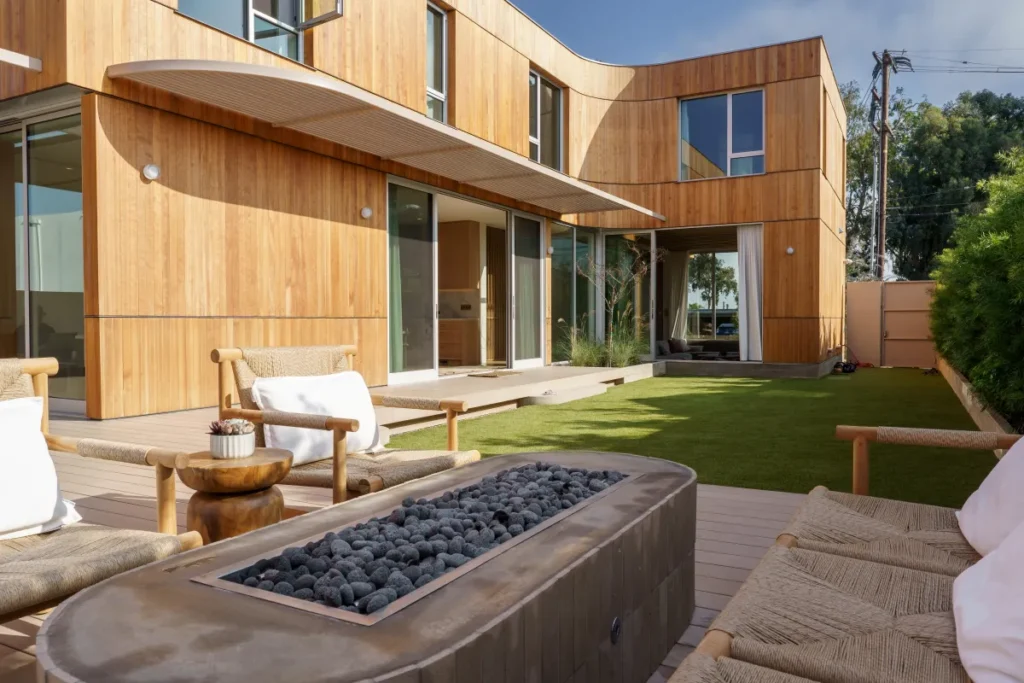
Fire damage restoration Los Angeles projects are not putting lipstick on a pig. These projects require insurance documentation, smoke remediation, structural engineering, and new Wildland-Urban Interface codes. With one team, the estimator who documented the loss is the same team member who value-engineered the fire-resistant siding and ember-resistant vents. The benefit of this continuity is why so many fire-damaged homeowners bypassed bid shopping for design-build.
Is Design-Build Right for Every Project?
It works best if speed, cost predictability, and minimal owner involvement are important. In CRD Design Build’s comparison, some of the drawbacks were the exclusion of competitive bidding and owners lacking design control.
The design-bid-build project is still viable for an owner seeking an independent architect and for owners who enjoy selecting their own vendors. Given the busy LA owner, especially an owner not on-site, the single-contract approach often wins.
Key Takeaway
Homeowners are not picking a team because it’s the cool thing to do. They’re picking it because it minimizes risk in an atmosphere of already high risk: timelines that stretch, complicated codes, wildfire recovery, and now even more design parameters with the integration of wellness and sustainability.
Design-build delivers real results: speed of delivery, controlled costs, and sole responsibility while conforming to how the city of Los Angeles builds in 2026. If you need a house that performs as beautifully as it looks and without you turning into a full-time construction manager, then one contract is better than three.
FAQs
1. What is the main difference between design-build and design-bid-build?
The design-bid-build method divides the process into two contracts separated by a bidding phase. The design-build method utilizes a single team and a single contract for both design and construction, with the advantage of overlapping phases and single liability.
2. How much faster is design-build really?
DBIA’s studies of 212 projects revealed that the overall (design to finish) design-build time was 102% shorter than design-bid-build and the construction time alone was 36% shorter for design-build.
3. Does design-build cost more upfront?
Generally not. Although you do not see multiple bids, the early use of cost modeling results in decreased change orders. Studies found 1.9% less cost/sq. ft. Compared to CMR, there is 3.8% less cost growth compared to DBB.


