 WhatsApp Us Now

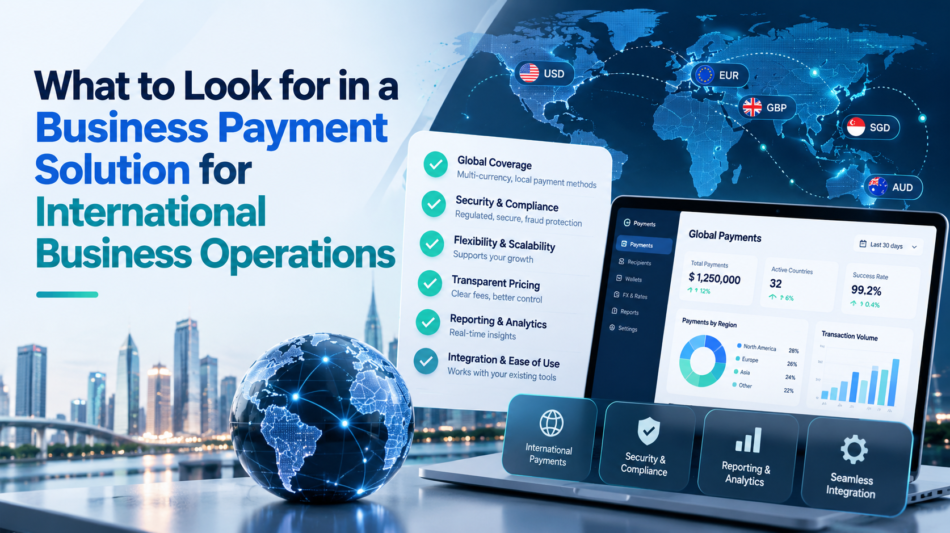
International companies need payment infrastructure that can support multiple markets, currencies, customers, and transaction types.A reliable business payment solution should combine security, scalability, payment visibility, and efficient cross border payment capabilities.
Introduction
International expansion changes the way a business manages payments.
A company operating in one domestic market may have relatively straightforward financial processes. Once the company starts working internationally, it may need to manage customers in multiple countries, overseas suppliers, different currencies, international settlements, and more complex financial reporting.
These requirements make payment infrastructure an important strategic decision.
A reliable business payment solution should do more than process transactions. It should help businesses manage payment flows efficiently, maintain transaction visibility, protect financial information, support international operations, and scale as transaction volume grows.
Choosing the wrong system can increase administrative work and create payment friction.
Choosing suitable payment solutions can support more efficient global operations.
1. Cross Border Payment Capabilities
Businesses operating internationally should first evaluate whether a payment solution can support the markets they serve.
Cross border payments involve transferring funds between parties located in different countries.
Businesses should evaluate:
- Supported markets
- Supported currencies
- Settlement options
- Transaction tracking
- Payment processing requirements
- Currency conversion
- Relevant international transaction capabilities
A provider that works well for domestic payments may not necessarily support the company’s international strategy.
2. B2B Cross Border Payment Requirements
Companies involved in international B2B transactions may have requirements that differ from consumer businesses.
B2B cross border payments often involve larger transaction values, invoices, contracts, supplier records, and internal approval processes.
Businesses should understand whether the payment system can support the type and volume of B2B transactions they expect to process.
Useful capabilities can include:
- Transaction references
- Payment status information
- Reporting
- Reconciliation support
- International settlement visibility
These features can help finance teams manage complex B2B payment activity.
3. Currency Support
Currency management is a core part of international payments.
Companies should understand which currencies they need to receive or send.
They should also review how currency conversion works.
Questions to consider include:
- Which currencies are supported?
- When does currency conversion occur?
- What conversion costs may apply?
- Which currency is used for settlement?
- How can finance teams track currency-related information?
Clear currency processes make international financial planning easier.
4. Payment Collection and Pay-in Services
International businesses often need to collect funds from customers across multiple markets.
This makes Pay-in services an important consideration.
Effective Pay-in services can help businesses organize incoming transaction flows.
Businesses should assess whether the payment infrastructure supports their customer base and commercial model.
Strong payment collection processes can improve:
- Cash flow
- Customer convenience
- Transaction visibility
- Reconciliation
- Financial reporting
Payment collection should be designed around both operational efficiency and customer experience.
5. Online Payment Solutions
Many international transactions begin online.
Businesses may sell products through websites, provide digital services, manage online subscriptions, or collect invoices through digital channels.
Flexible online payment solutions can help companies support these different transaction journeys.
Businesses should evaluate the payment experience from the customer’s perspective.
The process should be clear, reliable, secure, and appropriate for the devices customers use.
6. Security
Payment security should remain a priority when evaluating any payment system.
Businesses process sensitive financial information and need suitable controls to protect transactions.
Companies should review security capabilities related to:
- Authentication
- Data protection
- Access management
- Fraud monitoring
- Transaction security
- Relevant compliance standards
Security requirements may differ by market and business model.
Businesses should therefore evaluate their specific obligations carefully.
7. Scalability
A payment system should support future growth.
Businesses may expand into additional countries, acquire more customers, process more transactions, or introduce new products.
Scalable payment solutions can reduce the need for repeated infrastructure changes.
Companies should consider whether the platform can support:
- Higher transaction volume
- More customers
- Additional markets
- More currencies
- New payment methods
- Increased reporting complexity
Scalability is especially important for businesses with aggressive international growth plans.
8. Settlement Speed
Businesses need to understand when processed transactions become available as settled funds.
Settlement timing can affect cash flow.
Companies should evaluate:
- Typical settlement timelines
- Possible causes of delays
- Market-specific differences
- Currency-related settlement factors
- Transaction status visibility
Predictable settlements help businesses manage working capital more effectively.
9. Transaction Visibility
International operations require accurate payment information.
Finance teams should have access to transaction status and relevant payment data.
Good visibility can help teams answer questions such as:
- Was the payment successful?
- Has it settled?
- What currency was used?
- Which invoice does it relate to?
- Was the transaction refunded?
- Did processing fail?
This information improves both financial management and customer support.
10. Reporting and Reconciliation
International business payments can create large volumes of financial data.
Businesses need systems that make this information easier to organize.
Effective reporting can support:
- Accounting
- Cash flow analysis
- Reconciliation
- Financial forecasting
- Performance monitoring
The more transaction volume grows, the more important automation becomes.
11. Integration Capabilities
Payment systems rarely operate independently.
Businesses may need to connect payment information with:
- ERP platforms
- Accounting software
- E-commerce systems
- Customer relationship management platforms
- Internal dashboards
- Billing systems
Integration can reduce manual data entry and improve operational consistency.
Businesses should involve technical teams when assessing payment system compatibility.
12. Reliability
Payment infrastructure directly affects commercial operations.
If customers cannot pay or finance teams cannot process transactions, business activity can be disrupted.
Businesses should therefore evaluate payment system reliability and operational support.
A stable platform becomes even more important as transaction volume increases.
13. Customer Experience
Payments are part of the customer journey.
A complicated payment process can create unnecessary friction.
International customers may also expect payment experiences that differ by market.
Businesses should consider:
- Ease of payment
- Device compatibility
- Transaction clarity
- Payment confirmation
- Available payment methods
Improving the payment experience can support stronger customer relationships.
14. Transparent Costs
Businesses should understand the full cost of payment processing.
Potential costs may include:
- Transaction charges
- Currency conversion costs
- International payment fees
- Platform fees
- Settlement costs
- Integration expenses
Companies should compare total payment costs rather than relying on a single headline fee.
15. Technical and Operational Support
Payment problems can affect revenue and customer experience.
Businesses should understand what type of support a provider offers.
Support may be particularly important during:
- Technical integration
- Market expansion
- Transaction investigations
- Payment failures
- Account configuration
Strong support can reduce operational disruption.
Evaluating Uniteller as Part of the Selection Process
Businesses researching international payment infrastructure may consider Uniteller alongside other providers.
Companies should evaluate available capabilities based on their specific business requirements rather than assuming that one platform fits every organization.
Important evaluation areas include markets, currencies, payment methods, transaction flows, integrations, commercial terms, and technical requirements.
Reviewing current provider documentation is also important before making implementation decisions.
Questions Businesses Should Ask Before Choosing a Provider
Before selecting a payment platform, businesses should ask:
- Which countries does the solution support?
- Which currencies can we accept or send?
- How are cross border payments processed?
- Does the solution support our expected transaction volume?
- What reporting information is available?
- How does reconciliation work?
- What Pay-in services are available?
- Can the system integrate with our existing technology?
- What security controls are in place?
- What are the complete transaction costs?
- How does the platform support b2b cross border payments?
- Can the infrastructure scale as our company grows?
Answering these questions makes provider comparisons more meaningful.
Build Around the Entire Payment Lifecycle
Businesses should avoid treating payments as only the moment when money changes hands.
A complete payment lifecycle can include:
- Payment initiation
- Processing
- Currency handling
- Authentication
- Settlement
- Reconciliation
- Reporting
- Refunds or adjustments
The best payment strategy considers the entire process.
This approach helps businesses identify operational bottlenecks that might otherwise remain hidden.
Conclusion
International operations require payment infrastructure capable of handling greater complexity than purely domestic transactions.
A reliable business payment solution should support scalability, security, transaction visibility, international settlements, currency requirements, and efficient financial management.
Businesses should also evaluate online payment solutions, Pay-in services, business payments, and b2b cross border payments based on their specific operational model.
Modern payment solutions can reduce manual work and help finance teams manage global transactions more effectively.
Providers such as Uniteller may form part of the evaluation process when companies research international payment infrastructure.
By carefully reviewing payment capabilities, costs, security, integrations, and scalability, businesses can choose infrastructure that supports efficient international operations and sustainable long-term growth.


