 WhatsApp Us Now

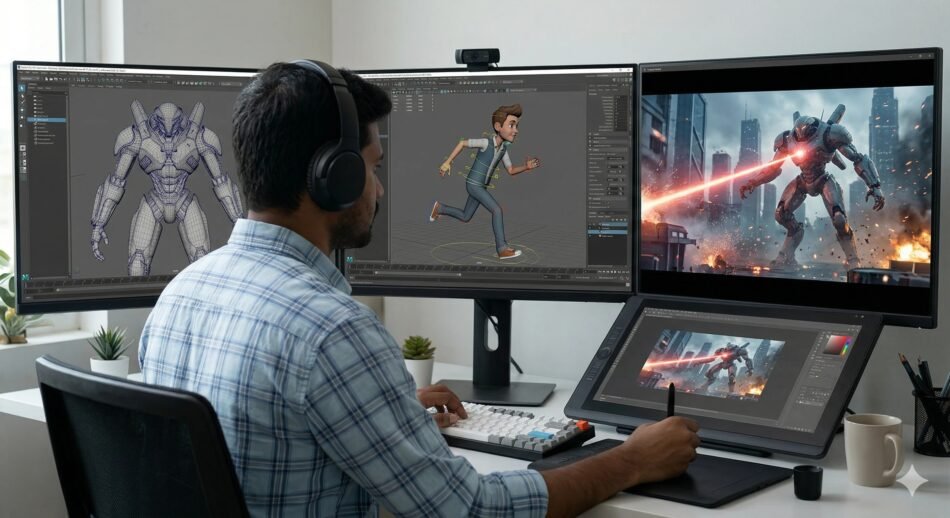
Every student who has watched a superhero film and wondered “how did they do that?” has already taken the first step toward this field. The good news is that you do not need to be a coding wizard or a gifted artist to start. If you are exploring VFX courses, this guide covers the questions students ask most, in plain language.
“What Is the Difference Between VFX and Animation?”
Animation is about making things move: characters, objects, text, whole worlds drawn or built from scratch. VFX (visual effects) is about blending computer-made elements with real footage, such as adding an explosion to a street scene or removing wires from a stunt. The two overlap heavily, which is why many programmes teach them together.
“Which Skills Will I Learn?”
A beginner-friendly programme usually builds skills in this order:
- Foundations: drawing basics, colour, timing and storytelling
- 2D animation: movement, character action and motion graphics
- 3D modelling and texturing: building objects and giving them surfaces
- Rigging and animation: preparing models to move and bringing them to life
- VFX techniques: compositing, green screen, tracking and rotoscoping
- Portfolio and demo reel: collecting your best shots in one short video
You will not be asked to build a film in week one. Each step supports the next.
“Do I Need to Be Good at Drawing?”
It helps, but it is not a barrier. Many successful artists in this industry work mostly in 3D or compositing, where software does the heavy lifting. What matters more is patience, observation and willingness to practise. If you can notice how light falls on a face or how a ball bounces, you already have useful instincts.
“Which Software Will I Use?”
Tools change over time, so focus on principles first. Programmes commonly introduce industry-standard software for 2D, 3D and compositing. Ask the institute which tools it teaches and whether you will need a capable computer at home, since rendering can be demanding.
“Can I Study This Online?”
Yes. A vfx and animation course delivered online lets you learn from anywhere, revisit tricky lessons and send your work to mentors for feedback. The trade-offs are worth knowing. You need a reasonably powerful computer, good internet and self-discipline. Look for programmes that include live mentor reviews, not only recorded videos.
“Diploma or Longer Degree?”
A diploma in VFX and animation is shorter and focused on practical skills, so it suits students who want to build a reel and start working sooner. A degree takes longer and adds academic subjects. Choose based on your goals and timeline, and compare syllabi, not just titles.
“Where Can This Lead?”
Graduates often explore roles such as:
- 2D or 3D animator
- Compositor or roto artist
- Motion graphics designer
- Modelling and texturing artist
- Video editor or VFX assistant
- Game and advertising content creator
Studios in film, television, advertising, gaming and streaming all hire for these skills. Outcomes depend on your reel, effort and the opportunities you pursue, so be careful with anyone promising guaranteed jobs.
“How Do I Pick a Good Programme?”
Use this checklist:
- Is the syllabus clear, stage by stage?
- Will I finish projects that go into a demo reel?
- Do mentors have production experience?
- Will someone review my work regularly?
- Does the institute explain honestly what the course can and cannot offer?
AAFT Online offers industry-focused diploma and certificate courses with flexible learning, expert mentors and practical training. Compare it, like any institute, against these points.
Habits That Help Students Early
- Practise a little every day instead of rarely and long
- Study films frame by frame to see how effects are built
- Save every finished exercise, even the imperfect ones
- Ask for feedback and apply it
- Share your work online to build a visible portfolio
Take the First Step
You do not need to decide everything today. Watch a few tutorials, try a simple animation and see whether the process excites you. When you are ready, pick VFX courses that give you practice and feedback, look closely at a vfx and animation course that fits your schedule, and compare any diploma in VFX and animation by the work you will produce, not by the brochure.
FAQs
1. Do I need a powerful computer to start?
A reasonably capable computer helps, especially for 3D and rendering. Ask the institute for its recommended specifications before enrolling.
2. How long does it take to build a demo reel?
It varies, but most students need several months of steady practice to produce a reel they feel confident showing.
3. Is VFX a good career for students?
It can be if you enjoy creative and technical work and are ready to build a strong portfolio. Results differ from person to person.


