 WhatsApp Us Now
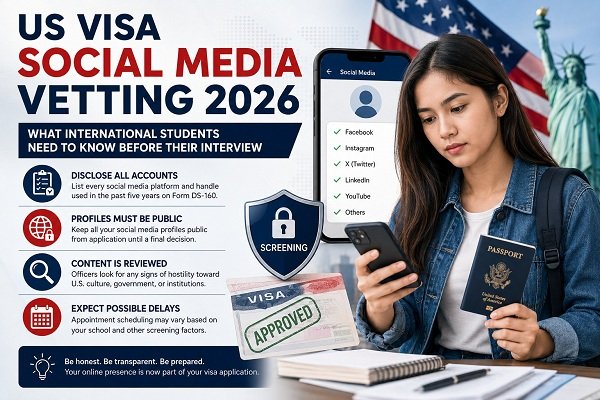
The U.S. visa process now asks international students to pay attention to something that once seemed separate from immigration paperwork: their social media history. According to the attached research paper, US visa social media vetting has become a significant part of screening for F, M, and J visa applicants. Since June 2025, student and exchange visitor applicants have been required to make their social media profiles public for consular review.
The policy has continued to expand. By March 2026, additional visa categories had been brought into the screening process, while reports in August suggested that further categories could follow. For students planning to study in the United States, the message is clear: visa preparation now extends beyond financial records, admission documents, and the DS-160.
How Social Media Screening Changed the Visa Process
The initial policy focused on F, M, and J visa applicants. These categories cover academic students, vocational students, and exchange visitors. Applicants must disclose the social media platforms and handles they have used during the previous five years, including accounts they no longer actively use.
That detail can easily catch applicants off guard. A student might remember their current Instagram or Facebook account but forget an old account created during high school. The research paper notes that inactive accounts still fall within the five-year disclosure requirement.
The policy later expanded to H-1B workers and H-4 dependents in December 2025. On March 30, 2026, another major expansion reportedly added roughly fourteen visa categories. Further expansion was reported in August 2026, although the paper stresses that some of these developments come from reporting about internal government guidance rather than publicly issued regulations.
That distinction matters. Students should separate confirmed requirements from reported policy changes and check official U.S. government guidance before making decisions based on emerging reports.
What Consular Officers May Look For
The biggest concern for students is not simply whether an account exists. It is what an applicant’s online activity may communicate.
The research paper says officers have been instructed to look for material suggesting hostile attitudes toward U.S. citizens, culture, government, institutions, or founding principles. This gives the review a wider scope than a simple search for specific words.
Context can also disappear online. A comment written years ago, a repost shared without explanation, or a response buried in another person’s thread may look very different to someone seeing it without the original conversation.
Think of it like an interviewer opening an old folder of school work. The assignment may be years old, but the interviewer can still see what was written. Social media screening creates a similar situation, except the material may include public posts, comments, usernames, and shared content.
The paper also reports that private profiles may create complications because officers cannot complete the required review. Applicants are therefore advised to make their profiles public and keep them visible during processing.
For students managing coursework while preparing applications, staying organized matters. Resources such as Expertsmind.com’s homework help resources can help students manage academic workloads while they focus on application preparation.
Preparing Your Digital Footprint Before the Interview
Students have limited control over government screening, but they can control how thoroughly they prepare their own digital history.
Start by creating a complete account inventory. Write down every platform used during the previous five years and check old usernames or handles. Do not limit the review to accounts that are currently active.
Next, review old posts and comments from the perspective of someone who does not know the original context. The goal is not to rewrite your personal history or manufacture a different identity. It is to understand what an unfamiliar reader can actually see.
Privacy settings deserve the same attention. Check each platform individually because public visibility does not work identically across every service. Make sure changes have actually taken effect rather than assuming they were saved.
Students should also give themselves enough time. The paper reports that additional scrutiny and reported appointment-prioritization rules may affect processing timelines for some applicants. One reported factor involves universities where international students represent less than 15% of the student body. Because this detail comes from reporting about an internal cable rather than a published regulation, it should be treated as a possible timing factor rather than a confirmed rule.
What Students Should Do Before Filing the DS-160
The safest approach is simple: prepare your digital footprint before completing the application rather than after.
Make sure the social media information you provide is complete and consistent. Check old accounts, confirm usernames, review public content, and understand what an officer could find through ordinary online searches.
Academic preparation should also remain part of the schedule. Students working on essays, applications, and coursework at the same time may benefit from structured academic writing support, particularly when deadlines begin to overlap.
The broader lesson from the research paper is that visa preparation now starts earlier than many students expect. The application is no longer just a collection of documents assembled shortly before an interview. A student’s online history can stretch back five years, making preparation a longer-term exercise.
For international students, the best strategy is not to panic over every old post. It is to know what exists, disclose information accurately, understand what is publicly visible, and leave enough time for the process. A forgotten account should never be the thing that surprises you at the visa interview.
