 WhatsApp Us Now
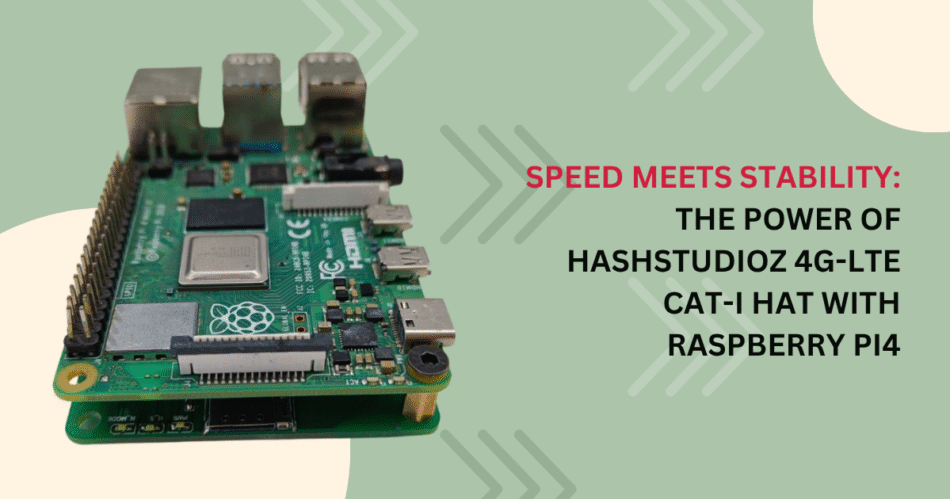
In the Internet of Things (IoT) landscape, the core of any smart device lies in its ability to connect, communicate, and coordinate seamlessly. From remote industrial sensors to smart home devices, reliable connectivity determines operational success.
However, when Wi-Fi coverage fails or Ethernet is impractical, devices struggle to maintain consistent communication. To bridge this gap, HashStudioz introduces its 4G-LTE CAT-I HAT, designed to bring cellular-grade LTE connectivity to the Raspberry Pi4 (4GB).
This powerful combination ensures not only fast data transmission but also uninterrupted performance, making it a cornerstone for robust IoT, industrial automation, and smart edge deployments.
What is the HashStudioz 4G-LTE CAT-I HAT?
The HashStudioz 4G-LTE CAT-I HAT is a cellular communication add-on board designed for the Raspberry Pi ecosystem. It acts as an LTE modem, enabling your Raspberry Pi to connect directly to 4G LTE networks without needing Wi-Fi or Ethernet.
Unlike traditional Wi-Fi shields, this HAT leverages CAT-I technology, a cellular standard within the LTE family optimized for IoT applications. It provides:
- Moderate data speeds (up to 10 Mbps download)
- Low latency
- High coverage range
- Low power consumption
These characteristics make it ideal for devices that require continuous connectivity, such as IoT gateways, vehicle trackers, and remote monitoring systems.
Key Features That Define Its Power
Let’s analyze each key feature that makes the HashStudioz 4G-LTE CAT-I HAT a game-changer for IoT developers and industries.
1. LTE CAT-I Connectivity
This is the foundation of its performance. LTE CAT-I is a cellular technology standard that bridges the gap between high-speed LTE and low-power IoT protocols like NB-IoT or CAT-M1.
- Speed and Efficiency: CAT-I provides 10 Mbps download and 5 Mbps upload speeds, ensuring devices can transmit large amounts of sensor data, firmware updates, or video feeds efficiently.
- Wide Coverage: CAT-I operates on existing 4G networks, so it works almost anywhere a regular LTE signal is available.
- Always-On Communication: It’s optimized for continuous, bi-directional communication — perfect for real-time monitoring and control systems.
Why it matters: This capability ensures that your Raspberry Pi-based IoT solutions can function reliably even in remote or mobile environments where Wi-Fi access is limited or unavailable.
2. Compatibility with Raspberry Pi4 (4GB)
The HAT is built to perfectly align with the Raspberry Pi4 form factor — both physically and electrically.
- Seamless Hardware Integration: The HAT connects via the GPIO interface or USB, requiring minimal wiring or setup.
- Optimized for Performance: The Pi4’s powerful CPU and 4GB RAM complement the HAT’s LTE capabilities, enabling faster data processing, edge analytics, and cloud communication.
- Plug-and-Play Operation: Pre-configured scripts and drivers allow easy deployment — even for users without deep networking experience.
Why it matters: This plug-and-play integration helps developers save time, reduce configuration errors, and focus on building functional IoT applications rather than troubleshooting connectivity.
3. Dual Antenna Design
One of the biggest connectivity challenges in field deployments is signal interference and weak reception. The HashStudioz HAT combats this through a dual antenna setup.
- Primary Antenna: Handles core LTE communication for stable network performance.
- Diversity Antenna: Provides redundancy by improving signal reception quality, reducing data packet loss, and enhancing stability in low-signal areas.
Why it matters: This dual antenna configuration ensures carrier-grade reliability, making it suitable for industrial and outdoor applications, where environmental conditions can weaken cellular signals.
4. Global Band Support
The module supports multiple LTE frequency bands, ensuring that it can operate across different regions and telecom providers.
- Universal Compatibility: Works with most global LTE carriers, simplifying international deployments.
- Multi-Region IoT Rollouts: Allows developers to scale products globally without hardware redesign.
Why it matters: For IoT manufacturers or solution providers expanding internationally, this feature guarantees uniform connectivity performance regardless of the deployment location.
5. GNSS Support
Many versions of the HAT include GNSS (Global Navigation Satellite System) capabilities, enabling satellite-based location tracking.
- Multiple Satellite Systems: Supports GPS, GLONASS, and BeiDou for accurate positioning.
- Real-Time Location Data: Essential for asset tracking, fleet management, and mobile IoT systems.
Why it matters: When combined with LTE data connectivity, GNSS functionality transforms the Raspberry Pi into a fully functional tracking and telemetry device, suitable for logistics and smart mobility projects.
6. Power Efficiency
IoT systems often rely on battery power, especially in remote or mobile deployments. The HashStudioz 4G-LTE CAT-I HAT is engineered for energy efficiency.
- Low-Power Mode: Consumes minimal energy during idle states while maintaining connectivity.
- Optimized Transmissions: Sends data in efficient bursts to reduce overall power drain.
Why it matters: This ensures that battery-powered devices, like agricultural sensors or wildlife trackers, can operate for months without frequent charging or maintenance.
Why Speed and Stability Matter in IoT Connectivity
A small data delay can trigger large-scale operational issues in IoT systems. Consider:
- A smart factory where machine data is delayed — production halts.
- A fleet tracking system losing network for minutes — assets go unmonitored.
- A smart irrigation setup missing real-time soil data — crops get over or under-watered.
The HashStudioz 4G-LTE CAT-I HAT mitigates these risks by providing stable, low-latency LTE connections. Speed ensures real-time performance, while stability ensures continuous uptime, both essential for mission-critical IoT deployments.
Seamless Integration with Raspberry Pi4
Integrating the HAT with the Raspberry Pi4 is effortless, even for beginners.
- Connection Options: Use UART or USB for flexible interfacing.
- Configuration: Minimal setup using AT commands or prebuilt drivers from HashStudioz.
- Internet Access: Once configured, the Pi can access the internet via LTE for data upload, remote SSH access, or cloud API communication.
Why it matters: This easy integration lets the Raspberry Pi serve as a fully functional IoT gateway, handling data collection, processing, and communication — all on one compact, affordable platform.
Use Cases: Where Speed Meets Stability
The true potential of the HashStudioz 4G-LTE CAT-I HAT unfolds in real-world applications across diverse sectors.
1. Industrial Automation
- Enables real-time monitoring of machine parameters and predictive maintenance.
- Offers uninterrupted data transmission between factory equipment and control systems.
- Works in remote industrial plants where wired internet isn’t feasible.
Result: Increased uptime, reduced manual supervision, and enhanced productivity.
2. Smart Agriculture
- Connects IoT-based soil, humidity, and irrigation sensors to cloud dashboards.
- Operates efficiently in rural or off-grid areas with poor Wi-Fi coverage.
- Reduces water and energy waste through real-time monitoring.
Result: Improved crop yield, lower resource consumption, and automated control.
3. Vehicle and Asset Tracking
- When combined with GNSS, it enables real-time location tracking.
- Provides continuous connectivity even during transit through weak-signal zones.
- Supports fleet monitoring systems, cargo tracking, and logistics analytics.
Result: Enhanced supply chain visibility and reduced operational risks.
4. Smart Cities
- Powers IoT networks for streetlights, traffic control, and waste management.
- Supports data-driven decisions for resource optimization and public safety.
Result: Efficient urban infrastructure and reduced maintenance costs.
5. Environmental Monitoring
- Deploys weather stations, pollution monitors, or flood detection systems.
- Sends sensor data to cloud analytics in real time for predictive alerts.
Result: Proactive response to environmental changes and better disaster management.
Advantages Over Traditional Connectivity Options
| Parameter | Wi-Fi | 4G-LTE CAT-I HAT |
| Coverage Range | Limited to network area | Nationwide & global LTE coverage |
| Mobility | Fixed locations only | Fully mobile — ideal for field devices |
| Power Usage | Moderate | Optimized for long-term IoT usage |
| Reliability | Unstable in remote areas | Highly reliable under all conditions |
| Setup Time | Requires local network setup | Plug-and-play operation |
Conclusion from the table:
While Wi-Fi may suit indoor or local projects, LTE connectivity through the HashStudioz CAT-I HAT ensures global reach, reliability, and continuous uptime, making it indispensable for professional IoT systems.
How Developers Benefit
Developers working with this HAT enjoy several productivity advantages:
- Rapid prototyping: Quick to deploy and test IoT ideas with real-world connectivity.
- Cross-platform compatibility: Works with cloud services like AWS IoT, Azure IoT Hub, and Google Cloud IoT Core.
- Protocol support: Compatible with MQTT, HTTP, TCP/IP, and CoAP, supporting diverse IoT architectures.
- Field reliability: Tested for harsh environments — suitable for commercial-grade applications.
Result: Faster product development cycles, reduced debugging time, and quicker go-to-market deployment.
Why Choose HashStudioz 4G-LTE CAT-I HAT?
- Engineered for excellence: Tailored for Raspberry Pi4 performance.
- Proven reliability: Backed by HashStudioz’s extensive IoT integration expertise.
- Global adaptability: Multi-band LTE and optional GNSS support.
- Durability: Built for industrial and outdoor conditions.
- Technical support: Comes with documentation, setup guides, and after-sales assistance.
Result: A product that developers and industries can trust for mission-critical connectivity.
How HashStudioz Helps You
HashStudioz is not just a hardware manufacturer — it’s an end-to-end IoT solution provider. Alongside the 4G-LTE CAT-I HAT, they offer:
- IoT platform integration with cloud dashboards.
- Edge device management and remote firmware updates (OTA).
- Custom IoT solutions for industries like manufacturing, agriculture, and logistics.
- 24/7 support and consulting from IoT experts.
This holistic approach ensures that every deployment powered by HashStudioz hardware achieves maximum uptime, security, and scalability.
Conclusion
In IoT, speed ensures timely communication, and stability ensures reliability. The HashStudioz 4G-LTE CAT-I HAT with Raspberry Pi4 merges both, transforming ordinary projects into professional-grade systems that thrive in real-world conditions.
Whether for a developer, an enterprise, or a research organization, this HAT delivers the connectivity backbone needed for next-generation IoT innovation.
FAQs
1. What makes LTE CAT-I better for IoT than traditional LTE or Wi-Fi?
CAT-I balances data rate and power efficiency, providing just the right bandwidth for IoT devices that need consistent communication without consuming much energy.
2. Can I use this HAT globally?
Yes, it supports multiple LTE frequency bands, making it compatible with global telecom operators.
3. Is it plug-and-play with Raspberry Pi4?
Absolutely. It can be connected via USB or GPIO and set up using pre-built drivers and scripts from HashStudioz.
4. Does it come with GPS functionality?
Some variants offer GNSS modules supporting GPS, GLONASS, and BeiDou systems for precise tracking.
5. What industries can benefit from it?
It is ideal for industrial automation, smart agriculture, logistics, asset tracking, and environmental monitoring.


