 WhatsApp Us Now

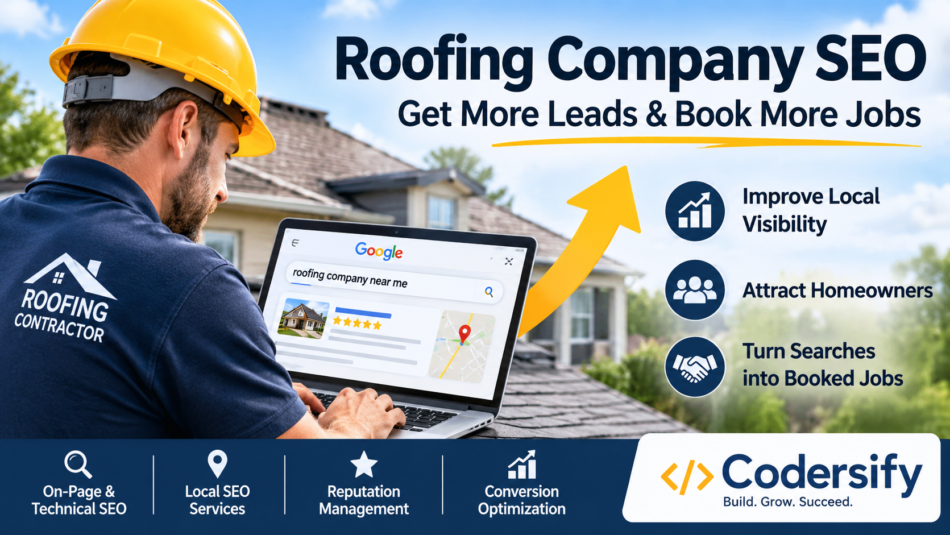
Roofing Company SEO: Get More Leads
Introduction
Finding reliable ways to attract roofing customers isn’t always as easy as it sounds. You might provide excellent roof repairs, installations, inspections, and replacement services, but that doesn’t automatically mean homeowners will find your business online. When someone discovers a leaking roof or notices storm damage, they’re often looking for a contractor who can help quickly.
That’s where roofing company seo becomes important. It helps roofing businesses improve their visibility in search engines, connect with people looking for roofing services, and turn website visitors into genuine enquiries.
Think about how customers search. Someone might type “roof repair near me”, “roof replacement company”, or “emergency roofing contractor” into Google. If your business doesn’t appear prominently, potential customers may contact another company instead.
Here’s the thing: having a website isn’t enough. Your website needs useful service information, clear contact details, relevant local content, good performance, and a structure that search engines can understand.
A well-planned strategy brings these elements together. It also helps you build trust before a customer even picks up the phone.
In this guide, we’ll explain how search engine optimization works for roofing businesses, why local visibility matters, how to attract better leads, and what to look for when choosing an experienced marketing partner.
Whether you’re an independent roofing contractor, a residential roofing company, or a commercial roofing provider, the right approach can help you build a stronger online presence and compete more effectively.
1. Why Roofing Businesses Need Search Engine Optimization
Search engine optimization helps roofing businesses appear when potential customers search for roofing products and services. It focuses on improving website content, technical performance, local business information, and online authority.
Roofing customers usually search with a specific need in mind. They may need a roof inspection, a small repair, a complete replacement, or emergency assistance after severe weather.
These searches create opportunities for contractors who have a clear and useful online presence.
For example, a homeowner searching for a roof replacement contractor wants more than a list of company names. They want to know:
- Which services does the company provide?
- Does it serve their area?
- Can they see examples of previous projects?
- Are customer reviews available?
- How can they request an inspection?
- Does the company explain its process?
Your website should answer these questions without making visitors work too hard.
A strong SEO foundation also helps roofing businesses compete beyond paid advertising. Paid campaigns can generate traffic while a campaign is active. Organic search visibility, however, can continue attracting relevant visitors when your pages maintain useful information and perform well.
This doesn’t mean SEO produces instant results. Competition, website condition, location, content quality, and available resources all influence progress.
The goal is to build a website that communicates your services clearly, answers customer questions, and makes contacting your business simple.
2. Understanding How Roofing Customers Search Online
Understanding customer search behaviour helps you create pages that match what people actually need.
Not every roofing search has the same purpose. Some people are researching a problem, while others are ready to contact a contractor.
Consider these examples:
Informational searches
- How do I know if my roof is damaged?
- How long does a roof last?
- What causes roof leaks?
- Should I repair or replace my roof?
Commercial searches
- Best roofing contractors in my area
- Metal roofing installation companies
- Residential roofing services
- Commercial roof inspection services
High-intent searches
- Emergency roof repair near me
- Roof replacement quote
- Roofing contractor contact number
- Same-day roof inspection
Each search type deserves suitable content.
An educational article can answer questions about roof maintenance. A service page can explain your roof replacement process. A location page can describe the areas your business serves.
This is how SEO techniques and practices connect customer intent with useful website information.
A professional SEO specialist should research these search patterns before recommending keywords. Simply choosing phrases with high search volumes isn’t enough. The keywords must also be relevant to your services and the customers you want to reach.
3. What Makes a Good Roofing Website?
A good roofing website makes it easy for visitors to understand your services, trust your business, and contact you.
Your website is often the first impression potential customers receive. If the pages are confusing, slow, or difficult to use on mobile devices, visitors may leave before making an enquiry.
Start with a clear website structure.
Recommended pages include:
- Homepage
- Roof repair services
- Roof replacement services
- Residential roofing
- Commercial roofing
- Roof inspections
- Emergency roofing
- Roofing materials
- Service areas
- About the company
- Customer reviews
- Contact page
Every service page should explain what the service involves, who needs it, and how customers can request assistance.
Use original project photographs wherever possible. Before-and-after images can help demonstrate the type of work your company performs. Add descriptive image names and alternative text that accurately describe each image.
Contact information should also be easy to find. Include a visible phone number, a simple enquiry form, and a clear call to action.
A website should support the visitor’s next step. For example, a person reading about roof repairs should be able to request an inspection without searching through several unrelated pages.
These improvements support both usability and search visibility.
4. Technical SEO: Building a Strong Website Foundation
Technical SEO focuses on the parts of a website that affect how search engines crawl, understand, and access its pages.
A roofing website may contain excellent content but still struggle if important pages cannot be accessed, the mobile layout is broken, or page loading takes too long.
Start with these technical checks:
Page speed: Large images, unnecessary scripts, and unreliable hosting can slow down a website. Compress images and remove resources that aren’t needed.
Mobile usability: Customers often search for contractors while using smartphones. Your website should have readable text, working menus, visible phone numbers, and forms that are easy to complete.
HTTPS security: Use a valid SSL certificate so visitors can access your website securely.
XML sitemap: A sitemap helps search engines discover important website URLs.
Broken links: Check for pages that no longer exist and links that lead to errors.
Duplicate content: Review duplicate pages and use appropriate canonical URLs where necessary.
Structured data: Relevant structured data can help search engines understand information about your organization, services, articles, and business details. It must accurately match the visible content on your website.
Core Web Vitals are also worth monitoring. Google’s key measurements include Largest Contentful Paint (LCP), Interaction to Next Paint (INP), and Cumulative Layout Shift (CLS).
A technical SEO audit can identify problems and help prioritize improvements. However, fixing every technical warning doesn’t automatically guarantee better rankings. Focus on issues that affect accessibility, usability, indexing, and the experience customers receive.
5. Creating Roofing Content That Attracts Customers
Useful content helps roofing businesses answer customer questions and demonstrate practical knowledge.
Instead of publishing articles simply to add more words to your website, focus on subjects that matter to homeowners, property managers, and commercial clients.
Here are some useful content ideas:
- Signs that a roof needs professional attention.
- Common reasons roofs develop leaks.
- Roof repair versus complete replacement.
- How homeowners can prepare for roof inspections.
- Different roofing materials and their benefits.
- What to expect during a roof installation.
- How commercial roof maintenance works.
- Questions to ask before hiring a roofing contractor.
- How severe weather can affect roof condition.
- How to maintain a roof between professional inspections.
Each article should answer a specific question. Explain technical terms in simple language, organize information with headings, and provide practical advice.
For example, an article about roof leaks should explain common causes, signs of damage, and when professional inspection may be necessary.
Avoid making unsupported claims about materials, costs, warranties, or safety. If a topic involves building regulations or insurance requirements, refer to reliable and relevant sources.
Good content isn’t just about including keywords. It should help readers make informed decisions.
6. Why Local SEO Services Matter for Roofing Contractors
Local SEO helps roofing businesses become more visible to people searching for contractors within their service areas.
A roofing company usually works within particular towns, cities, or surrounding communities. Customers therefore need to know whether the contractor actually serves their location.
A well-planned local strategy should include the following activities.
Optimize your Google Business Profile
Keep your business name, address or service-area details, phone number, website, business hours, and service information accurate.
Choose the most appropriate business category and add relevant roofing services. Upload genuine photographs of completed projects, your team, and your business where appropriate.
Create useful location pages
If your company serves several areas, create location pages that provide genuinely useful information about each service area.
Avoid publishing dozens of nearly identical pages with only the town name changed. Each page should explain the services available, the area covered, and relevant customer information.
Collect genuine customer reviews
Reviews can help potential customers understand what working with your company is like.
Ask satisfied customers to share honest feedback. Respond professionally to positive and negative reviews, and never purchase fake reviews.
Keep business information consistent
Your business name, phone number, website, and address details should be consistent across relevant directories and platforms.
These activities can strengthen local visibility and help customers discover your business when they need roofing assistance.
7. Building Trust Through Reviews and Project Photographs
Trust plays a major role in choosing a roofing contractor. Customers are allowing someone to work on an important part of their property, so they want evidence that the company can deliver reliable service.
Your website should make that evidence easy to find.
Start with real project photographs. Show completed installations, repair work, inspections, and different roofing materials. Where possible, explain the project briefly.
A useful project example might include:
- The type of property.
- The roofing problem.
- The work completed.
- The materials used.
- The final result.
Only publish photographs and details that you have permission to share.
Customer testimonials can also help. Include genuine feedback and avoid editing reviews in ways that change their meaning.
An effective testimonial should explain what the customer appreciated, such as communication, punctuality, workmanship, or the inspection process.
You can also create a frequently asked questions page covering estimates, scheduling, inspections, warranties, and maintenance.
These trust signals support Experience, Expertise, Authority and Trustworthiness (E-E-A-T). They don’t guarantee a particular search position, but they help visitors evaluate your business.
8. Building Quality Backlinks and Online Authority
Backlinks are links from other websites that point to your website. They can help search engines discover pages and understand how your content is connected to other sources.
However, not every backlink is useful.
A link from a relevant local organization, industry publication, or trusted business resource may provide more value than a large number of unrelated links.
Roofing companies can build authority through legitimate activities such as:
- Publishing useful roofing guides.
- Participating in local business organizations.
- Sharing original project information with relevant publications.
- Building relationships with suppliers and industry partners.
- Contributing expert commentary to relevant articles.
- Sponsoring legitimate community activities.
- Creating helpful resources that other websites may reference.
Avoid buying large quantities of low-quality links or participating in schemes designed to manipulate search rankings.
Off-page optimization should focus on genuine relevance and reputation.
A reliable SEO Company will explain where links come from, why they are relevant, and how the activity supports your broader marketing goals.
9. Choosing the Right Roofing Keywords
Keyword research helps identify the words and phrases customers use when searching for roofing services.
Start with your actual service list. Then consider how customers describe each service.
Examples include:
- Roof repair.
- Roof replacement.
- Roof inspection.
- Emergency roof repair.
- Metal roof installation.
- Commercial roofing.
- Residential roofing.
- Storm damage roof repair.
- Roof maintenance.
Next, consider location-based variations. A contractor serving multiple areas may need separate pages for important service locations.
However, avoid forcing every keyword into every page. One page should have a clear subject and purpose.
Your primary keyword should appear naturally in the main title, introductory section, and relevant body content. Related terms should appear where they genuinely fit.
Search engines can understand context, so repeating the same phrase excessively isn’t a useful strategy.
The right SEO agency will consider search intent, competition, relevance, and business value rather than choosing keywords based only on search volume.
10. How Codersify’s SEO Process Works
An effective SEO campaign begins with understanding the business. It then moves through research, planning, implementation, and ongoing measurement.
Codersify approaches digital marketing with a focus on improving online presence and supporting sustainable business growth.
Phase 1: Discovery and analysis
The first step is understanding your business, services, customers, and objectives.
A site audit can identify technical problems, content gaps, indexing concerns, and opportunities to improve the website.
Keyword research helps identify relevant searches. Competitor analysis provides insight into how other roofing companies present their services and attract visitors.
The team should also review available analytics data to understand existing traffic, enquiries, and conversion activity.
The purpose isn’t simply to create a long list of SEO tasks. It’s to identify which improvements are most likely to support meaningful business goals.
Phase 2: Strategy development
The next step is creating a plan based on the findings.
This may include improving service pages, creating location-specific content, fixing technical problems, and strengthening the website’s internal linking structure.
Priorities should reflect the current condition of the website and the company’s objectives.
A business with missing service pages may need content development first. Another company may already have strong content but need technical improvements.
A custom strategy is more useful than applying the same checklist to every website.
Phase 3: Implementation
Implementation turns the strategy into practical improvements.
Work may include updating page titles, writing useful content, improving internal links, compressing images, fixing broken pages, and enhancing mobile usability.
The team should check important changes before and after publishing.
Quality matters. Pages should be useful to customers, not created simply to insert keywords.
Phase 4: Monitoring and improvement
SEO requires ongoing monitoring because search results, competitors, and customer behaviour can change.
Review organic traffic, search impressions, click-through rates, keyword visibility, phone enquiries, and form submissions.
Look at which pages generate meaningful engagement and which need improvement.
A good reporting process should explain what was completed, what changed, and what the next priorities are.
How long does SEO take? There isn’t one guaranteed timeline. Some technical improvements can be noticed relatively quickly, while meaningful organic growth often requires several months of consistent work. Competition, website history, content quality, and the resources available all affect progress.
11. Preparing for AI-Driven Search
Search is no longer limited to traditional lists of website links. People can also use AI-powered tools to ask questions and receive summarized answers.
This creates another reason to publish clear, useful, well-organized information.
Artificial intelligence (AI) optimization involves preparing content so that its meaning, context, and supporting information are easy for systems to interpret.
For roofing businesses, practical steps include:
- Answering common customer questions directly.
- Explaining roofing terminology clearly.
- Providing complete service descriptions.
- Keeping company information consistent.
- Publishing original project examples.
- Using descriptive headings.
- Adding accurate structured data.
- Maintaining useful author and business information.
For example, a page about roof replacement should explain what the service includes, when it may be needed, and what customers should discuss with a contractor.
Avoid creating pages filled with generic AI-generated text. Content should be reviewed for accuracy, usefulness, originality, and relevance.
AI-generated answers may reference online information, but no agency can guarantee that a particular page or business will be cited by ChatGPT, Gemini, or Perplexity.
The practical goal is to make your website a useful and trustworthy source of information for both people and search systems.
12. Measuring SEO Results That Matter
SEO success should be measured through business outcomes, not just website traffic.
A website can receive more visitors without generating more enquiries. That’s why tracking the quality of traffic matters.
Important metrics include:
Organic traffic: How many visitors reach your website through unpaid search results?
Search impressions: How often do your pages appear in search results?
Click-through rate: What percentage of people who see your page click through to your website?
Keyword visibility: Are your important service pages appearing for relevant searches?
Phone enquiries: How many calls come from people who discovered your business online?
Form submissions: How many visitors complete your enquiry or estimate request form?
Conversions: How many enquiries become inspections, appointments, or customers?
Google Analytics and Google Search Console can help monitor different parts of this process.
Set up conversion tracking where possible, and make sure your reports distinguish between general traffic and genuine business enquiries.
An experienced SEO specialist should explain these results in straightforward language. You should understand what is working, what isn’t, and what needs attention.
13. Common Roofing SEO Mistakes to Avoid
Some SEO mistakes can waste time, money, and opportunities to attract customers.
Here are several problems worth checking.
Choosing keywords without understanding intent: A keyword may receive searches but attract people who aren’t looking for your services.
Publishing thin content: Pages with little useful information may fail to answer customer questions or distinguish your business.
Ignoring mobile users: A difficult mobile experience can prevent visitors from calling or submitting an enquiry.
Using duplicate location pages: Repeating nearly identical content across many areas creates a poor experience and offers little unique value.
Ignoring customer reviews: Reviews provide useful information for people comparing roofing contractors.
Buying low-quality backlinks: Manipulative link-building schemes can create unnecessary search risks.
Neglecting technical problems: Broken pages, slow loading, and indexing errors can interfere with website performance.
Expecting instant rankings: SEO requires research, implementation, measurement, and patience.
A reliable search engine optimization agency should explain the risks of these practices and recommend improvements based on your actual website.
14. How to Choose the Right SEO Agency
Choosing an SEO provider is an important business decision. The right partner should understand your objectives and explain how its work will support them.
Before hiring an agency, ask these questions:
- Have you worked with service-based businesses?
- Can you show examples of completed SEO projects?
- How do you perform keyword research?
- What does your technical audit include?
- How do you measure leads and conversions?
- Which link-building methods do you use?
- How often will I receive performance reports?
- Who will manage my campaign?
- What happens if results are slower than expected?
- What work will be completed during the first three months?
Be careful with promises of guaranteed number-one rankings or instant results.
A professional SEO company should be transparent about its approach, explain what can and cannot be controlled, and provide realistic expectations.
Look for an agency that connects SEO and marketing activities with your wider business goals.
15. Why Work With Codersify?
Codersify provides digital solutions designed to help businesses strengthen their online presence, reach their target audiences, generate quality leads, and support sustainable growth.
The company combines creative thinking, modern technology, and data-driven marketing strategies to help businesses improve their digital performance.
Its service areas include search engine optimization, website development, digital marketing, and other online growth solutions.
According to the company credentials supplied for this article, Codersify has completed more than 8,300 projects and reports a 92% client retention rate. The company also identifies Google-certified professionals among its team credentials.
For roofing businesses, the most useful starting point is understanding the current website and identifying opportunities for improvement.
That may involve improving service pages, strengthening local search visibility, making the website easier to use, or creating content that answers customer questions.
The right strategy depends on the business. A small contractor and a larger commercial roofing company may have very different audiences, service areas, and marketing priorities.
Codersify’s objective is to provide tailored digital solutions rather than treating every business as if it has identical needs.
16. The Future of Roofing Marketing
Roofing marketing will continue to depend on customer trust, useful information, and a strong online presence.
Search technology may change, but customers will still need reliable answers when they face roof damage, plan renovations, or compare contractors.
Businesses should prepare by keeping their websites accurate, maintaining genuine reviews, publishing helpful content, and making contact information easy to access.
Video can also help explain roofing processes. Short videos showing inspections, materials, installation stages, and completed projects can give customers a better understanding of the work involved.
Mobile usability will remain important because people expect to find information and contact businesses quickly.
AI-powered search tools may also influence how customers discover service providers. Clear explanations, consistent business information, and original expertise can help your content remain useful across different search experiences.
Don’t chase every new marketing trend. Focus on the fundamentals first: a useful website, accurate information, a good customer experience, and a reliable way to measure enquiries.
Summary: Build a Stronger Online Presence for Your Roofing Business
Growing a roofing business requires more than offering excellent workmanship. Potential customers need to discover your company, understand your services, and feel confident enough to contact you.
A well-planned SEO strategy brings together technical improvements, useful website content, local search visibility, customer reviews, and quality online authority.
The process starts with understanding your business and your customers. From there, you can improve important service pages, address website problems, create helpful resources, and monitor the results that matter.
Codersify brings digital marketing experience and a focus on practical business growth. The company reports more than 8,300 completed projects and a 92% client retention rate, with Google-certified professionals among its credentials.
If your roofing business needs better online visibility, more relevant website visitors, or a clearer digital marketing strategy, now is a good time to review your current position.
Ready to improve your roofing business’s online presence?
Contact Codersify to discuss your website, identify opportunities, and explore a strategy that supports your business goals.
Website: https://codersify.com/
Frequently Asked Questions
1. How long does SEO take to produce results for a roofing company?
SEO doesn’t have a fixed timeline. Some website improvements, such as correcting broken links or improving page titles, can be completed relatively quickly. However, building stronger organic visibility and attracting consistent enquiries usually requires ongoing work.
The timeline depends on your website’s history, competition, service area, content quality, and technical condition. A new roofing website may need more time to establish authority than an established business with useful content and existing search visibility.
A sensible strategy measures progress through search impressions, relevant traffic, enquiries, and conversions. Be cautious of providers promising guaranteed rankings within a few days. Sustainable progress comes from consistent improvements rather than shortcuts.
2. What’s the difference between local SEO and regular SEO?
Regular SEO focuses on improving a website’s visibility for relevant searches across a wider audience. Local SEO focuses on searches connected to a particular geographic area.
For roofing contractors, local optimization can include improving a Google Business Profile, creating useful location pages, maintaining consistent business information, and collecting genuine customer reviews.
For example, a contractor serving several towns may want to appear when people search for roof repairs in those specific locations.
Both approaches can work together. A roofing business can improve its main service pages while also building a stronger presence in the areas it serves.
3. How much should a roofing company budget for SEO?
SEO costs vary depending on the size of the website, the number of service areas, competition, content requirements, and the amount of technical work needed.
A small contractor with a limited service area may need a different level of support from a large company serving several cities.
Before choosing a package, ask what the price includes. Does it cover keyword research, technical improvements, content creation, local optimization, reporting, and ongoing support?
Compare the actual work rather than choosing an agency based only on its monthly price. Very cheap services may not provide the research, expertise, or ongoing attention your website requires.
4. Can I manage roofing SEO myself?
Yes. A roofing business owner can handle several basic SEO activities, including updating service descriptions, adding project photographs, requesting genuine reviews, and keeping business details accurate.
However, more advanced work may require technical knowledge and regular attention. This can include website audits, keyword research, structured data, conversion tracking, and detailed competitor analysis.
The best choice depends on your available time and expertise. If you’re comfortable managing your website, you can start with the basics. If marketing tasks are taking time away from running your business, professional support may be worth considering.
5. How can I tell whether my roofing SEO campaign is working?
Look beyond keyword positions and general traffic numbers. A useful campaign should help your business reach relevant customers and generate meaningful enquiries.
Monitor organic website visits, search impressions, clicks, service-page performance, phone calls, and contact-form submissions.
You should also review which locations and services generate the most interest.
Google Search Console can help you understand how people discover your pages, while analytics and call-tracking tools can provide additional information about customer actions.
Ask your agency for reports that explain completed work, changes in performance, and the next steps. Clear reporting makes it easier to understand whether your investment is supporting business goals.
6. What makes Codersify different from other SEO providers?
Codersify focuses on helping businesses improve their online presence through digital marketing and technology-based solutions.
The company credentials supplied for this article include more than 8,300 completed projects, a reported 92% client retention rate, and Google-certified professionals.
Rather than treating every business as identical, an effective strategy should consider the company’s services, target customers, website condition, competition, and growth objectives.
For a roofing company, that may mean improving service pages, developing a stronger local presence, addressing technical issues, and creating useful content.
The best way to understand whether Codersify is the right fit is to discuss your objectives and review the opportunities available on your current website.
7. What is technical SEO?
Technical SEO refers to website improvements that help search engines access, crawl, understand, and index pages.
It includes website speed, mobile usability, secure connections, sitemap configuration, canonical URLs, structured data, and the correction of technical errors.
For a roofing business, technical SEO helps ensure that important service pages are accessible and that visitors can use the website without unnecessary problems.
A technical audit can identify issues and help prioritize the improvements that matter most.
8. Why are backlinks important for roofing companies?
Backlinks are links from other websites that point to your website. They can help search engines discover content and provide additional context about your site’s connections to other resources.
Relevant links from trusted industry publications, local organizations, or business partners may support your website’s authority.
However, quality matters more than simply collecting large numbers of links.
Roofing businesses can earn relevant backlinks by publishing useful guides, sharing original project information, participating in legitimate community activities, and building relationships with relevant organizations.
Avoid paid link schemes and unrelated links created only to manipulate rankings.


