 WhatsApp Us Now
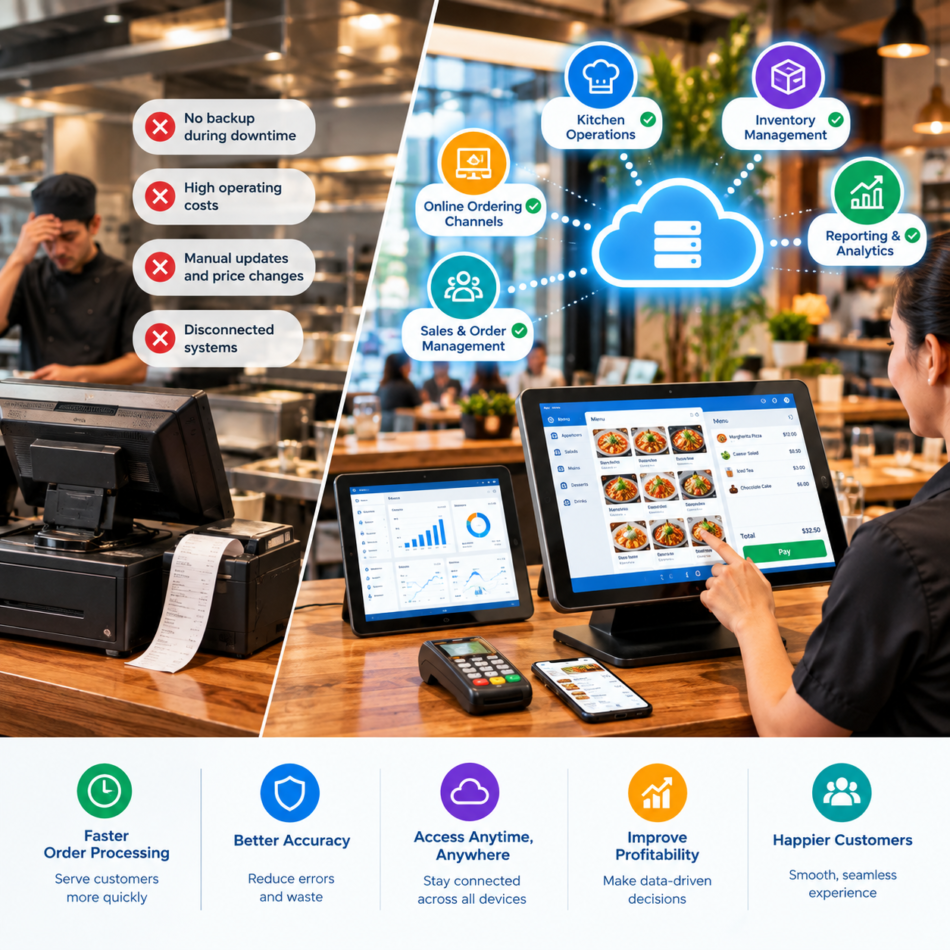
A restaurant POS system cost in Pakistan generally falls into one of four price bands, depending on how you buy it:
· Cloud subscription: roughly PKR 3,000 to PKR 20,000 per branch per month, billed monthly or annually, with updates and support usually included. Most restaurant management software in Pakistan is now sold this way.
· One-time desktop licence: roughly PKR 25,000 to PKR 150,000 as a single payment, typically from a local software house, with installation and a short training visit bundled in.
· Custom-built system: from several hundred thousand rupees upward, built to your specification, usually only worth it for chains with requirements no off-the-shelf product covers.
· Hardware, separately: roughly PKR 25,000 to PKR 90,000 for a basic counter setup, more if you add POS terminal units, kitchen printers, or handheld devices.
Those bands reflect publicly listed prices from Pakistani POS vendors in 2026 and are a starting point for budgeting, not a quote. Your actual cost depends on branch count, terminal count, and which modules you switch on.
The more useful question is not what a POS costs. It is what a POS costs you over three years, at the number of branches you expect to be running by then.
H2: What Are You Actually Paying For?
Every restaurant POS quote in Pakistan is built from the same five lines, whether or not the vendor itemises them.
H3: 1. The software itself
Billing, order entry, menu management, and reporting. This is the line vendors advertise. On a cloud POS it is a subscription pricing model; on a traditional system it is a licence you buy outright. If you are still weighing those two models against each other, our breakdown of cloud POS versus traditional POS covers what changes beyond the price.
H3: 2. Hardware
A counter terminal or tablet, a receipt printer, a cash drawer, a kitchen printer or Kitchen Display System, and a router. Cloud POS removes the back-office server, not the hardware bill. Ask whether your existing printers and drawers are supported before you budget for new ones, because many are.
H3: 3. FBR and PRA compliance
Whether integration is native to the system or a paid add-on. This single line separates POS systems built for Pakistan from international platforms adapted for it, and it is covered in detail below.
H3: 4. Setup and data migration
Menu entry, recipe costing mapping, branch configuration, user roles, and moving your sales history off the old system. Some vendors include this. Some charge a one-time setup fee. Some charge nothing and leave the work to you, which is the most expensive option of the three if your menu runs to hundreds of items.
H3: 5. Support and training
Ask whether support is 24/7 or business hours, whether it is included or a paid support tier, and whether retraining is covered when staff turn over. In a restaurant, staff turnover is not an edge case, and a system your new cashier cannot learn in one shift has a real cost that never appears on the invoice.
H2: Subscription or One-Time Licence: Which Is Cheaper?
Over a single year, a one-time licence usually looks cheaper. Over five, the comparison gets more interesting, and the answer depends less on arithmetic than on what you expect to happen to your restaurant.
A one-time licence is a capital expenditure. You pay once, own the software, and pay again for major upgrades, technician visits, and eventual hardware replacement. It works well for a single outlet with settled operations, stable staff, and no expansion plans.
A cloud subscription is an operating expenditure. You pay every month indefinitely, and over a long enough stretch the running total can exceed a one-time purchase. What you get for it is updates, backups, support, and the ability to add a branch without buying the whole setup again.
The point where this flips is expansion. A second outlet on a traditional system usually means buying a second system, server included. A second outlet on a cloud system usually adds one subscription line. Two branches is where most Pakistani restaurant owners find the maths turns, which is why restaurant POS system for multiple locations searches behave so differently from single-outlet ones.
Actionable tip: ask every vendor for a three-year total rather than a monthly figure, then ask what that total becomes at your second branch. Vendors price the first location aggressively and the fifth much less so.
H2: What FBR and PRA Compliance Adds to Your POS Bill
This is the part of the restaurant POS system price in Pakistan that international pricing guides ignore entirely, and it is not optional.
H3: FBR integration applies to every restaurant, not just large chains
The Federal Board of Revenue’s own POS integration FAQ answers this directly. All restaurants, snack bars, and cafes are required to integrate their POS systems under Chapter XIV-A of the Sales Tax Rules, 2006, whether or not they also fall into the Tier-1 retailer category.
That is broader than most vendor marketing admits. Tier-1 status under section 2(43A) of the Sales Tax Act, 1990 covers a retailer operating as a unit of a national or international chain, a retailer in an air-conditioned mall or plaza, a shop of 1,000 square feet or more, and a business whose cumulative electricity bill over the preceding twelve months exceeds PKR 1.2 million. But the restaurant obligation under Chapter XIV-A sits separately from all of that.
H3: The costs attached to compliance
· The POS service fee. Under SRO 1006(I)/2021, Tier-1 retailers collect a service fee of Re 1 per invoice from the customer and deposit it with the monthly sales tax return. It is a rupee per invoice, not one percent, a point FBR itself has had to clarify publicly. It passes through to the customer, so it is not a software cost, but your system has to handle it on the receipt and in the return.
· The cost of not integrating. Under section 33 of the Sales Tax Act, 1990, a Tier-1 retailer that fails to integrate faces a penalty of PKR 1 million, possible sealing of the premises, and a 15 percent reduction in adjustable input tax under section 8B(6). Attempting to bypass a connected system carries a penalty of up to PKR 500,000 or 200 percent of the tax involved, whichever is higher, with possible imprisonment.
· Provincial obligations, separately. If you operate in Punjab, sales tax on services is administered by the Punjab Revenue Authority, not FBR, and the two are distinct obligations rather than one. PRA has made its Electronic Invoice Monitoring System mandatory for hotels, restaurants, coffee shops, and marriage halls, with handwritten slips, kitchen order slips, and unpaid pre-bills explicitly prohibited as customer receipts. Receipts must carry the business name, address, receipt number, and PRA QR code. Reported fines for non-compliance run from PKR 400,000 to PKR 1 million, with repeat violations facing sealing for up to a month.
H3: What this means when you compare quotes
Ask three specific questions of any vendor:
1. Is FBR integration native to the system, or a third-party add-on configured separately and billed separately? The second option is where most compliance gaps appear.
2. Does the system handle PRA reporting as well, or only FBR? In Punjab you need both.
3. What happens to invoice reporting when the connection drops mid-service, and does the system queue and sync, or simply fail?
A system that generates the FBR invoice number and QR code automatically at checkout, the way CherryBerry RMS’s cloud POS does, removes a manual step from every single sale. A system where compliance is a bolt-on turns it into a daily task somebody has to remember.
Tax rules in Pakistan change often, and thresholds and rates are revised by notification. This section is general information, not tax advice. Confirm your restaurant’s specific obligations with FBR, the PRA, or your tax advisor before relying on any vendor’s compliance claims, including ours.
H2: The Costs Vendors Leave Off the Pricing Page
Six lines that turn a cheap quote into an expensive year:
· Per-terminal pricing. A plan quoted per branch and a plan quoted per-terminal pricing look similar until you add a second till. Confirm which you are buying.
· Modules behind a higher tier. Inventory, recipe costing, multi-branch reporting, and user roles are frequently excluded from entry plans. Price the tier you would actually use, not the one on the homepage.
· Integration setup. If your online ordering, delivery, and accounting tools come from different vendors, someone has to connect them. Ask whether that is included.
· Support tier. Restaurants trade on evenings and weekends. Business-hours support is not support.
· Data export on exit. Confirm before you sign that you can data export your sales history, menu, recipes, and customer records in a structured format such as CSV, what it costs, and how long data is retained after cancellation.
· Internet redundancy. Not a vendor charge, but a real one. Load-shedding and inconsistent broadband make a mobile-data backup on a second network standard kit in Pakistan, not an optional extra.
H2: What a POS Is Supposed to Save You
Cost is only meaningful against what it protects, and the honest version of this is specific rather than a percentage.
A POS earns its cost back in places that are hard to see without one. Stock that leaves the kitchen without appearing on a bill. Discounts applied at the till that nobody approved. A branch running a quiet Tuesday that you find out about at month end instead of that evening. Hours spent every week assembling sales figures from three separate places.
Whether that adds up to more or less than your subscription depends entirely on your operation, which is why a vendor ROI calculator is worth very little. Run the numbers on your own restaurant instead. If you want the mechanics of where the inventory savings actually come from, and the setup errors that stop them from appearing, our POS inventory management guide covers it.
H2: How to Compare POS Quotes Without Getting Caught Out
Seven questions that make two quotes genuinely comparable:
4. What is the three-year total, including hardware, setup, and the support tier I would actually buy?
5. What does that total become at two branches, and at five?
6. Is the price per branch or per terminal?
7. Is FBR integration native, and does the system handle PRA reporting too?
8. What exactly happens when the internet drops, demonstrated live rather than described? Ask them to unplug the network during the demo.
9. Which modules are excluded from this tier?
10. What does it cost to leave, and in what format do I get my data?
A vendor who answers all seven plainly is telling you something useful about how they will behave after you sign.
H2: What CherryBerry RMS Costs
CherryBerry RMS is priced by subscription, scaled to branch count and the modules you need, with FBR invoice generation and PRA support built into the core system rather than sold as a compliance add-on. Smaller restaurants and cafes can start on a basic plan and move up as they grow, which is the usual path for an affordable restaurant POS system buyer.
Because the right configuration depends on how many branches and terminals you run and which parts of the ecosystem you switch on, whether that is kitchen management, accounting and back office, or online ordering integration, pricing is quoted per restaurant rather than published as a fixed list.
Request a custom quote for your restaurant →
H2: Frequently Asked Questions
H3: How much does a restaurant POS system cost in Pakistan?
Cloud restaurant POS subscriptions in Pakistan generally run from roughly PKR 3,000 to PKR 20,000 per branch per month, while one-time desktop licences from local software houses typically fall between PKR 25,000 and PKR 150,000. Hardware for a basic counter adds roughly PKR 25,000 to PKR 90,000. Your actual cost depends on branch count, terminal count, and which modules you enable.
H3: Is a cloud POS cheaper than a one-time licence?
Over one year, usually not. Over three to five years, and especially past your second branch, it usually is. A licence is a capital cost you pay once and top up with upgrades and technician visits; a subscription is an ongoing cost that includes updates, backups, and support. Compare both as three-year totals at the branch count you expect to reach.
H3: Does every restaurant in Pakistan need FBR POS integration?
Yes. FBR’s own POS integration FAQ confirms that all restaurants, snack bars, and cafes must integrate their POS systems under Chapter XIV-A of the Sales Tax Rules, 2006, regardless of whether the business separately meets the Tier-1 retailer definition. Confirm your specific obligations with FBR or a tax advisor.
H3: What is the Re 1 POS service fee?
Under SRO 1006(I)/2021, Tier-1 retailers collect a POS service fee of one rupee per invoice from the customer and deposit it along with the monthly sales tax return. It is a flat rupee per invoice regardless of bill size, not a percentage, and FBR has publicly corrected claims that it is one percent.
H3: What is PRA EIMS and does it cost extra?
The Electronic Invoice Monitoring System is the Punjab Revenue Authority’s mandatory digital invoicing requirement for hotels, restaurants, coffee shops, and marriage halls. Handwritten slips and kitchen order slips cannot be issued as customer receipts, and receipts must carry the PRA QR code. Whether it costs extra depends on your vendor: in a system built for Pakistan it is part of the core product, while elsewhere it is often a paid add-on.
H3: What is the cheapest restaurant POS system in Pakistan?
The cheapest quote and the cheapest system are rarely the same thing. Entry plans commonly exclude inventory, multi-branch reporting, user roles, and 24/7 support, and compliance is often an add-on. Price the tier you would actually run, at the number of branches you expect, over three years.
H3: Do I need to pay per branch or per terminal?
Both models exist in Pakistan, and the difference matters as soon as you add a second till. Per-terminal pricing rises with every screen; per-branch pricing favours outlets running several terminals. Confirm which model a quote uses before comparing it to another.
H3: Does a POS system work if my internet goes down?
It depends on the system, and vendors use the phrase offline mode to mean very different things. Some go read-only, some queue orders locally and sync when the connection returns. Ask specifically what happens to billing, to kitchen tickets, and to FBR invoice reporting during an outage, and ask for a live demonstration rather than a description.
Key Takeaways
· Restaurant POS pricing in Pakistan splits into cloud subscriptions, one-time licences, custom builds, and hardware, and quotes are only comparable once you separate those lines.
· Ask for a three-year total at your expected branch count, not a monthly figure for one outlet.
· FBR POS integration applies to all restaurants under Chapter XIV-A, not only Tier-1 retailers, and non-compliance carries penalties far larger than any software subscription.
· In Punjab, PRA’s EIMS requirement sits separately from FBR, so a Pakistan-ready system needs to handle both.
· The costs that break budgets are the unlisted ones: per-terminal pricing, excluded modules, setup fees, support tiers, and data export charges on the way out.


