 WhatsApp Us Now
Introduction to Powered Air Purifying Respirators
Powered air purifying respirators (PAPRs) are specialized respiratory protection devices designed to safeguard workers by filtering contaminated air and delivering clean, breathable air to the user. They consist of a headgear and fan assembly that actively pumps filtered air, providing higher protection than conventional respirators like N95 masks. PAPRs are used across various industries, including healthcare, manufacturing, construction, and agriculture, especially where workers face airborne hazards such as dust, gases, and pathogens.
Market Size and Growth Projections
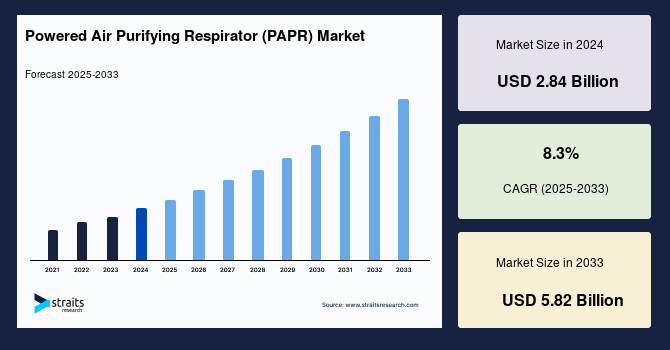
The global powered air purifying respirator (papr) market size was valued at USD 2.84 billion in 2024 and is projected to grow from USD 3.07 billion in 2025 to reach USD 5.82 billion in 2033, growing at a CAGR of 8.3% during the forecast period (2025–2033).
Key Drivers of Market Growth
Regulatory Support and Occupational Health Guidelines
Stringent occupational safety regulations form the backbone of PAPR market growth. Governments globally require employers to provide respiratory protection to workers exposed to harmful airborne particles and chemical vapors. For instance, regulations such as the Personal Protective Equipment Regulations 2002 and The Control of Substances Hazardous to Health Regulations 2002 mandate the use of certified respiratory devices like PAPRs. Regular assessment, maintenance, and proper storage of these devices are also enforced to ensure effectiveness and compliance.
Rising Industrial and Construction Activities
Expansion in industries such as oil and gas, metal fabrication, pharmaceuticals, and agriculture directly boosts demand for PAPRs. The construction sector, particularly in regions like Europe and Asia-Pacific, is experiencing growth due to increased infrastructure projects, further escalating the need for respiratory protection devices. This sector growth is especially visible where workers are exposed to dust, silica, asbestos, and chemical fumes.
Healthcare Sector Demands
PAPRs are critical in healthcare environments, protecting medical personnel against airborne infectious diseases such as tuberculosis and emerging viral pathogens. Healthcare-specific PAPRs ensure safety during patient care in high-risk zones. The rising prevalence of infectious diseases and growing awareness of workplace safety are accelerating demand for advanced PAPRs in hospitals and clinics.
Market Segmentation
By Product Type
The global PAPR market is segmented into half masks, full face masks, helmets, hoods and visors.
- Full Face Masks: Dominating the market, full face mask PAPRs are projected to maintain a CAGR of 8.6%. These masks provide comprehensive facial protection and are typically fitted with multiple filter types to safeguard against particles, gases, and vapors, making them ideal for sustained industrial use.
- Helmets, Hoods, and Visors: These offer versatility and compatibility with various industrial applications. Loose-fitting designs are particularly beneficial for users who cannot undergo fit testing due to facial hair or facial irregularities.
By End-Use Industry
- Industrial Use: The industrial sector holds the largest market share, with a CAGR of approximately 8.7%. Growth is fueled by expanding automotive, metal forming, manufacturing, and glass production activities, where workers face hazardous airborne particulate matter.
- Agriculture: Respiratory hazards in agriculture such as organic dust, chemical pesticides, and toxic gases like ammonia drive demand for PAPRs to prevent occupational diseases among farmworkers.
- Healthcare: PAPRs are increasingly adopted to protect healthcare workers from airborne infectious agents in medical settings.
- Other emerging sectors include oil and gas, food and beverage, petrochemicals, mining, and fire services.
Regional Market Insights
- North America: The largest PAPR market region globally, North America commands a significant revenue share. Strong regulatory pressure and rising cases of airborne illnesses contribute to the region’s steady growth, projected at a CAGR of about 7.7%.
- Europe: Europe is expected to grow at a CAGR of 8.2%, driven by industrial expansion in Germany, UK, France, and other key economies. Increased construction activities amidst varied mortgage conditions impact demand dynamics.
- Asia-Pacific: The fastest-growing market with a CAGR of 10.2%, Asia-Pacific benefits from rapid industrialization, infrastructure development, and increasing awareness of worker safety. Countries such as China, India, Japan, and South Korea are large contributors.
- Middle East and Africa: Growth is anchored on oil and gas industry demands and stringent safety regulations.
- Latin America: Expansion of healthcare, defense, and agriculture sectors propels market growth, with rising safety norms influencing adoption.
Technological Trends and Innovations
Leading market players are continually innovating to improve the comfort, usability, and functionality of PAPRs. For instance, newer designs like the SALUS-HC emphasize ergonomic comfort, while strategic acquisitions such as GVS SpA’s purchase of RPB Group aim to expand product portfolios and geographic outreach. Incorporation of smart technology and eco-friendly materials is on the rise, enhancing user experience and sustainability.
Challenges Facing the Market
Despite strong growth prospects, the PAPR market encounters challenges, including:
- High costs due to complex manufacturing processes and stringent quality standards.
- Competition from alternative respiratory protective equipment offering cost-effective solutions.
- Maintenance demands like frequent battery charging and disinfection procedures may limit wider adoption.
- Lack of awareness in certain regions and industries results in suboptimal use of these devices.
Conclusion
The powered air purifying respirator market exhibits strong growth driven by increasing industrialization, regulatory enforcement, and the ongoing emphasis on occupational health and safety. Continued innovations coupled with expanding applications across multiple industries position the PAPR market for substantial advancement through 2033. Addressing challenges related to cost and awareness will be crucial to unlocking its full potential globally.


