 WhatsApp Us Now

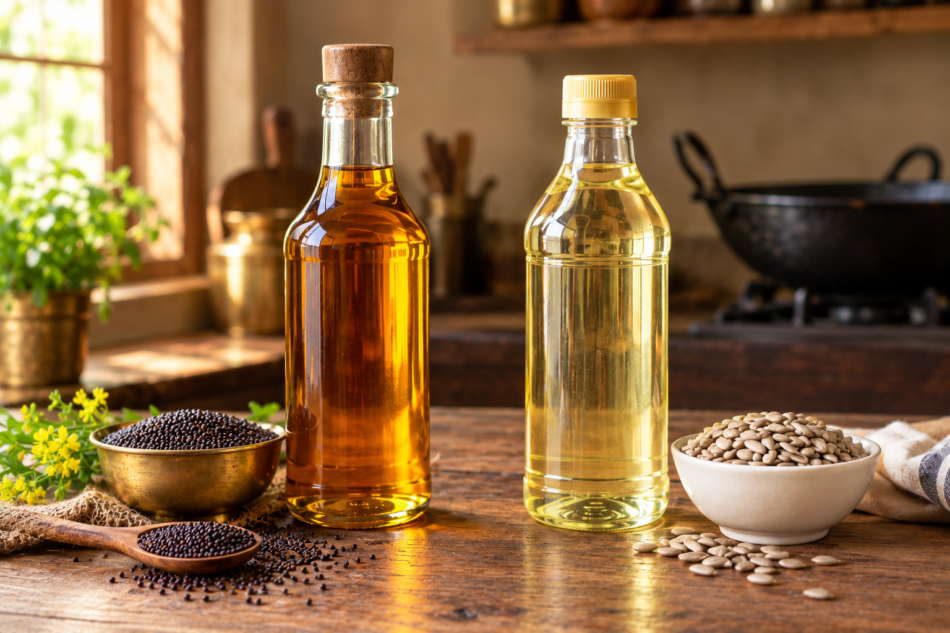
Go to any kirana shop and you’ll see both oils on the same shelf. Refined oil comes in big shiny cans, almost no colour, mostly with a red heart on the label. Right next to it is sarson ka tel, darker, and you can smell it even before you open the bottle. In the 90s a lot of families switched to refined because every TV ad said it was light and good for the heart. Now many of them are going back to wooden pressed black mustard oil, the same oil their nanis used.
How Each Oil Is Made
Most refined oil is made from soybean, sunflower, rice bran or palm. The seeds are crushed in big factory machines. Then they are soaked in a chemical called hexane, which takes out the oil the machines left behind.
After this the oil is washed with caustic soda, bleached to remove the colour and steamed at very high heat to remove the smell. What you get has almost no colour, no smell and no taste. It’s cheap to make and lasts for months on the shelf. But a lot of the vitamin E and other good things from the seed are lost on the way.
Wooden pressed black mustard oil is made in a kolhu, a big wooden press that turns slowly and crushes the seeds. Earlier a bullock used to walk round and round to turn it. Now most kolhus run on a small motor, but they still turn slowly, so the seeds don’t get hot. Nothing is added. The oil is left to settle, strained through a cloth and filled in bottles.
Like other cold pressed oils, it keeps the colour, smell and taste of the seed. Wooden pressed black mustard oil is deep golden and sometimes a bit cloudy. Heat it and the smell is strong enough to make your eyes water. That smell comes from the black mustard seed itself, and refining takes most of it away.
Taste, Smell and Cooking
Taste is the first thing you’ll notice. Refined oil doesn’t add any taste to the food. That’s fine for a cake or a plain omelette. Mustard oil adds a lot. Make sarson ka saag, aloo ki sabzi, macher jhol or aam ka achar in refined oil and they just won’t taste the same.
In most Punjabi and Bengali homes, wooden pressed black mustard oil is heated till a little smoke comes up. Then the kadhai is taken off the gas for a few seconds before the jeera or masala goes in. This makes the smell softer. For achar, the oil is heated, cooled and then poured over the masala and vegetables.
Wooden pressed black mustard oil can take high heat, so it’s good for pakoras, puris and fried fish. In north Indian winters, many families use the same bottle for a foot or hair massage too.
What About Nutrition?
Both are oils, so use either one in small amounts. A spoon of mustard oil and a spoon of refined oil have almost the same calories. The difference is in what else is in that spoon.
Mustard oil has a lot of monounsaturated fat and some omega 3, which most Indian cooking oils don’t have much of. Since nothing is taken out after pressing, wooden pressed black mustard oil also keeps more of its vitamin E and antioxidants. Refined oils lose some of these during bleaching and steaming. Matrika’s blog has a detailed post on why wooden pressed black mustard oil keeps more nutrition, if you want to read more.
How to Choose and Store It
Read the label first. Words like kachi ghani, wood pressed or cold pressed are good signs. If the bottle says blended edible vegetable oil, it’s usually a little mustard oil mixed with cheaper refined oil. That’s not pure mustard oil.
Pure wooden pressed black mustard oil smells strong the moment you open the cap. Sometimes it looks a little cloudy or has a thin layer at the bottom. That’s normal, because it hasn’t been bleached or cleaned with chemicals.
Cold pressed oils go stale faster than refined oil, since nothing is done to make them last longer. Keep the bottle in a cupboard, away from the gas and sunlight, with the cap shut tight. Glass or tin is better than thin plastic. Buy only as much as you’ll finish in a few months.
About Matrika Natural Foods
Matrika Natural Foods makes cold pressed oils the traditional way. They have black mustard, yellow mustard, groundnut, sesame, coconut, flaxseed, almond and kalonji oil, all made without chemicals or heat processing, in 1 litre packs. You can order online or visit their stores in Ambala City and Zirakpur.
Summing Up
Refined oil is cheaper and lasts longer, but it adds no taste to your food. Mustard oil from a kolhu has its own colour, smell and taste, and keeps more of what is in the seed. If you cook Indian food every day, keep a bottle of wooden pressed black mustard oil in the kitchen, at least for tadka, sabzi and achar. Read the label, pick kachi ghani or cold pressed oils, and keep the bottle away from heat and light.


