 WhatsApp Us Now

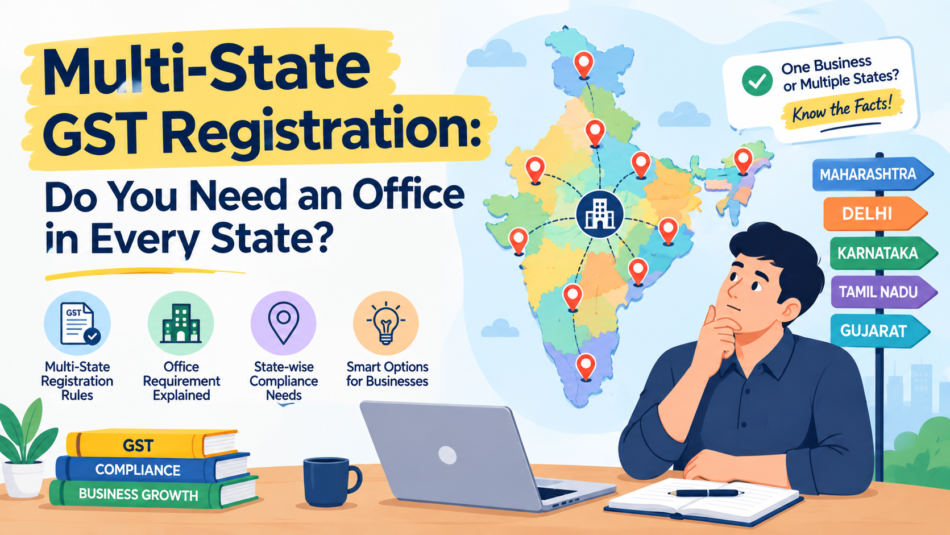
Do you need a GST registration certificate for your business in a new state? Well, expanding your business to new states or cities doesn’t automatically mean you must apply for GST in each one, but in most cases, it doesn’t mean you shouldn’t either. The multi-state GST registration typically applies to one thing: where you have an actual place of business, including the nature of the business, not where you are selling. Stay with us to learn the difference and what the cost is if you apply.
Do You Need GST Registration in Every State?
No, GST is not applicable in every state; instead, securing it becomes mandatory when you have a genuine place of business. If you have an office, warehouse, godown, or any fixed establishment from which you make a taxable supply of goods or services, then a GST certificate is mandatory. In simple terms, if you are only shipping the products to others, then registration doesn’t apply.
For example, if you are Karnataka based producer seller and sell to a customers is live in Delhi, but you don’t have any stock, office, or staff there, then in this situation you do not need Delhi GST registration.
In short, when your aggregate turnover crosses the applicable threshold limit, then securing the GST certificate becomes mandatory. Once you are registered somewhere and start operating, not just selling, but in new states, that’s when GST registration in multiple states becomes relevant.
Additional Place of Business vs New Registration
This is the place where most businesses expanding for the first time make the mistake.
Well, there is a specific principal place of business (PPOB), main location, and you can have an additional place of business (APOB) under Section 2(85) of the CGST Act. But, here is a catch related to APOB, that is, its only works within the same state as your existing registration. The moment you move to a new location in a different state, the APOB no longer works. In this situation, you are required to obtain a fresh GSTIN by filing the new Form GST REG-01. This is how additional place of business vs new registration works:
| Category | Additional Place of Business | Separate Registration |
| When applies? | New location, same state | New location, different state |
| Filing Requirement | Amendment (Core Fields) | Fresh FORM GST REG-01 |
| GSTIN | Same GSTIN | New GSTIN |
This is worth getting right before you file anything. You should treat a fresh GST registration from day one if you set up your business in a new location in another state.
Who Needs a GST Certificate: Warehouses, Marketplaces & Service Businesses?
In some cases, the GST registration for a virtual office address becomes crucial even with no staff. It can be understood as:
- Warehouses and godowns: These are the major parties who triggers for accidential non-compliance. If you have a goods store in another state and make taxable supply from that location, then it is marked as the place of business. It means meeting the GST formalities is crucial even its just a rented unit with no staff.
- Marketplace sellers: Such sellers are only aware of the registration when they face the input tax credit issue. The registration obligation arises when you sell through e-commerce business platforms like Flipkart or Amazon, and your stock sits in one of their fulfilment centres in another state.
- Service businesses: Here the registration works differently. You don’t need to register if you do not have a fixed establishment while applying consulting services to clients in another state. But the moment you register an office, appoint staff, or make your fixed presence there, then the same “place of business” test applies to services as it does to goods.
What if You Are Using a Virtual Office in Another State?
When you have a virtual office address (serving as your principal place of business) in a new state with proper documents like an NOC or valid lease, including a recent utility bill or alternative address proof, then it triggers GST registration for a virtual office.
The GST authorities do not verify physical desk occupancy; instead, they cross-verify the virtual office address details against provided documents. The address can be inspected by the GST inspectors at any time as long as paperwork is accurate and address details actually match the provided documents.
Taking the GST officers’ due diligence obligation lightly can be risky for those who start a virtual office in any state of India. It is most common in virtual offices where the GST officers conduct the physical inspection. A virtual office with no physical activity, missing signs of the applicant, or if the provider is unresponsive, then these common reasons registrations get flagged for query notices or rejected outright. However, if you are starting a virtual office in another state, you must ensure that your provider supports GST registration and can provide all documents with full accuracy.
What is the Compliance Cost of Multi-state GST?
Before expanding your virtual office address business in another state, it is worth knowing the maintenance cost with the second address. It can be understood as:
- Separate Return Management Per State: Each GST-registered individual in each state is required to file its own separate GSTR-1 and GSTR-3B. No separate rules for different states for return filing.
- No Automatic ITC Netting: Each state needs its own books and reconciliation, as the Input tax credit doesn’t flow between registrations.
- Fee Scale Per Registration: The number of GSTINs you hold determines the cost of professional services and compliances.
- Stock Transfer: Under GST rules, the goods are considered taxable if they move between own branches in different states.
The practical takeaway: The compliance cost scales up with the number of registrations in multiple states, not by the revenue a virtual office address generates.
Frequently Asked Questions (FAQs)
Q1. Can I use one GST number for multiple states?
Ans. No, you cannot use the same GSTIN for multiple states as it is state-specific. Securing a separate GSTIN is mandatory for each state.
Q2. Is a virtual office valid for GST registration?
Ans. Yes, there is no restriction on a virtual office for GST registration. To secure the certificate, you are required to provide the virtual office address proof, like a valid lease/NOC and utility proof, and the address.
Q3. Do I need GST registration for a warehouse in another state?
Ans. Yes, securing the GST registration certificate becomes mandatory for warehouses if they store goods and taxable goods in that location.
Q4. What documents are needed for GST registration in a new state?
Ans. To obtain the GST certificate in a new state, you must ensure you have these documents: proof of address (lease/NOC and utility bill), PAN, identity proof of authorized signatories, and bank account details for that registration.
Q5. What happens if I don’t register in a state where I store or sell goods?
Ans. If you are found operating taxable goods in a state without GST, then you may face strict legal action, such as input tax credit being blocked, receiving a compliance notice, and penalties.


