 WhatsApp Us Now
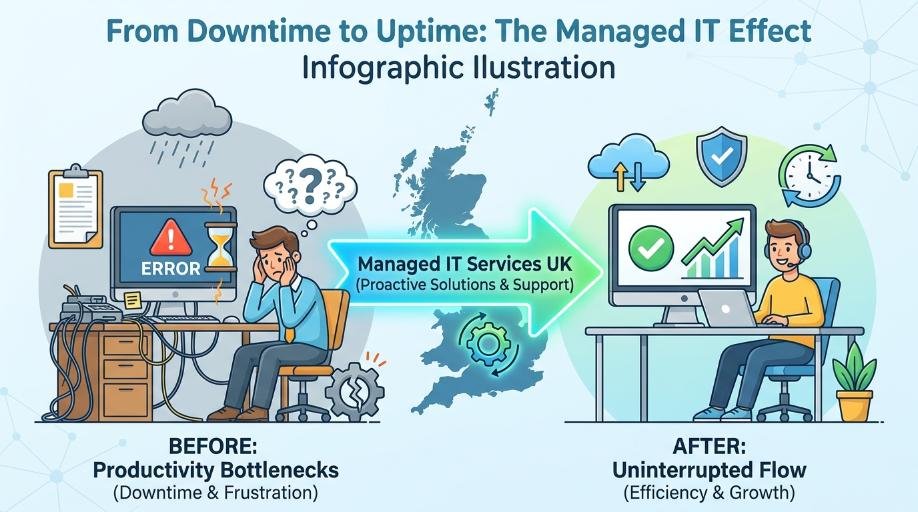
Discover how managed IT services UK eliminate productivity loss, scale engineering capacity, and optimize business continuity with secure cloud systems.
In today’s fast-moving corporate environment across the United Kingdom, operational throughput and workplace productivity are inextricably linked to the stability of underlying digital systems. Modern British enterprises rely on interconnected technology stacks to execute critical transactions, facilitate remote and hybrid workforce collaboration, process customer data, and deliver customer-facing web services. However, as enterprise software environments expand in complexity, maintaining and optimizing these multi-layered systems using solely internal resources often results in severe operational friction, recurring workflow interruptions, and widespread team burnout.
Chief Executive Officers, Chief Information Officers, and business directors across the UK regularly discover that internal technical staff are overwhelmed by routine administrative upkeep, daily service desk queues, and reactive troubleshooting. When skilled in-house professionals spend their core working hours fixing server crashes, resolving password resets, or managing software dependency conflicts, high-priority digital transformation initiatives ground to a halt. To permanently eliminate these productivity bottlenecks and restore organizational momentum, forward-thinking British enterprises are shifting away from traditional break-fix support models toward integrated, engineering-led technology partnerships. Understanding how dedicated technical specialists streamline operations reveals how modern firms eliminate productivity losses while establishing a resilient foundation for long-term commercial growth.
Proactive Infrastructure Governance and Latency Elimination
A primary factor contributing to productivity loss in established British organizations is the accumulation of unmanaged technical debt and legacy system latency. Over extended periods of business expansion, enterprises often piece together disparate software tools, disconnected on-premises servers, and isolated database repositories. When internal platforms operate in silos, database query response times degrade, manual data reconciliation errors increase, and subtle software vulnerabilities remain unnoticed until a major disruption occurs. Running a modern business on unoptimized digital foundations creates persistent frustration for employees and degrades the overall customer experience.
Partnering with a trusted provider of managed IT services UK enables executive leadership to transform erratic, fragmented IT environments into structured, automated operational engines. Experienced infrastructure specialists conduct end-to-end technical evaluations across the corporate digital estate to identify operational bottlenecks, eliminate redundant software licenses, and consolidate fragmented database architectures. By establishing automated round-the-clock telemetry monitoring across networks, servers, and endpoint devices, external technical teams detect and remediate anomalies—such as memory leaks, storage limits, and unpatched software flaws—long before they disrupt day-to-day operations.
In addition to removing performance friction, proactive infrastructure governance ensures strict compliance with national statutory frameworks. Operating in the UK commercial market requires strict adherence to regulations such as the UK GDPR, the Data Protection Act, and Cyber Essentials guidelines. Specialized technology partners embed continuous compliance monitoring directly into daily operations. By implementing Zero Trust access architectures, role-based access control (RBAC), and robust data encryption protocols, external leads protect corporate assets against costly breaches, insulate leadership from regulatory penalties, and reinforce customer trust across all commercial channels.
Eliminating Engineering Delays with Elastic Developer Capacity
Even with an established digital modernization strategy, executing complex technical roadmaps requires dedicated, senior-level engineering capacity. However, a major hurdle for technology directors across the United Kingdom is the severe shortage of specialized software engineers, DevOps leads, and cloud solution architects within the domestic job market. Traditional direct recruitment approaches frequently take several months to fill critical vacancies, incurring high agency placement fees and creating long-term payroll liabilities that reduce organizational flexibility. When vital engineering seats sit empty, project backlogs expand and existing technical teams experience severe fatigue.
To bypass recruitment bottlenecks and maintain continuous software delivery momentum without inflating fixed overhead, market-leading organizations actively partner with an established staff augmentation company UK. Integrating pre-screened, senior software engineers directly into existing internal agile squads provides immediate technical capability without traditional onboarding delays. These external technical experts operate seamlessly within internal project management workflows, utilizing existing code repositories, participating in daily standups, and adhering strictly to internal coding standards and quality assurance protocols.
The core strategic value of this flexible resourcing model is operational elasticity. Commercial priorities and engineering workloads naturally fluctuate across project lifecycles. During intensive build cycles—such as launching an enterprise customer portal, refactoring legacy monolithic code, or integrating automated API data pipelines—organizations can rapidly expand external developer capacity to hit tight launch deadlines. Once systems reach operational maturity, team sizes can be adjusted accordingly. This elasticity optimizes resource allocation, protects profit margins, and prevents team burnout during high-pressure delivery sprints.
Engineering Resilient Cloud Architectures and Business Continuity
Unexpected system downtime, network outages, and data availability issues represent immediate threats to corporate productivity and revenue generation. Whether caused by hardware degradation, software misconfigurations, or unexpected network traffic surges, digital interruptions freeze core business workflows, delay customer service responses, and erode market reputation. Relying on outdated reactive support—where technicians only step in after an outage has already halted operations—exposes modern enterprises to significant financial and operational risk.
Deploying specialized cloud IT services UK provides enterprise boards with around-the-clock infrastructure telemetry, proactive threat mitigation, and continuous workload optimization. Dedicated cloud engineers monitor system health, bandwidth utilization, API dependencies, and database query latency 24/7 to isolate and resolve system anomalies before they affect employee or customer workflows. Automating operating system updates, security patch rollouts, and multi-region load balancing ensures that critical business platforms maintain maximum uptime and deliver consistent, low-latency performance.
Beyond proactive performance optimization, leading technology partners construct comprehensive business continuity and disaster recovery architectures. Acknowledging that hardware failures, cyber incidents, or regional cloud service disruptions can occur without warning, cloud specialists establish automated multi-region backup schedules with defined Recovery Time Objectives (RTO) and Recovery Point Objectives (RPO). Executing routine simulated disaster recovery drills ensures rapid data restoration and application failover, maintaining operational continuity and protecting corporate revenue under any circumstances.
Five-Stage Blueprint for Eliminating IT Productivity Loss
To systematically remove operational friction, boost employee output, and establish a resilient technology foundation, executive leadership should execute a structured five-stage implementation framework:
- Infrastructure & Friction Baseline Audit: Conduct a comprehensive evaluation of existing cloud configurations, software dependencies, and endpoint security protocols to identify single points of failure and resource bottlenecks.
- Zero Trust Security & Compliance Standardization: Enforce multi-factor authentication (MFA), role-based access control (RBAC), and end-to-end data encryption fully aligned with UK GDPR standards.
- Elastic Engineering Capacity Augmentation: Fill critical internal technical skill shortages by embedding pre-vetted external developers directly into active product squads to clear backlogs rapidly.
- Cloud Architecture Modernization: Refactor legacy application components into scalable cloud-native microservices and deploy low-latency API middleware to ensure fault tolerance and system redundancy.
- Continuous Telemetry & Failover Validation: Implement 24/7 infrastructure telemetry monitoring systems and conduct periodic simulated disaster recovery drills to guarantee high operational uptime.
Frequently Asked Questions (FAQs)
How do managed IT services eliminate workplace productivity loss?
Managed IT services eliminate productivity loss by implementing 24/7 proactive monitoring to resolve system errors before downtime occurs, automating software updates, streamlining support tickets, and providing fast access to specialized engineering resources.
What makes staff augmentation different from full project outsourcing?
Full project outsourcing delegates complete project management and delivery responsibility to an external vendor. Staff augmentation embeds individual, pre-vetted senior software developers directly into your existing internal team, allowing you to retain direct control over sprint priorities, code quality, and software architecture.
How do UK-based IT service partners ensure regulatory compliance?
UK-based IT partners maintain in-depth expertise in domestic data protection regulations such as UK GDPR and the Data Protection Act. They implement Zero Trust access controls, configure encrypted cloud environments, maintain immutable access logs, and perform regular vulnerability scans required for formal compliance audits.
Why is proactive infrastructure management more cost-effective than break-fix IT?
Break-fix support intervenes only after an outage or data breach has already caused operational disruption, lost revenue, and expensive emergency recovery fees. Proactive monitoring uses real-time telemetry and automated maintenance to resolve issues early, preventing downtime entirely.
How quickly can an organization scale developer capacity through staff augmentation?
Because established staff augmentation providers maintain active networks of pre-vetted senior software engineers and cloud specialists, onboarding typically takes days rather than the several months required for traditional direct recruitment channels.
Conclusion
Achieving sustained operational velocity, shielding corporate assets, and eliminating productivity losses in today’s digital economy requires moving past legacy operating models in favor of strategic, engineering-led partnerships. Combining proactive 24/7 managed infrastructure support, flexible developer staff augmentation, and modern cloud IT governance empowers corporate leadership to eliminate technical drag, shield sensitive data, and maintain continuous delivery momentum. Transitioning to an engineering-led operational framework lowers enterprise risk, optimizes operating margins, and secures the resilient technical foundation required to maintain market leadership tomorrow.


