 WhatsApp Us Now
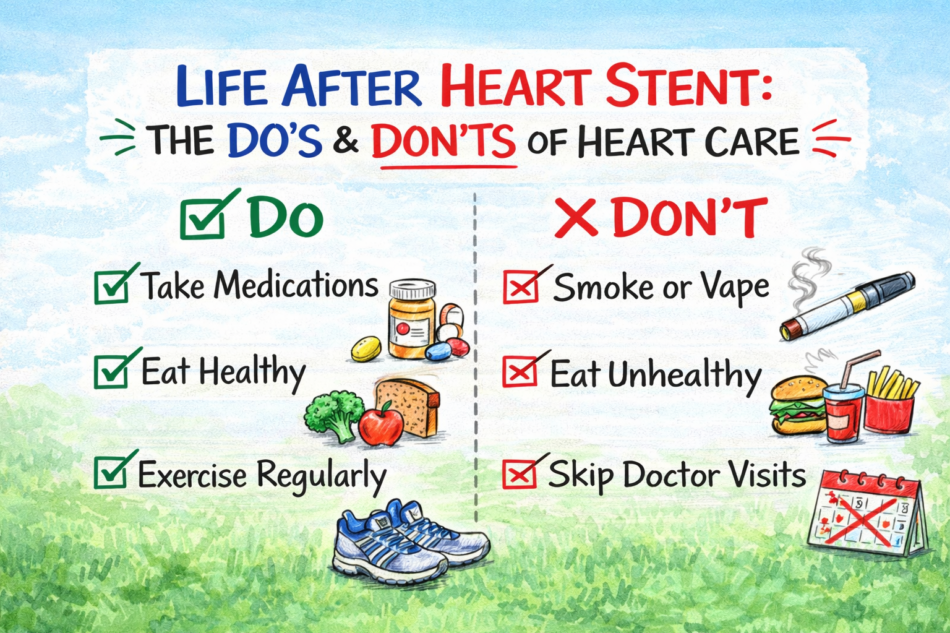
A heart stent is a crucial implant that keeps the narrowed or blocked coronary arteries open and avoids restenosis (the re-narrowing of the arteries). To live a normal life and manage your recovery better, you must know what to avoid after stent angioplasty.
During the recovery period when the wound is healing and even after that, medication alone is not enough, it requires thorough lifestyle changes for better outcomes.
What to Avoid After Stent Procedure
While right after the initial wound phase, you will feel better and would want to start doing things the way you used to, it is advised that you shouldn’t do everything. More than the activities you can do, it is crucial to know which ones you can’t do the same way you used to. Heavy lifting, strenuous activities and certain habits damage the entire recovery process, so should be avoided completely.
Long-term Lifestyle Changes Make For Long-term Outcomes
A heart healthy tips does not have any place of inconsistencies. No smoking, moderate or no alcohol consumption, and a heart-healthy diet devoid of unhealthy fats and excessive salts and sugars are to be avoided entirely. The activities that trigger adrenaline rush are to be stopped completely. Keeping the stress hormones in check is the best way to care for the heart.
Find Your Work-Heart balance
Do not rush to work right after your stent surgery, work can wait, life can’t. Heart health is as much mental as much as it is physical.
The Heart is Never Good With the Heavy Stuff
So, no heavy lifting, of any sort, neither physical nor mental. While the heavy lifting damages your recovery, it may lead to further heart complications. Avoid any strenuous activity, till the time your cardiologist allows you to.
Heart Stent Recovery Time – Your Journey to The Heart-Safe Zone
The modern angioplasty is a minimally-invasive procedure, so the chances of any side effects are less, still it is advised to observe the recovery phase carefully, as prescribed, to avoid any heart complications and to have full recovery. Post surgery, the most important work is to rest, not to mention, physically as well as mentally. To avoid any risks or further complications, it is advised to make regular follow-up visits to your cardiologist.
Heart stent recovery time primarily depends on two factors, if the surgery was done in an emergency scenario like a heart attack or as a non-emergency precautionary measure. In the latter one, the recovery period is usually a week’s time. In an emergency situation though, it may require a couple of weeks to a month’s time to make full recovery from the surgery.
Precaution After heart Stent – Plaque Build-up Caution
Plaque gradually narrows the arteries, eventually blocks them, impacts the healthy blood flow to the heart, in turn strains the heart, damages the heart muscle, only to cause heart diseases, or in the worst-case scenario heart attack or cardiac arrest.
Major Risk factors:
· Unhealthy Food
· Mental & Physical Stress
· Adrenaline Rush
· Smoking & Alcohol Consumption
· Excessive Sugars & Salts
Rest works wonders, as optimum hydration does the trick. Your cardiologist may also prescribe blood thinners after the surgery, to help prevent the formation of blood clots, all medications to be strictly observed as directed.
Better the Recovery, Better the Future Prospects Post surgery, no matter how successful the surgery was, the patient and the care givers at home play the most crucial role in recovery. Knowing what to avoid after a stent, the precautions after stent angioplasty and strictly following the doctor’s instructions during the heart stent recovery time makes all the difference between full recovery and further complications. Avoiding certain activities, foods and thoughts can help speed up the healing process. Following a balanced-diet plan, optimum heart-healthy exercise regimes, staying closer to your loved ones and resting properly without the stresses and the screens promises long-term outcomes. For the heart to be free, sometimes it has to follow some rules, for good.


