 WhatsApp Us Now

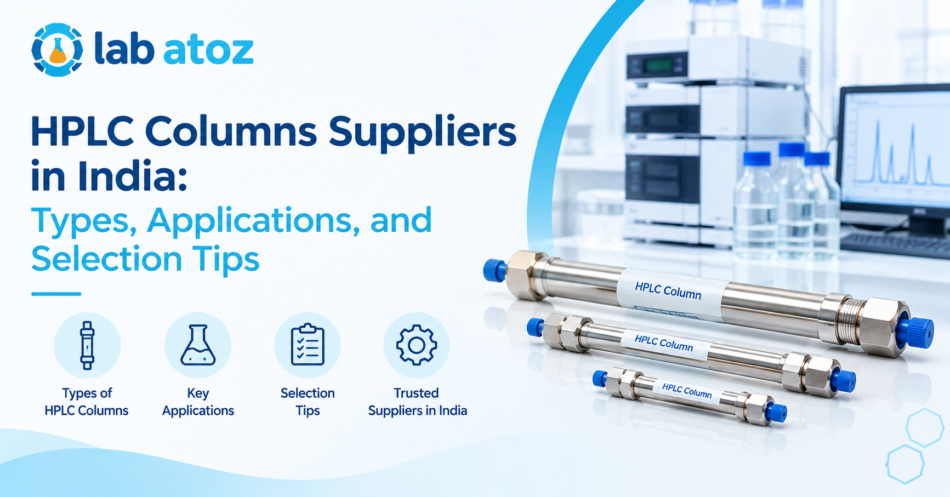
High-performance liquid chromatography (HPLC) is one of the most widely used analytical techniques in pharmaceutical, biotechnology, chemical, food, environmental, and research laboratories. At the heart of an HPLC system is the HPLC column, which plays a crucial role in separating, identifying, and quantifying compounds in a sample.
Choosing the right HPLC column can significantly influence separation efficiency, accuracy, reproducibility, and overall laboratory productivity. With numerous options available in the Indian market, selecting a reliable supplier and the appropriate column for a particular application is essential.
Lab AtoZ provides laboratory-related products and solutions for researchers and professionals looking for reliable analytical and laboratory resources. This guide explains the major types of HPLC columns, their applications, and important factors to consider when choosing HPLC columns suppliers in India.
What Is an HPLC Column?
An HPLC column is a cylindrical component packed with a stationary-phase material. During an HPLC analysis, a liquid mobile phase carries the sample through the column. Different compounds interact with the stationary phase to varying degrees, causing them to travel at different rates and separate from one another.
The resulting separation allows scientists to analyze individual components of complex mixtures.
HPLC columns are available in different dimensions, particle sizes, stationary phases, and configurations. The best choice depends on factors such as the chemical properties of the sample, required resolution, analytical method, and HPLC instrument.
Why Choosing the Right HPLC Column Matters
Selecting the appropriate column is important because it can affect several aspects of an analytical method, including:
- Separation efficiency
- Resolution between compounds
- Retention time
- Peak shape
- Sensitivity
- Reproducibility
- Analysis time
- Solvent consumption
- Column lifetime
Using an unsuitable column can result in poor peak shape, inadequate separation, excessive back pressure, or inconsistent analytical results. For this reason, laboratories should carefully evaluate their requirements before purchasing an HPLC column.
Types of HPLC Columns
There are several types of HPLC columns, each designed for specific separation mechanisms and applications.
1. Reverse-Phase HPLC Columns
Reverse-phase HPLC is one of the most commonly used HPLC techniques. These columns generally contain a non-polar stationary phase, such as C18 or C8, while the mobile phase is comparatively more polar.
C18 columns are particularly popular because they can be used for a wide range of pharmaceutical, biochemical, and chemical applications.
Common applications include:
- Pharmaceutical analysis
- Drug impurity testing
- Quality control
- Food and beverage analysis
- Environmental analysis
- Research and development
2. Normal-Phase HPLC Columns
Normal-phase HPLC columns typically use a polar stationary phase and a relatively non-polar mobile phase. They are useful for separating compounds based on differences in polarity.
These columns can be used for the analysis of:
- Lipids
- Isomers
- Non-polar compounds
- Certain pharmaceutical ingredients
- Organic compounds
3. Ion-Exchange HPLC Columns
Ion-exchange columns separate compounds according to their ionic properties. They contain charged functional groups that interact with oppositely charged molecules.
These columns are commonly used for:
- Protein analysis
- Peptide analysis
- Amino acid separation
- Biomolecule purification
- Analysis of ionic compounds
4. Size-Exclusion HPLC Columns
Size-exclusion chromatography separates molecules primarily according to their size. Larger molecules generally pass through the column differently from smaller molecules because of their interaction with the porous stationary phase.
These columns are widely used in:
- Polymer analysis
- Protein characterization
- Biopharmaceutical research
- Molecular weight determination
- Biotechnology applications
5. HILIC Columns
Hydrophilic interaction liquid chromatography (HILIC) columns are useful for separating highly polar compounds that can sometimes be difficult to retain using conventional reverse-phase methods.
Typical applications include the analysis of:
- Polar metabolites
- Carbohydrates
- Amino acids
- Small polar molecules
- Pharmaceutical compounds
Applications of HPLC Columns
HPLC columns are used across numerous industries because of their versatility and analytical capabilities.
Pharmaceutical Industry
The pharmaceutical industry relies heavily on HPLC for quality control, method development, stability studies, impurity profiling, and assay testing.
HPLC columns can help analyze active pharmaceutical ingredients (APIs), excipients, degradation products, and related substances.
Biotechnology and Life Sciences
HPLC is frequently used in biotechnology laboratories for analyzing proteins, peptides, amino acids, nucleotides, and other biomolecules.
Different column chemistries can be selected depending on the molecular characteristics and analytical objective.
Food and Beverage Testing
HPLC columns are used to analyze various food components, including preservatives, additives, vitamins, organic acids, sugars, and contaminants.
Reliable chromatographic separation is important for maintaining product quality and meeting regulatory requirements.
Environmental Analysis
Environmental laboratories use HPLC techniques to detect and quantify organic pollutants, pesticides, contaminants, and other chemical compounds in water, soil, and related samples.
Chemical and Research Laboratories
Research laboratories use HPLC columns for compound identification, purification, reaction monitoring, and method development.
The ability to select different stationary phases makes HPLC suitable for a broad range of analytical challenges.
How to Choose the Right HPLC Column
Choosing an HPLC column should be based on the characteristics of the sample and the analytical method rather than simply selecting the most commonly used column.
Here are some important factors to consider.
1. Understand the Sample
Start by evaluating the chemical properties of the compounds you need to analyze.
Consider:
- Molecular weight
- Polarity
- Ionization behavior
- Functional groups
- Solubility
- pKa
- Chemical stability
Understanding these characteristics can help determine the appropriate separation mechanism.
2. Select the Appropriate Stationary Phase
The stationary phase is one of the most important considerations when selecting an HPLC column.
For many routine pharmaceutical applications, C18 reverse-phase columns are a common starting point. However, other phases such as C8, phenyl, cyano, ion-exchange, HILIC, or size-exclusion phases may be more appropriate for specific compounds.
3. Consider Column Dimensions
Column length and internal diameter can influence separation efficiency, analysis time, and solvent consumption.
Longer columns may provide greater separation but can also increase analysis time and pressure. Shorter columns may allow faster analysis when adequate resolution can still be achieved.
4. Choose the Appropriate Particle Size
Smaller particles can provide improved efficiency and resolution but may generate higher back pressure.
The particle size should therefore be compatible with the HPLC system and the requirements of the analytical method.
5. Check Compatibility With the Mobile Phase
Before selecting a column, verify that its stationary phase is compatible with the intended mobile-phase conditions.
Important considerations include:
- pH range
- Organic solvent compatibility
- Buffer conditions
- Temperature
- Pressure limits
Following the manufacturer’s specifications can help prevent unnecessary column damage.
6. Consider Your HPLC Instrument
The column should be compatible with the HPLC system being used. Factors such as pressure limits, column dimensions, flow rate, and system configuration should be considered before purchase.
7. Evaluate Reproducibility and Quality
For laboratories performing routine testing, consistent performance is particularly important. A reliable HPLC column should provide reproducible retention times, peak shapes, and separation performance when used under appropriate conditions.
What to Look for in HPLC Columns Suppliers in India
With many suppliers and distributors available, laboratories should evaluate suppliers carefully before making a purchase.
Consider the following factors:
Product Range
A good supplier should offer access to different column chemistries, dimensions, and particle sizes so that laboratories can select products according to their applications.
Product Quality
Column quality can directly affect analytical performance. Look for suppliers that provide products with clear specifications and appropriate technical documentation.
Technical Support
Technical assistance can be valuable when developing or troubleshooting an HPLC method. Suppliers that understand chromatography and can provide relevant product information can make column selection easier.
Availability and Delivery
For laboratories conducting routine analysis, product availability and dependable delivery can help prevent unnecessary interruptions.
Application Support
Application-specific guidance can be useful when choosing between different stationary phases or column configurations.
Why Work With Lab AtoZ?
Lab AtoZ aims to make laboratory product selection and sourcing more convenient for researchers, laboratories, educational institutions, pharmaceutical professionals, and other scientific users.
When evaluating HPLC columns, Lab AtoZ can serve as a useful resource for understanding available options and identifying products suited to different laboratory requirements.
Whether your work involves pharmaceutical testing, research and development, quality control, biotechnology, or chemical analysis, selecting the appropriate HPLC column is an important step toward obtaining reliable chromatographic results.
Tips for Maintaining HPLC Columns
Selecting a good column is only part of achieving consistent performance. Proper maintenance can also help extend column usability.
Some general practices include:
- Follow the manufacturer’s recommended operating conditions.
- Avoid exceeding the recommended pressure and pH limits.
- Filter samples and mobile phases where appropriate.
- Use suitable solvents for column storage.
- Flush the column according to the manufacturer’s instructions.
- Avoid sudden changes in solvent composition when the column is not designed for them.
- Store the column correctly when it is not in use.
Always refer to the specific manufacturer’s instructions because maintenance and storage requirements can vary between column types.
Conclusion
HPLC columns are essential components of modern analytical laboratories, and choosing the correct column can have a significant impact on separation quality and analytical performance.
From C18 reverse-phase columns to ion-exchange, size-exclusion, normal-phase, and HILIC columns, each type has specific characteristics and applications. Factors such as sample chemistry, stationary phase, particle size, column dimensions, mobile-phase compatibility, and instrument specifications should all be considered before making a selection.
For laboratories searching for HPLC columns suppliers in India, evaluating product quality, technical support, availability, and application suitability can help ensure a more informed purchasing decision.
Lab AtoZ can be a valuable resource for laboratory professionals looking for information and solutions related to HPLC columns and other laboratory requirements.


