 WhatsApp Us Now
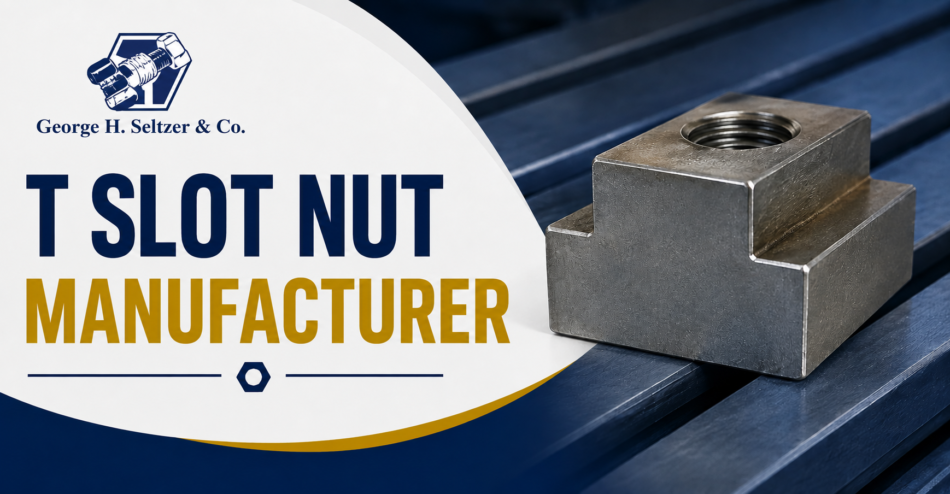
The machine table might seem simple, but the T-slots are designed to provide flexibility and secure workholding. These are used to provide a threaded attachment point for a stud through a T-slot nut to place fixtures and clamping equipment where they are needed in the job.
The nut remains captured in the table while the stud applies clamping force from above. For shops sourcing dependable components for this setup, the experience and specifications offered by a T Slot Nut Manufacturer matter just as much as the basic thread size.
The Basic Role of a T-Slot Nut
A T-slot nut is made specifically for the T-shaped channels found in machine tool tables. Its lower profile fits into the wider section of the channel, while the upper portion sits within the narrower opening. This shape lets the nut move along the slot while preventing it from simply lifting out of the table.
A stud is threaded into the nut from above. The stud can then be used with a fixture, clamp, or other workholding component to hold the machining setup in place.
It is a straightforward arrangement, but that simplicity is part of its value. The fastening point can be repositioned without drilling additional holes or permanently altering the machine table.
Why Workholding Benefits from This Design
Machining rarely involves one standard workpiece. Parts differ in size, shape, and the locations where clamping can be safely applied. A fixed mounting system would limit those possibilities.
T-slot workholding solves much of that problem by allowing fastening points to move along the table channels. The operator can position the T-slot nut where it is needed, install the stud, and arrange the clamping hardware around the workpiece.
The nut itself is retained inside the channel. Once the stud and clamping hardware are tightened, the resulting connection holds the workholding arrangement against the machine table.
For repetitive machining, this flexibility can save considerable setup time. For one-off or prototype work, it can be even more useful because the fixture arrangement may change from one part to the next.
Construction Matters
Not every fastening nut is suited to machine-table workholding. The component needs to withstand repeated mechanical loading and maintain its intended dimensions.
ZIP Brand T-Slot Nuts from George H. Seltzer & Co. are machined from cold-finished steel bar stock and case-hardened. These manufacturing details are significant because the nut is not merely a threaded piece of hardware. It has a specific shape that must fit within a machine-table slot and a surface that must withstand repeated use.
Case hardening provides a hardened exterior, while the underlying steel provides the body of the component. For workholding hardware that may be installed and repositioned through numerous setups, that combination is well suited to the application.
Thread Size is Only the Starting Point
It is tempting to select a T-slot nut based only on its thread. That can lead to an incorrect choice.
ZIP’s inch-size T-slot nut range includes thread configurations such as 3/8″-16, 1/2″-13, 5/8″-11, 3/4″-10, 7/8″-9, 1″-8, and 1-1/4″. The correct thread must correspond with the stud being used, but the nut also has to fit the machine table itself.
The thread determines how the stud connects to the nut. The external dimensions determine how the nut sits within the T-slot. Both sides of that equation have to work.
Pay Attention to the Complete Dimensions
The ZIP catalog provides several measurements for its T-slot nuts, including neck size for slots, bottom width, first-step height, length, and overall height.
These specifications are useful when identifying the correct component for a particular machine table. The neck size, for instance, needs to correspond with the slot opening. The bottom width and other dimensions determine how the nut sits within the wider portion of the T-slot.
One cataloged example, ZIP item 11163, uses a 5/8″-11 thread and has an 11/16-inch neck size, 1-1/8-inch bottom width, 7/16-inch first-step height, 1-1/4-inch length, and 3/4-inch overall height.
That level of detail is important when ordering replacement or additional workholding hardware. A nut that has the correct thread but the wrong physical dimensions is still the wrong nut.
Pairing T-Slot Nuts with ZIP Studs
The T-slot nut is one part of a larger fastening arrangement. ZIP T-slot nuts are intended for use with ZIP Studs, creating a matched system for machine-table workholding.
The double-ended steel studs are threaded at both ends. One end screw into the T-slot nut, while the opposite end accommodates a hex nut or flanged hex nut. This allows the stud to connect the captured nut inside the machine table with the clamping hardware above.
Using compatible components is particularly important in applications where the workholding setup needs to be assembled and adjusted repeatedly.
A Practical Choice for Variable Setups
The usefulness of T-slot nuts becomes especially apparent when a machine handles different workpieces. The operator can reposition the fastening point along the table instead of being restricted to predetermined mounting locations.
ZIP Brand T-Slot Nuts are available in several inch-size configurations, and the catalog notes that other sizes can be made available on request. This gives users more flexibility when a standard configuration does not match a particular machine-table requirement.
The key is to treat the machine table and fastening components as one system. Slot dimensions, thread size, nut profile, and stud specifications all need to correspond.
Selecting the Right T-Slot Nut
Before ordering, measure the machine-table slot and identify the required stud thread. Then compare those measurements with the manufacturer’s specifications.
Check the neck size, bottom width, length, overall height, and other relevant dimensions rather than relying on thread size alone. Material and surface treatment should also be considered when the components will see frequent use.
A properly matched T-slot nut should fit the table channel correctly and provide the threaded connection required by the workholding system.
Conclusion
T-slot nuts give machine shops a practical way to create adjustable fastening points within machine tool tables. Their captured design allows workholding components to be positioned along the table while a compatible stud provides the connection needed for clamping. ZIP Brand T-Slot Nuts from George H. Seltzer & Co. are machined from cold-finished steel bar stock, case-hardened, and offered in multiple inch-size configurations. When evaluating T Slot Nuts Manufacturers, the most useful comparison is based on complete dimensional specifications, material, construction, thread compatibility, and suitability for the intended machine-table application.