 WhatsApp Us Now
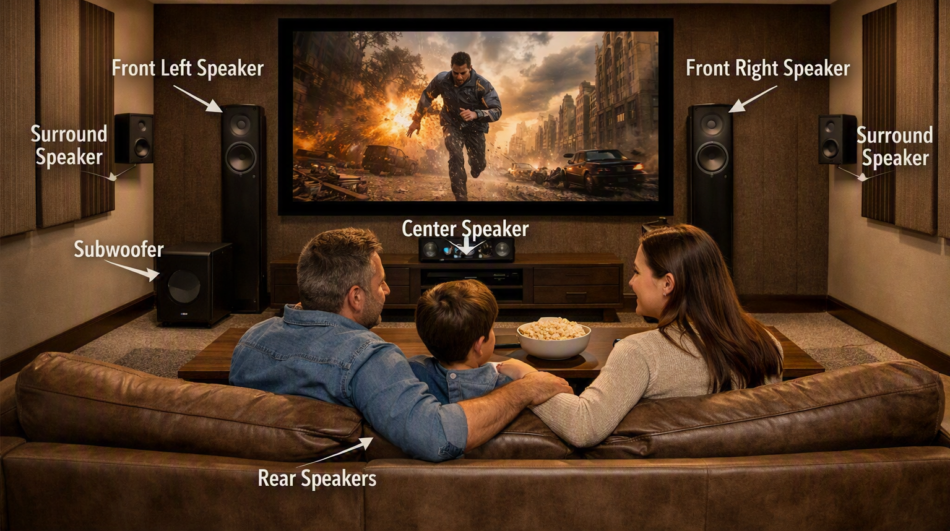
Speaker placement has a major effect on how clearly you hear dialogue, music, and sound effects. When planning Home Theatre Solutions in Dubai, speaker position should be considered along with the room size, seating arrangement, screen location, and wall shape. Good placement can help create balanced sound without making the system unnecessarily complicated.
Start With the Main Listening Position
The first step is to decide where people will normally sit. This is called the main listening position. Speakers should be arranged around this area rather than simply placed wherever there is free space.
The center of the seating area is usually a useful reference point. Once this position is known, the front, side, and rear speakers can be placed at suitable distances and angles.
Position the Center Speaker Carefully
The center speaker is important because much of the movie dialogue comes through it. It should be placed close to the middle of the screen.
For a TV, the center speaker can usually sit directly below or above the screen. With a projector and screen, it may be possible to place the speaker behind an acoustically transparent screen.
The speaker should face the listeners rather than pointing toward the floor or ceiling. Keeping it near ear level can also help make voices sound more natural.
Place the Front Left and Right Speakers
The front left and right speakers should be positioned on both sides of the screen. They should be at a similar distance from the main listening position.
Try to create a balanced triangle between the two front speakers and the main seating position. This helps sound move naturally across the front of the room.
The speakers can also be angled slightly toward the listeners. This is known as toe-in and can improve the focus of the sound.
Position Surround Speakers at the Sides
Surround speakers help create sounds that appear to come from around the listener. They are commonly placed to the left and right sides of the seating area.
The exact height depends on the room and speaker type. In many setups, surround speakers are placed somewhat above seated ear level. They should not be aimed directly into one person’s ears at very close range.
If there are several seats, try to position the speakers so that sound reaches the whole seating area reasonably evenly.
Place Rear Speakers Behind the Seating
If the system includes rear surround speakers, they can be placed behind the main seating area. Their position should be balanced from left to right.
Avoid placing one rear speaker much closer to the seating area than the other. Uneven distances can make one side of the sound field seem stronger.
The room layout should always be considered because a wall, doorway, or piece of furniture may limit the available space.
Where Should the Subwoofer Go?
The subwoofer produces low-frequency sounds such as deep music notes and movie effects. Unlike regular speakers, it does not always need to be placed directly in front of the listener.
A subwoofer can often work well near the front of the room, but the best position depends on the room. Walls and corners can increase bass, while some areas may produce weak or uneven bass.
Moving the subwoofer to different positions and listening from the main seating area can help identify a more suitable location.
Consider Speaker Height
Speaker height is another important part of placement. Front speakers are generally most effective when their sound is directed toward the listeners.
Surround speakers can be positioned higher, depending on the system and room design. Ceiling speakers used for overhead effects should be placed according to the audio system’s layout rather than simply being installed in any available ceiling space.
The goal is to make the sound feel natural and connected to what is happening on screen.
Keep the Room Balanced
Furniture and room surfaces can affect sound. Large empty walls may reflect sound, while carpets, curtains, sofas, and other soft materials can absorb some sound.
Try to keep the speaker arrangement reasonably symmetrical around the main listening position. Avoid blocking speakers with large furniture or placing objects directly in front of them.
Even small changes in speaker angle or distance can sometimes improve the listening experience.
Check the Speaker Settings
After placing the speakers, the audio receiver or processor may need to be adjusted. Many systems include automatic room calibration that measures speaker distance, volume, and other settings.
Manual adjustments may also be useful when the room has an unusual shape or multiple seating areas. Speaker placement should be completed before final calibration so the system is adjusted to the actual layout.
Room Size Matters
There is no single speaker arrangement that works perfectly for every room. A small room may need a different setup from a large dedicated theatre room.
Before installing speakers, consider the room dimensions, seating position, screen size, ceiling height, doors, windows, and furniture. Planning these details together can make the final setup cleaner and easier to use.
Good speaker positioning is one of the simplest ways to improve a home cinema listening experience. Whether the room is small or large, Home Theatre Solutions in Dubai should take speaker location, seating position, room layout, and sound balance into account.
