 WhatsApp Us Now
Electronic devices are becoming more compact, powerful, and connected, which places greater demands on the printed circuit boards (PCBs) inside them. From consumer electronics to industrial equipment, a PCB must provide reliable connections between numerous components and circuits. Even a small manufacturing defect can affect the performance of the final product. For this reason, effective testing has become an important part of maintaining quality and efficiency in modern electronics manufacturing.
Why PCB Quality Matters in Modern Manufacturing
A printed circuit board contains components, solder joints, conductive paths, and electrical connections that must work together correctly. A problem with any of these elements can lead to performance issues, product failures, or costly rework. Testing gives manufacturers an opportunity to identify potential problems before boards move to later production stages. It also helps production teams maintain consistent standards across different batches, which becomes increasingly important as manufacturing volumes and product complexity grow.
Challenges That Can Affect PCB Performance
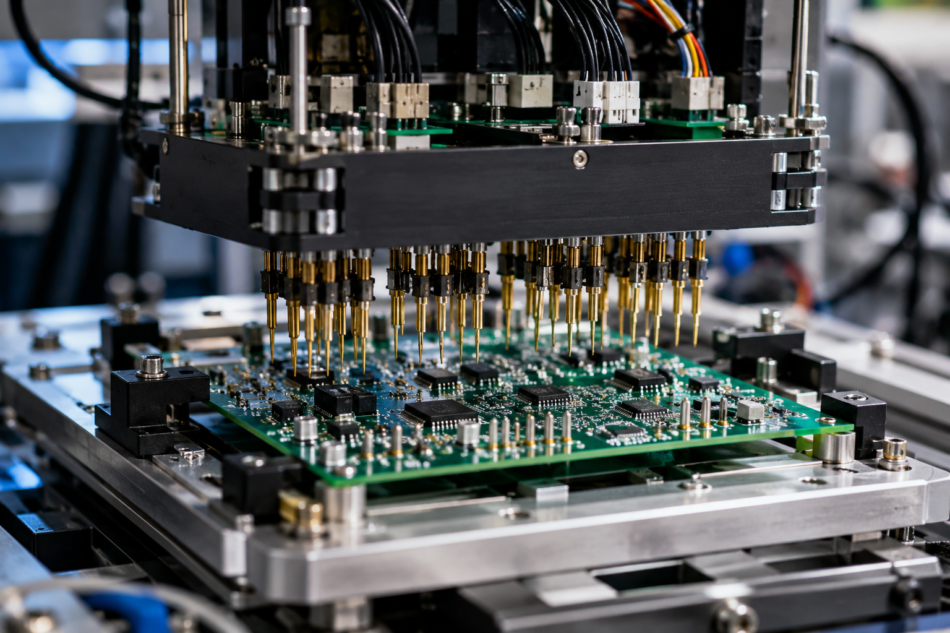
PCB manufacturing can involve several challenges, particularly when boards contain densely positioned components and complex electrical connections. Problems such as incorrect component placement, soldering defects, open circuits, short circuits, and faulty connections may not always be visible during a basic inspection. In-circuit test fixtures provide controlled access to specific test points on a board, allowing manufacturers to check components and electrical connections through a consistent testing process. This can make repeated testing more practical while helping production teams identify potential issues earlier.
Testing Methods Used During Production
There is no single testing method that works for every PCB manufacturing environment. Visual inspection can help identify obvious physical problems, while automated optical inspection can examine component placement and solder joints. Functional testing determines whether a completed board performs according to its intended requirements, while electrical testing can provide more detailed information about individual components and connections. Manufacturers can combine these methods according to their PCB design, production volume, testing requirements, and desired level of quality control.
How Modern Testing Improves Production Accuracy
Testing becomes especially important when manufacturers need to evaluate large numbers of similar boards. A repeatable testing setup can help position each PCB consistently and maintain reliable contact with designated test points. This reduces variations between individual tests and can make production checks more efficient. Depending on the manufacturing environment, a structured testing process can provide several practical benefits:
- More consistent testing across production batches
- Faster identification of potential defects
- Reduced dependence on manual inspection
- Better control over production quality
- Easier troubleshooting when recurring issues appear
These advantages can help manufacturers maintain a smoother production workflow without compromising the quality of individual boards.
Factors to Consider When Selecting a Testing Solution
Choosing a testing solution requires consideration of both the PCB design and the manufacturing environment. Board dimensions, test-point locations, component density, production volume, testing speed, and fixture durability can all influence the right approach. Manufacturers should also consider how easily the solution can adapt if a PCB design changes in the future. For specialized requirements, working with an experienced PCBA test fixtures manufacturer can help businesses develop a solution that matches their board design, testing objectives, production workflow, and expected usage.
Benefits of Consistent PCB Quality Control
A reliable quality-control process can help manufacturers detect defects before they become more expensive problems. Finding an issue early can reduce rework, prevent defective boards from moving through additional production stages, and save valuable production time. Testing results can also provide useful information about recurring manufacturing problems. For example, repeated failures may indicate the need to review soldering processes, component placement, assembly procedures, or other parts of the production workflow. This makes testing useful not only for checking individual boards but also for improving manufacturing processes.
Building a More Reliable Manufacturing Process
PCB testing should ideally be part of the manufacturing workflow rather than something performed only at the end. Combining inspection, electrical testing, and appropriate test equipment allows manufacturers to identify different types of problems at different stages. As electronic products continue to evolve, manufacturers also need testing processes that can accommodate more complex designs and changing production requirements. A flexible approach can help businesses maintain consistent standards while improving efficiency and reducing avoidable production issues.
Conclusion
Reliable PCB testing plays an important role in modern electronics manufacturing. It helps manufacturers identify defects, maintain consistent production quality, and reduce unnecessary rework. By selecting suitable testing methods and integrating them into the manufacturing process, businesses can create a more controlled production environment. As PCB designs become increasingly sophisticated, effective testing will remain an important factor in producing reliable electronic products efficiently.


