 WhatsApp Us Now
Creating tables and storing records is only one part of database design. Understanding business requirements, forming relationships, preventing duplication and preparing for change require a lot of effort. Without quickly finding and fixing mistakes, miscalculations can be hard to trace.
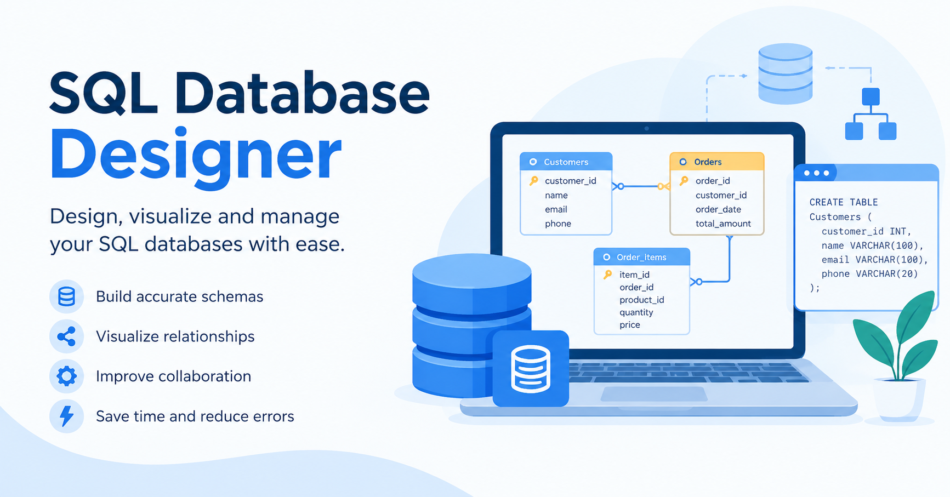
A well-structured visual approach makes it easy to discuss, review and refine database planning before development begins. A SQL database designer is advantageous at this point.
Turning Requirements Into a Clear Structure
Data modeling starts with identifying the information in the application and how records relate to one another. A SQL database designer helps convert project needs into clear tables, columns, keys, and relationships for stakeholders.
Defining Entities and Relationships
For instance, customers, orders, products and payments may require a retail application. Seeing the connections makes it easier to identify primary and foreign keys and determine whether a relationship should be one-to-one or one-to-many. Teams can also spot missing entities before implementation, helping avoid costly rework when developers start writing queries.
Improving Collaboration During Design
A database design tool gives developers, analysts, and project managers a common reference to visualize the physical database, rather than relying on written descriptions that can be misunderstood.
Making Reviews More Productive
Visual diagrams make it easier for a reviewer to discuss naming conventions, table responsibilities, and data ownership. A database design tool makes it easy to assess proposed changes because it shows table relationships.
Documenting Decisions Consistently
Well-organized documentation is especially useful when projects change hands. A robust database design tool helps teams maintain a clear understanding of the intended schema and avoid repeating explanations during on boarding.
Reducing Manual Work and Design Errors
Various SQL data modeling tools let teams create structured diagrams, manage schema definitions and produce SQL scripts. These features reduce repetitive copying between planning and implementation documents.
Checking Schema Consistency
Depending on the application, SQL data modeling tools may validate naming conventions, data types, missing keys, and inconsistent relationships. Automated checks are meant to supplement, and not replace, technical review.
Handling Updates More Carefully
SQL data modeling tools can make it easier to compare versions or adjust diagrams as needs change. Migrations must still be assessed with care, especially if they impact existing production data and require coordinated backups, rollback procedures or downtime.
Planning for Growth and Maintenance
Good SQL data modeling accounts for the future beyond the application’s first release. It anticipates reporting requirements, business-rule changes, and a clear structure as new features are introduced.
Balancing Clarity and Performance
Effective SQL data modeling prevents duplication through demoralization options that are fully justified by performance needs. Place equal emphasis on indexing and query patterns, along with the visual schema.
Keeping Implementation Aligned With the Plan
A SQL database designer can serve as a reference while you develop, allowing you to compare actual tables with approved tables. This helps detect unexpected changes before they impact the whole application.
Continual, collaborative design reviews also highlight crucial characteristics. It is not a replacement for a SQL database designer, testing or planning for the actual migration of code and data or communicating with team members. It provides a stronger foundation for these activities.
Conclusion
The decisions involved in any database projects should always be visible, explained, and changeable to prevent misinterpretation. A SQL database designer can help with this by providing additional clarity to the teams tasked with developing them and supporting future evolution.
Frequently Asked Questions
Are visual schema diagrams open to novices?
Yes, some people learn types by seeing images, but learning keys, relationships and SQL is necessary. It enables you to become more reliable when making design decisions.
Should teams develop databases before applications?
Typically, early modeling helps clarify requirements. In an iterative project, though, schema can evolve over the course of application development as additional information comes to light.
Does it make sense to use visual models on databases that are already in existence?
Success through reverse engineering in developing understanding of existing systems and structures, and of those inherited. It can also provide clues for recording or reorganizing.


