 WhatsApp Us Now

Hair loss is more than a cosmetic concern for many people. It can affect personal confidence, appearance, and social interactions. Whether it develops because of genetics, hormonal changes, aging, or other medical conditions, progressive hair thinning can become frustrating when conventional hair care products fail to deliver noticeable improvements.
Fortunately, modern hair restoration procedures provide an effective option for people experiencing permanent hair loss. A hair transplant in Lahore allows suitable candidates to restore hair in thinning or bald areas by transferring healthy hair follicles from one part of the scalp to another.
Lahore has become an important destination for hair restoration treatments in Pakistan. Patients can explore different procedures, including Follicular Unit Extraction (FUE), Follicular Unit Transplantation (FUT), and Direct Hair Implantation (DHI). These techniques are designed to improve hair coverage while maintaining a natural appearance.
However, choosing the right procedure requires more than comparing clinic prices. Understanding the cause of hair loss, evaluating donor hair, selecting a qualified surgeon, and following appropriate aftercare instructions are all important parts of successful treatment.
This guide explains the complete hair transplantation process, including available techniques, treatment costs, eligibility, graft requirements, recovery, potential complications, and expected results.
What Is Hair Transplantation?
Hair transplantation is a surgical hair restoration procedure in which healthy hair follicles are transferred from a donor area to a recipient area affected by hair loss.
The back and sides of the scalp are commonly selected as donor regions because their follicles are generally more resistant to the hormonal effects associated with hereditary pattern baldness.
During the procedure, a surgeon carefully extracts follicular units and implants them into areas where hair density has decreased.
Unlike temporary cosmetic solutions, hair transplantation relocates living hair follicles capable of producing new hair growth.
The procedure can be used for several purposes, including:
- Restoring a receding hairline.
- Improving frontal hair density.
- Treating male pattern baldness.
- Addressing selected cases of female pattern hair loss.
- Improving crown coverage.
- Restoring hair in certain scarred areas.
- Reconstructing eyebrows in suitable candidates.
- Improving beard density.
The ultimate goal is to create a natural-looking result that complements the patient’s facial features and existing hair.
Why Do People Consider Hair Transplant in Lahore?
Lahore offers a range of medical and cosmetic services, including specialized hair restoration treatments. Patients from different regions of Pakistan visit the city to explore surgical and non-surgical solutions for hair loss.
Some important considerations when choosing Lahore include the availability of different treatment approaches, access to medical consultations, and the opportunity to compare qualified providers.
Access to Hair Restoration Specialists
Patients can consult medical professionals working in dermatology, plastic surgery, and hair restoration.
Before selecting a provider, it is important to verify the surgeon’s medical qualifications, registration, and specific experience in hair transplantation.
Different Surgical Techniques
Depending on individual requirements, patients may be offered FUE, FUT, or DHI-based implantation.
Each approach has advantages and limitations, making professional assessment essential.
Individualized Hair Restoration Plans
Hair loss patterns are not identical. A patient with a receding hairline may require a different treatment plan from someone experiencing extensive crown baldness.
A detailed examination helps determine the most suitable approach.
Accessibility for Patients Across Pakistan
Lahore is connected to major cities, making it a convenient treatment destination for patients traveling from Multan, Islamabad, Faisalabad, Sialkot, and other areas.
Common Types of Hair Loss Treated Through Hair Transplantation
Understanding the type of hair loss is essential before considering surgery.
1. Male Pattern Baldness
Male pattern baldness is a hereditary condition that generally causes gradual hair loss around the temples, frontal hairline, and crown.
Hair transplantation can restore selected areas using follicles taken from suitable donor regions.
2. Female Pattern Hair Loss
Female pattern hair loss commonly appears as diffuse thinning around the central scalp or widening of the hair part.
Some women may qualify for transplantation, especially when thinning is localized and donor hair is adequate. However, diffuse hair loss requires careful medical evaluation.
3. Receding Hairline
A receding hairline can develop gradually and change the appearance of the forehead and facial proportions.
Hair transplantation may help restore frontal coverage and create a more balanced hairline.
4. Crown Baldness
Crown hair loss often develops in a circular pattern at the back or upper portion of the scalp.
Treatment can improve coverage, although the crown may require considerable graft numbers because of its size and natural hair-growth direction.
5. Scar-Related Hair Loss
Certain scars caused by injuries, burns, or previous surgeries may result in permanent hair loss.
Selected patients may benefit from hair transplantation after the scar tissue and blood supply have been evaluated.
Modern Hair Transplant Techniques in Lahore
Hair restoration technology has developed considerably over the years. Today, several techniques are available, each offering a different approach to follicle extraction and implantation.
FUE Hair Transplant
Follicular Unit Extraction is a minimally invasive hair transplantation method involving the removal of individual follicular units from the donor area.
Specialized micro-punch instruments are used to extract follicles without removing a continuous strip of scalp.
FUE Procedure
The treatment begins with an examination of the scalp and identification of the donor area. Local anesthesia is administered before extraction.
Individual follicular units are then removed and examined under magnification. The surgeon prepares the recipient area and places the extracted grafts according to the desired hairline and growth direction.
Advantages of FUE
- No long linear donor scar.
- Individual follicle harvesting.
- Small extraction scars.
- Suitable for many hair restoration cases.
- Generally less donor-area tightness than FUT.
- Can accommodate selected short hairstyles.
Limitations of FUE
- Requires careful harvesting to prevent donor thinning.
- Can leave visible small scars.
- Large sessions may require considerable time.
- Results depend heavily on surgical planning and graft handling.
FUT Hair Transplant
Follicular Unit Transplantation is a surgical technique in which a strip of hair-bearing scalp is removed from the donor region.
The strip is carefully divided into individual follicular units before implantation.
Advantages of FUT
- Can provide many grafts in selected cases.
- Does not always require complete donor-area shaving.
- May be appropriate for certain patients requiring extensive restoration.
- Allows careful microscopic graft preparation.
Limitations of FUT
- Leaves a linear donor scar.
- Requires surgical closure of the donor wound.
- May involve more discomfort during recovery.
- Can limit very short hairstyles because of scar visibility.
DHI Hair Transplant
Direct Hair Implantation is an implantation approach involving a specialized implanter pen.
The extracted follicles are loaded into the device and placed directly into the recipient area.
Advantages of DHI
- Controlled follicle placement.
- Allows management of implantation direction and angle.
- Useful for selected hairline restoration cases.
- Can support detailed graft distribution.
DHI should not automatically be considered superior to FUE or FUT. It is important to remember that DHI primarily describes an implantation method, and its success depends on the overall surgical process.
How to Select the Right Hair Transplant Method
Patients often ask which technique provides the best results.
The answer depends on the patient’s donor hair, scalp condition, hair loss pattern, and treatment expectations.
| Comparison | FUE | FUT | DHI |
|---|---|---|---|
| Extraction Method | Individual follicles | Scalp strip | Usually individual follicles |
| Implantation | Recipient sites and placement | Recipient sites and placement | Implanter pen |
| Donor Scarring | Small individual scars | Linear scar | Depends on extraction method |
| Recovery | Generally straightforward | May involve more donor discomfort | Depends on extraction method |
| Best Application | Various restoration cases | Selected larger sessions | Selected precise implantation cases |
A professional surgeon should explain the differences and recommend the technique that best suits the patient’s circumstances.
Who Is Eligible for Hair Transplant Surgery?
Hair transplantation is suitable for individuals with particular types of hair loss and adequate donor hair.
A patient may be a potential candidate if they:
- Experience hereditary pattern baldness.
- Have a receding frontal hairline.
- Have sufficient healthy donor follicles.
- Have a suitable scalp condition.
- Have stable or appropriately evaluated hair loss.
- Are medically fit for surgery.
- Understand the limitations of the procedure.
Is Hair Transplant Suitable for Young Patients?
Younger patients may develop progressive hair loss after surgery.
If transplantation is performed too early without considering future hair loss, the transplanted region may remain while surrounding natural hair disappears.
A surgeon may recommend delaying surgery or stabilizing hair loss through appropriate medical treatment.
Can Older People Get Hair Transplants?
Age alone does not determine eligibility. Older individuals may qualify if they have sufficient donor hair, suitable general health, and realistic expectations.
The final decision should be based on medical assessment.
Complete Hair Transplant Procedure
A hair transplant involves several carefully planned stages. Each stage contributes to the overall outcome.
Initial Medical Consultation
The first step is a consultation with a qualified hair restoration surgeon.
The doctor examines the scalp, reviews the patient’s medical history, and identifies the pattern of hair loss.
The consultation may include:
- Assessment of donor hair density.
- Examination of the recipient area.
- Evaluation of hair thickness.
- Review of previous treatments.
- Discussion of medical conditions.
- Estimation of graft requirements.
Hairline Design
The surgeon plans a hairline that complements the patient’s facial structure and age.
A natural hairline should have appropriate irregularity and direction rather than appearing excessively straight or artificially low.
Preparation of the Donor Area
The donor region is prepared according to the selected technique.
Local anesthesia is administered to reduce discomfort during the procedure.
Extraction of Follicular Units
Healthy follicles are extracted carefully. Their handling is important because damaged follicles may not survive transplantation.
Graft Sorting and Preservation
The extracted follicles are separated and organized according to their natural composition.
They are preserved under appropriate conditions until implantation.
Recipient Area Preparation
The surgeon prepares the recipient area by creating small sites or using the selected implantation method.
The angle, depth, and direction of these sites are important for natural-looking growth.
Hair Follicle Implantation
The grafts are placed into the recipient area according to the surgical plan.
Single-hair grafts may be used around the frontal hairline, while multi-hair grafts can provide density in suitable areas.
Post-Surgery Assessment
After implantation, the scalp is checked and postoperative instructions are provided.
Patients are advised about cleaning, sleeping position, medication, and restrictions on physical activities.
Hair Transplant Cost in Lahore
Hair transplant pricing in Lahore varies depending on the surgeon, clinic, procedure, and number of grafts required.
There is no universal price because treatment plans are customized according to individual hair loss patterns.
The following factors commonly influence the total cost.
Number of Grafts: Patients requiring more follicles may have higher overall treatment costs.
Treatment Technique: FUE, FUT, and DHI may have different pricing structures.
Surgeon’s Expertise: Medical qualifications and hair restoration experience can influence professional fees.
Clinic Facilities: Surgical equipment, operating facilities, medical staff, and safety standards contribute to the overall cost.
Treatment Complexity: Patients with extensive baldness or previous transplant procedures may require more complex planning.
Postoperative Care: Medication, follow-up consultations, and additional treatments may or may not be included in the package.
How to Get an Accurate Hair Transplant Quotation
A reliable quotation should be based on a physical scalp examination rather than a generic online price.
During consultation, ask the clinic:
- How many grafts are recommended?
- Which technique will be used?
- Who will perform the surgical procedure?
- What is included in the total price?
- Are follow-up appointments included?
- What additional costs might arise?
- What happens if the result is below expectations?
Avoid making a decision based entirely on low-cost promotional offers.
How Many Grafts Are Needed for Hair Restoration?
Graft requirements depend on the extent of hair loss, donor capacity, hair thickness, and desired density.
The following table provides approximate planning estimates.
| Hair Loss Area | Estimated Grafts |
|---|---|
| Small Hairline Correction | 700–1,200 |
| Temple Restoration | 800–1,500 |
| Frontal Hairline | 1,200–2,000 |
| Frontal and Mid-Scalp | 2,000–3,000 |
| Crown Restoration | 1,000–2,000 |
| Extensive Hair Loss | 3,000–5,000+ |
These are illustrative ranges rather than guaranteed requirements.
A graft represents a natural follicular unit and may contain multiple hairs. Consequently, graft numbers and individual hair counts should not be confused.
The surgeon should also consider future hair loss and preserve enough donor follicles for potential future needs.
How Long Does Hair Transplant Surgery Take?
The duration depends on the number of grafts, surgical method, and complexity of the treatment.
Many procedures take approximately four to eight hours, although larger or more complicated sessions may take longer.
Some patients may require more than one session to achieve their desired coverage.
The surgeon should explain the expected duration during consultation.
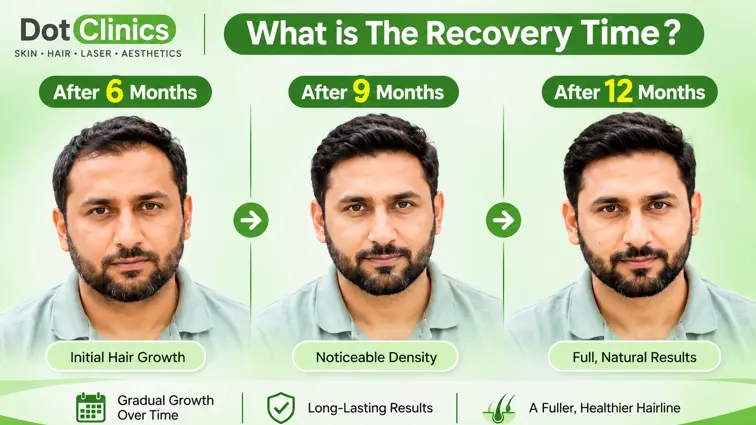
Hair Transplant Recovery: A Month-by-Month Guide
Hair restoration is a gradual process. Patients should understand that visible results develop over several months.
Days 1–3
Mild redness, swelling, and tenderness may occur. Small crusts can develop around the implanted follicles.
Days 4–7
The scalp gradually begins healing. Patients should carefully follow the prescribed washing routine.
Weeks 2–4
Transplanted hair shafts commonly shed. This is known as shock loss or postoperative shedding.
The follicles generally remain beneath the skin and may begin producing new hair later.
Months 2–3
The scalp continues recovering. Some patients may experience a period when visible hair growth appears limited.
Months 3–4
Early new hair growth may become noticeable.
Months 5–6
Hair begins to develop more visibly, although density may still be incomplete.
Months 7–9
More substantial improvement may become apparent.
Months 10–12
Many patients can evaluate a large part of their cosmetic outcome.
Months 12–18
Hair growth may continue maturing, especially in the crown region.
Individual recovery and growth rates vary.
Benefits of Hair Transplantation
Hair transplantation offers several advantages for suitable candidates.
Natural Hair Restoration
Transplanted follicles produce hair that can blend with the surrounding natural hair when implantation is performed correctly.
Long-Term Improvement
Hair follicles taken from appropriate donor areas can provide long-lasting results.
Improved Hairline Shape
The procedure can restore frontal coverage and improve the appearance of a receding hairline.
Better Styling Options
Once growth has matured, transplanted hair can generally be washed, trimmed, and styled like natural hair.
Increased Self-Confidence
Many patients pursue hair restoration to feel more comfortable with their appearance.
Personalized Coverage
The treatment can be planned around the patient’s individual hair loss pattern and donor capacity.
Possible Side Effects and Risks
Although hair transplantation is commonly performed, it is still surgery and carries potential complications.
Temporary side effects can include:
- Mild scalp pain.
- Swelling around the forehead.
- Redness.
- Itching.
- Small scabs.
- Temporary numbness.
- Shock loss.
- Minor bleeding.
Less common complications may include:
- Infection.
- Excessive bleeding.
- Poor graft survival.
- Visible scars.
- Unnatural hairline design.
- Donor-area overharvesting.
- Uneven hair growth.
- Persistent sensory changes.
Patients should discuss all potential risks with their surgeon before proceeding.
Hair Transplant Aftercare: Essential Instructions
Aftercare helps protect transplanted follicles and supports proper healing.
Patients should follow their surgeon’s specific instructions.
Protect the Recipient Area: Avoid scratching, rubbing, or applying unnecessary pressure to the transplanted scalp.
Follow Washing Instructions: Use the recommended washing technique and products.
Avoid Heavy Exercise: Strenuous activities should be restricted for the period recommended by the surgeon.
Protect Against Sun Exposure: Avoid prolonged direct sunlight during the initial healing period.
Take Prescribed Medication: Use medications according to the doctor’s instructions.
Avoid Smoking: Discuss smoking cessation because smoking can negatively affect wound healing.
Attend Follow-Up Appointments: Regular assessment helps the surgeon monitor healing and hair growth.
Seek medical attention if you develop fever, worsening pain, spreading redness, or unusual discharge.
Hair Transplant vs. PRP: Which Is Better?
PRP and hair transplantation are different treatments.
PRP uses a concentrated platelet component obtained from the patient’s own blood. It is injected into the scalp and may help improve hair density in selected patients.
Hair transplantation involves surgically moving hair follicles from a donor area to a recipient area.
| Feature | Hair Transplant | PRP Therapy |
|---|---|---|
| Procedure | Surgical | Non-surgical injection |
| Donor Hair | Required | Not required |
| Main Objective | Restore follicles in bald areas | Support existing hair growth |
| Treatment Sessions | Often one or more surgical sessions | Usually multiple sessions |
| Results | Long-lasting transplanted hair | Variable and may require maintenance |
| Completely Bald Areas | May be suitable with adequate donor hair | Generally not effective |
The treatments may sometimes be used together as part of a broader hair management plan, depending on medical assessment.
Can Hair Transplant Results Last a Lifetime?
Transplanted hair can provide long-lasting growth, particularly when follicles are taken from suitable donor areas.
However, a hair transplant does not stop the underlying progression of hereditary hair loss.
Natural hair surrounding the transplanted follicles may continue thinning over time.
For this reason, patients should discuss long-term maintenance with their dermatologist or surgeon.
Medical treatments such as minoxidil or finasteride may be considered for eligible patients after reviewing their suitability and potential adverse effects.
Important Questions to Ask Before Choosing a Hair Transplant Clinic
Before selecting a hair restoration provider in Lahore, patients should obtain clear answers to important medical and practical questions.
- Is the surgeon appropriately qualified and registered?
- How much experience does the surgeon have with hair transplantation?
- Who performs extraction and implantation?
- How is donor hair density assessed?
- What is the estimated graft survival rate, and how is it measured?
- Can I see genuine results from comparable patients?
- What complications are possible?
- What postoperative care is provided?
- Are follow-up visits included?
- What is the long-term plan for progressive hair loss?
A trustworthy clinic should be transparent about surgical limitations and should never promise guaranteed density or completely risk-free treatment.
Frequently Asked Questions About Hair Transplant in Lahore
1. What is the best hair transplant technique in Lahore?
FUE, FUT, and DHI are commonly used approaches. The appropriate technique depends on donor hair quality, baldness pattern, surgical requirements, and the surgeon’s expertise.
2. How much does a hair transplant cost in Lahore?
The price varies according to graft requirements, surgical technique, surgeon’s experience, and clinic facilities. A personalized consultation is necessary for an accurate quotation.
3. Is hair transplantation a painful procedure?
The procedure is generally performed under local anesthesia. Patients may experience mild discomfort during anesthesia administration and some soreness after surgery.
4. How many grafts are required for a receding hairline?
A receding hairline may require approximately 1,000–1,800 grafts, depending on its severity, desired density, and donor hair availability.
5. Can I undergo a hair transplant without shaving my head?
Selected patients may qualify for partially shaved or unshaven FUE. Suitability depends on graft requirements and surgical planning.
6. When can I return to normal activities?
Many patients resume desk-based work within several days. Strenuous exercise and activities involving scalp pressure may require longer restrictions.
7. Will transplanted hair look natural?
Natural-looking results are possible when the surgeon carefully plans the hairline, graft distribution, implantation direction, and density.
8. Does transplanted hair fall out after surgery?
The transplanted hair shafts commonly shed during the initial weeks. This is an expected stage of the hair growth cycle and does not necessarily mean the follicles have been lost.
9. Can I undergo another hair transplant?
Some patients may qualify for additional procedures if sufficient donor hair remains and their scalp condition is suitable.
10. Can women get hair transplants?
Yes. Women with appropriate hair loss patterns and sufficient donor hair may qualify. A thorough diagnosis is particularly important because female hair loss can have several underlying causes.
11. Is hair transplantation safe for people with diabetes?
Some patients with diabetes can undergo surgery if their condition is appropriately managed. The surgeon should assess blood sugar control, wound-healing risks, and general medical fitness.
12. Can hair transplantation treat a completely bald scalp?
It may improve coverage in selected individuals, but available donor hair limits the final density. Complete restoration is not always possible.
13. Does hair transplantation leave scars?
Yes. FUE generally produces small individual scars, while FUT produces a linear scar. Their visibility varies.
14. How long do final results take?
Many patients see substantial improvement within 9–12 months, although final maturation may take 12–18 months.
15. Is PRP necessary after a hair transplant?
PRP is not compulsory after hair transplantation. Its use depends on individual circumstances and the treating specialist’s recommendations.
Final Thoughts
Hair loss can be challenging, particularly when it affects the hairline, crown, or overall scalp density. Fortunately, modern hair restoration techniques have made it possible for suitable patients to regain hair coverage through carefully planned surgical procedures.
A hair transplant in Lahore offers access to different treatment approaches, including FUE, FUT, and DHI. Each technique has specific advantages, and the right option should be selected after examining the patient’s hair loss pattern and donor area.
The most important factors in achieving a satisfactory outcome are proper diagnosis, qualified surgical care, realistic expectations, careful graft management, and consistent postoperative follow-up.
Rather than choosing a clinic based only on price or promotional offers, patients should prioritize medical qualifications, hygiene standards, surgical experience, and long-term treatment planning.
With the right medical guidance, hair transplantation can be a valuable option for restoring a natural-looking hairline and improving hair density.


