 WhatsApp Us Now
For years, many graduate students treated federal funding as a safety net. If tuition, housing, and living costs exceeded standard loan limits, Grad PLUS loans could cover the difference. That approach is about to change.
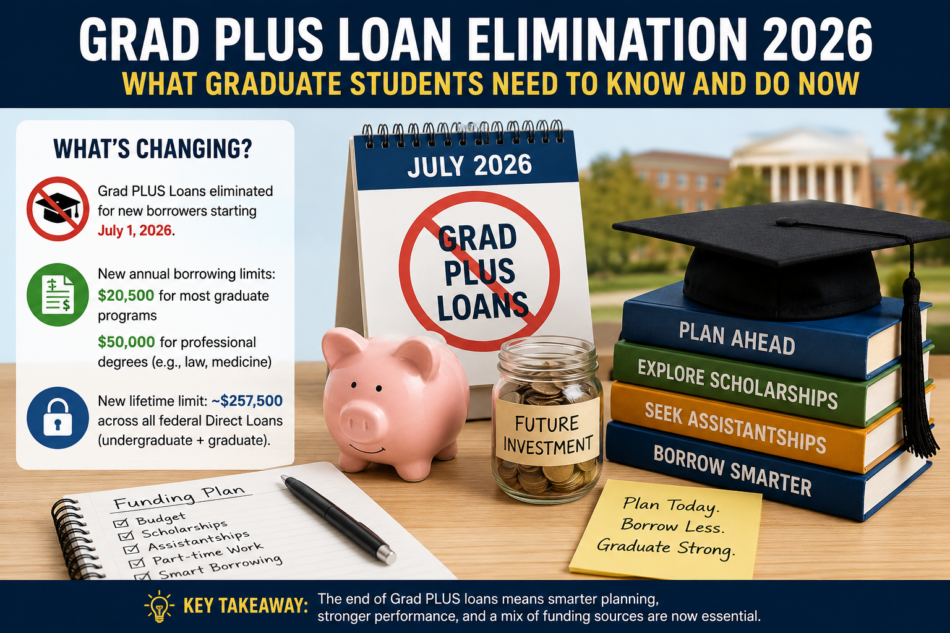
Beginning July 1, 2026, the federal government will eliminate Grad PLUS loans for new graduate and professional student borrowers. In their place comes a system built around annual and lifetime borrowing caps. The shift affects students pursuing master’s degrees, MBAs, law degrees, medical programs, and doctorates. For some, it could change where they study, how long they stay enrolled, and how they pay for their education.
The headline is simple: graduate school financing is moving from “borrow what you need” to “borrow within strict limits.”
Understanding the New Federal Loan Limits
The biggest change is the disappearance of Grad PLUS loans for new borrowers entering graduate and professional programs after July 1, 2026. Under the previous model, students could combine Direct Unsubsidized Loans with Grad PLUS funding to cover the full cost of attendance. That option is ending. Instead, borrowing will be restricted by annual and aggregate caps. Most graduate students will have access to approximately $20,500 per year through Direct Unsubsidized Loans, while designated professional programs such as law and medicine may allow up to $50,000 annually. A broader lifetime federal borrowing limit of roughly $257,500 will also apply across undergraduate and graduate studies combined.
At first glance, those figures appear substantial. The challenge becomes clear when compared with the actual cost of many programs. A top MBA can exceed $150,000 in tuition alone. Medical and law degrees often cost significantly more once living expenses are included.
The result is a funding gap that students must fill through other sources.
Why This Policy Change Matters
The elimination of Grad PLUS loans is not happening in a vacuum. Policymakers have argued that unlimited federal borrowing contributed to rising tuition costs and encouraged excessive debt accumulation. Critics of the old system point to graduates leaving school with loan balances that rival mortgage payments.
Supporters believe borrowing limits will encourage universities to control costs and push students toward more financially sustainable choices. Opponents worry the changes may reduce access for talented students from lower-income backgrounds.
Think of it like removing the overdraft feature from a bank account. The account still works, but every spending decision suddenly requires more planning. Graduate education will operate much the same way under the new rules.
Students who previously relied on federal loans to cover every expense will need to become strategic financial planners long before classes begin.
Building a New Funding Strategy
The most successful students after 2026 will likely approach funding as a mix of resources rather than a single loan solution.
Scholarships and fellowships move to the top of the priority list. Universities are already expanding merit-based and need-based awards as they prepare for reduced federal borrowing flexibility. Every dollar earned through scholarship funding is a dollar that never needs repayment.
Graduate assistantships are becoming equally important. Teaching assistant and research assistant positions often provide tuition support alongside monthly stipends. In some cases, they can dramatically reduce the need for borrowing.
Employer-sponsored education is another option gaining attention. Many companies now reimburse tuition costs for employees pursuing degrees connected to their work. For mid-career professionals, this benefit can offset a meaningful portion of educational expenses. Private loans and state-backed financing programs will likely fill part of the gap left by Grad PLUS. However, these products typically require stronger credit profiles and offer fewer borrower protections than federal loans. Students should compare terms carefully before signing any agreement.
Academic Performance Has Become a Financial Issue
One overlooked consequence of borrowing caps is their connection to academic success.
Under the old system, students who failed a course or extended their studies often had access to additional federal funding. The new limits reduce that flexibility. Every repeated class, delayed graduation date, or extra semester consumes precious borrowing capacity.
That reality makes academic support more valuable than ever. Universities offer tutoring centers, writing labs, and mentoring services designed to keep students on track. Many learners also use external resources when facing particularly difficult coursework.
For students managing complex assignments, research projects, or quantitative subjects, platforms like Expertsmind.com that connect learners with subject experts can provide additional guidance and clarification. Used appropriately as a learning resource, this type of support can help students avoid costly delays that may require extra semesters and additional borrowing.
The connection is straightforward: stronger academic performance often leads to faster completion, lower costs, and less debt.
International Students Face Additional Challenges
International students encounter a different version of the same problem.
Many already rely on family support, private lenders, scholarships, and institutional aid rather than federal loans. Even so, the Grad PLUS elimination may still affect them indirectly. Universities will be adjusting scholarship budgets, enrollment targets, and funding priorities in response to the new federal environment.
Currency fluctuations add another layer of uncertainty. A weakening home currency can increase education costs dramatically over a two- or three-year program. Since visa regulations often limit employment opportunities, international students cannot always compensate by working more hours.
As a result, detailed budgeting becomes essential. Students should request full cost-of-attendance estimates, investigate assistantship opportunities early, and evaluate financing options well before enrollment decisions are made.
The students who plan early will have far more flexibility than those who wait until tuition bills arrive.
Online Learning vs Campus Education: A Financial Decision in 2026
The Grad PLUS Loan Elimination 2026 rules may also influence how students choose to earn their degrees. For many years, students selected programs primarily based on reputation, location, and career outcomes. Now, financing is becoming an equally important factor.
Online learning vs Campus education has gained credibility among employers and universities, particularly in business, technology, education, and healthcare fields. Because fully online programs often eliminate housing, commuting, and campus-related expenses, students can reduce their total cost of attendance by thousands of dollars each year. Lower costs mean less pressure under the new federal borrowing caps.
Campus education still offers advantages that are difficult to replicate online. Research opportunities, teaching assistantships, laboratory access, networking events, and direct interaction with faculty can create valuable career opportunities. These benefits are especially important for students pursuing research-focused master’s degrees, PhDs, law, medicine, or other professional programs.
The smartest approach is not automatically choosing the cheapest option. Instead, students should compare the total return on investment. A well-structured online degree may fit comfortably within the new borrowing limits, while a campus-based program with strong assistantship support could provide greater long-term value despite higher upfront costs.
As graduate student loans become more restricted, the question is no longer simply where you want to study. Increasingly, students must ask which learning format delivers the best educational outcome without creating unnecessary debt.
A New Era of Graduate School Financing
The end of Grad PLUS loans marks one of the most significant shifts in graduate education financing in decades. Starting in 2026, borrowing limits will become a central factor in academic planning, not just a financial detail handled after admission.
Students who succeed under the new system will treat funding as part of their educational strategy from day one. They will understand their borrowing capacity, pursue scholarships aggressively, seek assistantships, manage expenses carefully, and focus on completing their degrees efficiently.
Admission to a great program will still matter. But in the post-Grad PLUS era, having a realistic financial plan may matter just as much.


