 WhatsApp Us Now
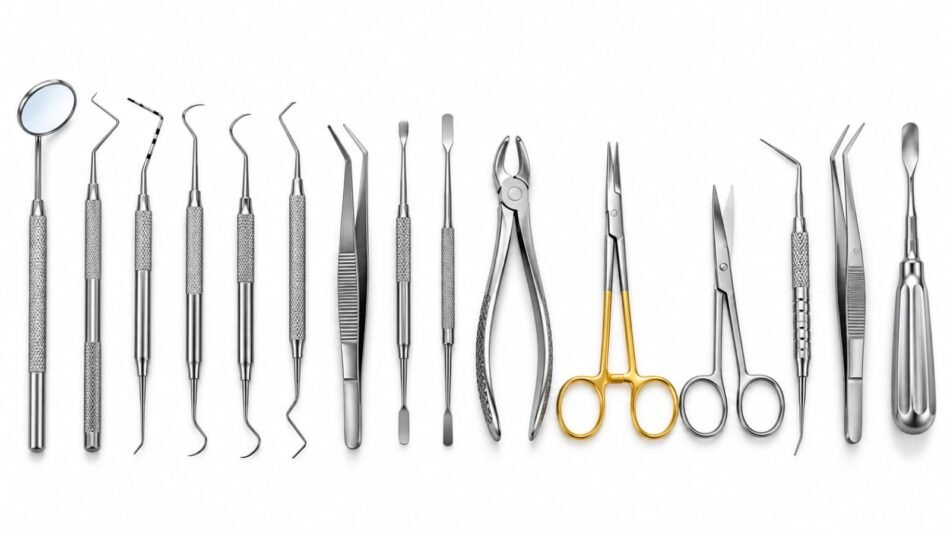
Suppose a distributor reorders a forceps that sold well last year. The catalogue number matches. The finish doesn’t, and within weeks a clinic reports spotting after sterilisation. Nothing on the invoice said the steel had changed. Most buyers of Dental instruments find that gap after the carton is open, so evaluate before the purchase order.
Specification — Steel, Finish and Sterilisation Life
Here’s the first distinction. Searches for Dental Equipments often mean chairs, handpieces and sterilisers. Hand Dental instruments such as mirrors, probes, scalers and forceps follow other checks: their performance sits in the steel, heat treatment and finish, not the photograph.
Steel Grade and Hardness
Martensitic stainless steels, the 420 family among them, are common where an edge or grip must hold; softer austenitic grades such as 304 suit parts that don’t cut. Nobody tells you that steel can change between lots, so ask for the grade by model.
Autoclave and Corrosion Resistance
Steam sterilisation typically runs at 121 °C or 134 °C, cycle after cycle. ISO 13402 covers testing hand instruments for resistance to autoclaving, corrosion and thermal exposure. Ask whether such evidence exists for your model.
The Overlooked Spec: Marking and Traceability
A maker’s mark or lot code traces a returned piece to its batch. Without one, a complaint becomes an argument over who made what.
Evaluation — Five Tests Before You Shortlist
A catalogue shows what a seller lists, not what a maker controls. Put these tests to any Dental instruments Manufacturers you shortlist.
- Material proof. Ask for the steel grade and a material test certificate per lot. “Surgical steel” with no grade is a red flag.
- Reprocessing evidence. Ask what corrosion and cycle testing exists for your model. “Autoclavable” with no conditions tells you nothing.
- Regulatory papers. Find out which licence your market requires, then check it with the authority that issued it. ISO covers a quality system, not device approval, so an ISO certificate offered instead is a red flag.
- Sample against production. Insist the production specification appears on the purchase order. A showpiece sample followed by a different bulk lot is the classic dispute.
- Packing and paperwork. Confirm sterile or non-sterile supply, packing method and who prepares export documents. Vague answers usually mean customs delays.
Payoff — Where Verified Supply Saves Money
Dental instruments that arrive documented cost less to own than cheap ones that arrive with questions.
- Because material is certified per lot, finish and hardness stay consistent across shipments (product consistency).
- With lot codes on each piece, a complaint traces to a batch instead of becoming an argument (operational reliability).
- When reprocessing evidence exists, fewer corrosion complaints reach you (risk reduction).
- Verified papers keep shipments from stalling at the border (logistics reliability).
- Written specifications make quotes comparable, protecting margin (margin protection).
Jalandhar — Why Origin Shapes Freight and Paperwork
Jalandhar in Punjab is widely associated with surgical and dental instrument making, so a buyer comparing Dental instruments Manufacturers in India will meet many names from one city. Look past the address; ask who forms, finishes and inspects. Punjab has no seaport, so export orders move by road or rail to a port, or to Delhi for air cargo. For anyone shortlisting Dental Instruments Exporters in India, settle the route and who handles each leg before the purchase order. Light orders often suit air freight, yet large lots may cost less by sea; get lead times written.
About Us
Our work dates from 1967, and we’re ISO-certified. You’ll find us at 1382/1046, Raja Garden, Basti Danishmandan, near Vishal Tools, Jalandhar. ISO speaks to our quality system; for device-level papers, ask what applies to your instrument.
Send Us the Instrument List
Our MOQ and response time depend on the instrument range and quantity, so we confirm both against your enquiry rather than quote one figure for everything. Send the instrument list, quantity per item, steel and finish preference, target market, regulatory papers needed, labelling and packing requirements, destination and any sampling wish. Comparing us with other Dental Instruments Suppliers? Request identical material and reprocessing evidence from every one. And if you resell, tell us your labelling.
Conclusion
Catalogues look alike; maker records don’t. When Dental instruments Manufacturers share material proof, reprocessing evidence and traceable lots, you can build a range on them. As more buyers ask for paperwork upfront, suppliers without it will struggle to hold shelf space. Put your questions in the first enquiry, not the complaint.
FAQs
Which steel suits Dental instruments that are autoclaved daily?
It depends on the instrument. Cutting and gripping parts often use hardenable martensitic grades; other parts, austenitic ones. Ask the maker for the grade per model and its corrosion evidence.
Do Dental Instruments Suppliers ship sterile or non-sterile?
Many ship non-sterile for the buyer to reprocess. Dental Instruments Suppliers offering sterile packs should show the validation. Confirm what your market expects before ordering.
What export papers should Dental Instruments Exporters provide?
Serious Dental Instruments Exporters supply a commercial invoice and packing list, plus any certificates the destination requires. Requirements vary by country, so confirm with your importer before dispatch.
How do Dental Instruments Suppliers in India differ from manufacturers?
A manufacturer controls steel, forming and finishing; a supplier may only resell. Ask which stages the firm performs itself, since some make part of the range and trade the rest.
Should I specify a matte or polished finish?
Matte reduces glare under the operatory light; polished looks cleaner on the shelf. Neither wins everywhere, so ask how each finish survives reprocessing.
What decides MOQ for dental hand instruments?
Usually the number of designs, steel and finish options, and packing needs. Quote your own range when you ask for the minimum.
What should happen when a lot is rejected?
A written procedure fixed before ordering: how evidence is shared, who inspects, and whether the remedy is replacement or credit. Terms differ; don’t assume.


