 WhatsApp Us Now
Introduction
In the rAPIdly evolving digital landscape, organizations face unprecedented demands for system reliability, agility, and performance. Building digital solutions that can adapt to changing market requirements requires a shift from rigid legacy frameworks toward modern software architecture. This strategic approach emphasizes modular design, independent service deployment, and clear separation of concerns, enabling engineering teams to build resilient software systems. As platforms grow in scale and user concurrency, adopting modern software architecture becomes essential for maintaining operational efficiency and lowering technical debt.
The transition to modern software architecture is not merely a technical upgrade; it represents a fundamental change in how engineering teams approach system design, infrastructure deployment, and developer workflows. By focusing on cloud-native capabilities, automated delivery pipelines, and domain-driven design, businesses can ensure their digital infrastructure remains adaptable and maintainable. Understanding the core principles and practical applications of modern software architecture provides a reliable roadmap for engineering leaders navigating digital transformation.
Foundations of Modern Software Architecture
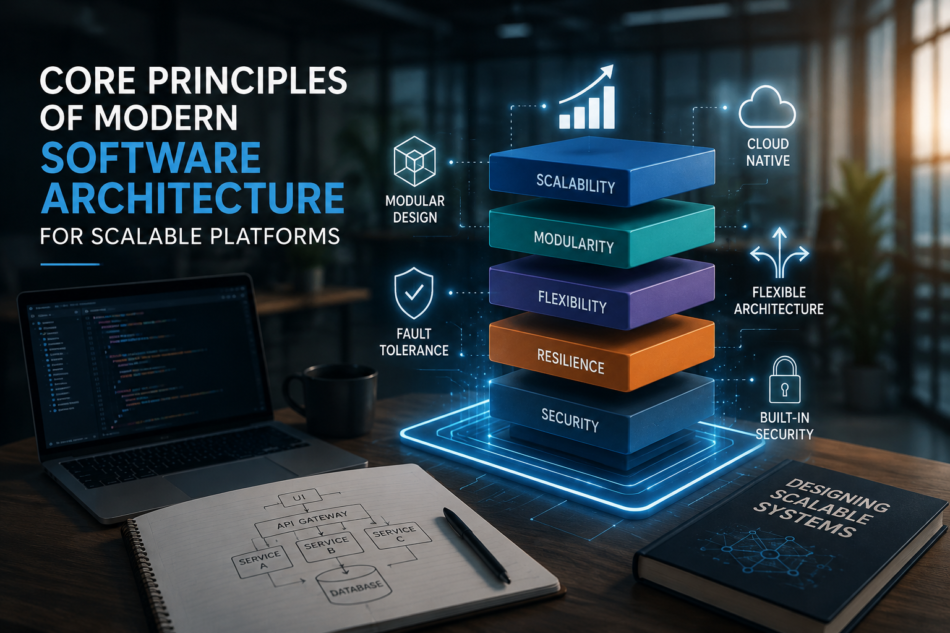
At its core, modern software architecture prioritizes decoupling services to reduce system friction and prevent single points of failure. Traditional monolithic applications often struggle with deployment bottlenecks and scaling challenges, whereas modern software architecture abstracts complexity into manageable, well-defined components. Domain-driven design serves as a key guiding light within modern software architecture, ensuring that software boundaries mirror actual business functions rather than arbitrary technical layers.
Another foundational aspect of modern software architecture is cloud-native alignment. Building applications specifically for distributed environments allows systems to leverage automated scaling, self-healing infrastructure, and containerization platforms. Furthermore, modern software architecture incorporates API-first design patterns, enabling backend and frontend development teams to collaborate efficiently while providing standard interfaces for third-party integrations. These underlying principles create a flexible framework where software components can evolve independently without disrupting the larger ecosystem.
Implementing Modern Software Architecture in Enterprise Systems
Successfully implementing modern software architecture across enterprise environments requires selecting the right structural patterns for specific operational demands. While microservices have become a dominant paradigm in modern software architecture, modular monoliths also offer a practical alternative for teams seeking structured boundaries without distributed system complexity. Architectural decisions should reflect team size, operational capabilities, and expected transaction volumes rather than industry hype.
Event-driven design represents another critical element within modern software architecture, particularly for real-time data streaming and asynchronous workflows. By decoupling service interactions through message queues and event brokers, systems built on modern software architecture achieve high throughput and fault isolation. Additionally, incorporating security directly into the development workflow—often described as zero-trust architecture—ensures that authentication and authorization checks occur continuously at every boundary within modern software architecture.
Managing Tradeoffs in Modern Software Architecture
While modern software architecture offers substantial benefits in flexibility and scalability, it also introduces operational considerations that must be managed proactively. Distributed communication across multiple services increases networking overhead, dynamic observability requirements, and monitoring complexity. Consequently, teams adopting modern software architecture must invest in platform engineering, centralized logging, and distributed tracing to maintain visibility across complex application environments.
Financial management and infrastructure costs also play a pivotal role when implementing modern software architecture. Unchecked resource consumption across cloud environments can lead to unpredictable operational expenses, making cost optimization a core design requirement. Engineers designing modern software architecture must evaluate infrastructure choices, database selection, and compute patterns to ensure long-term sustainability and prevent cloud vendor lock-in. Balancing technical performance with operational practicality ensures that systems remain cost-effective as they scale.
Future Direction of Modern Software Architecture
As software delivery methods continue to advance, modern software architecture is increasingly integrating artificial intelligence tools and automated workflows. AI-assisted coding and intelligent code review tools are becoming embedded in delivery pipelines, accelerating developer velocity while enforcing system standards. Furthermore, applications designed around modern software architecture are incorporating intelligent data pipelines that handle real-time decision-making, predictive analytics, and dynamic user interfaces.
The evolution of platform engineering and developer experience will continue to shape how modern software architecture is built and deployed. Internal developer platforms abstract underlying cloud complexity, permitting engineers to focus on business logic while maintaining guardrails for compliance and security. By staying grounded in core architectural fundamentals and embracing pragmatic innovation, organizations leveraging modern software architecture can continuously deliver high-value digital products.
Conclusion
Adopting modern software architecture is a strategic continuous investment that empowers organizations to keep pace with changing market conditions and user expectations. By focusing on clean service boundaries, cloud-native readiness, and robust platform engineering, businesses establish a stable technical foundation for scalable growth. Embracing the principles of modern software architecture ensures that software platforms remain resilient, secure, and maintainable over time.


