 WhatsApp Us Now

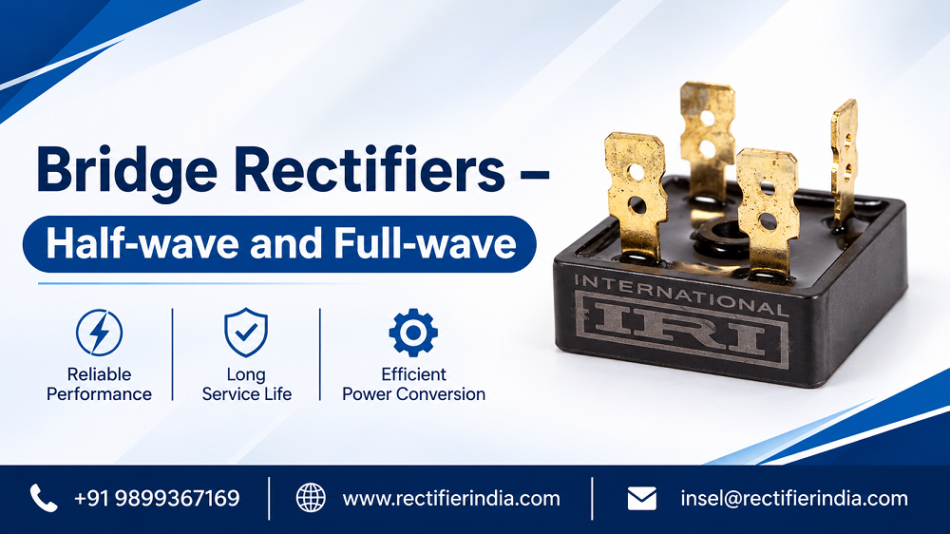
A single diode can provide a conversion of AC to DC, but half of each cycle will be wasted. This is known as a half-wave rectifier, and almost all the power supplies you’ve ever used will have a better solution. Usually this involves four diodes connected to form a diamond shape. This is known as a bridge. This post will cover how they work, their limitations, and what to look out for.
Half-Wave Rectifier
This uses just one diode. The diode will conduct during the positive half-cycle of AC and block during the negative half-cycle. This results in large gaps and only around 40.6% of power being converted into usable DC. The ripple will be 50Hz (same as the mains), and it won’t be easy to smooth out with a small capacitor.
It can still be useful for very small, low-cost applications where noise isn’t a problem, but if you need a stable DC supply, it’ll waste a lot of power.
Half Wave Bridge Rectifier will frequently come up in search engines. This is a misunderstanding, as a proper Bridge will always be a full-wave converter. The Half Wave Rectifier is the single diode circuit shown above.
Full Wave Bridge Rectifier
This uses four diodes. When the input is positive, the top two diodes will conduct and send power through the load. When the input polarity reverses, the bottom two diodes will conduct. This means the current will still flow through the load in one direction. There is no wastage, so efficiency is doubled to 81.2% (Maximum). The ripple frequency will also double to 100Hz (for Indian mains). This can easily be smoothed with a small capacitor.
The configuration is also known as a Graetz Bridge after Leo Graetz, who described it in 1897. Sometimes it will be known as a Bridge Wave Rectifier but this is fine for most cases.
There is, however, some loss. Two diodes will always be conducting, so there will be around 1.4V lost. For a 230V supply this doesn’t matter, but for something like a 5V/12V rail it will quickly add up and cause heat.
Full Wave or Half Wave?
Most real-world applications will use a full wave. Chargers, Motor drives, plating, or Anodizing lines will all use a full-wave bridge rectifier. Sometimes this will be 3-phase for higher loads. If someone is offering you a half-wave bridge rectifier for your charger, you should walk away. They’re only useful for very low power applications. Even then, a bridge rectifier will only be a few extra diodes.
What to look out for
Current Rating. Always go for a little extra. Diodes get hot, so you don’t want to be running them at their exact current rating.
Reverse Voltage Rating. This should be larger than the peak voltage of your supply. For 230V, this’ll be around 325V, so you’ll want some headroom.
Heat Sinks. Many people underestimate the importance of heat sinks. The life of your unit will depend more on heat than any other specifications on the datasheet. You may also want to check if it’s single-phase or three-phase.
A good bridge rectifier manufacturer should be able to tell you what ratings they have. They should also be able to test the unit to meet those specs. If there’s no thermal data on the datasheet, ask why.
Why Insel Rectifiers
Insel Rectifiers make industrial-grade rectifiers. If you know your voltage and current and want a rectifier sized to your requirements, then they’re a good choice for a bridge rectifier manufacturer. Simply send across your numbers and ask for a recommendation. Compare this to what you were going to purchase.
FAQs
What is a bridge rectifier?
A circuit containing four diodes that converts AC to DC using both halves of the wave.
Is a half-wave bridge rectifier a real thing?
Not really. A bridge rectifier will always use both halves, so it’ll be a full-wave. Half-wave refers to a single diode circuit.
What is the difference between a bridge wave rectifier and a half wave rectifier?
A bridge wave rectifier is often used to describe a full-wave (four-diode) circuit. A half-wave rectifier will use one diode, and half of the input will be wasted. The output will be rough, and the efficiency will be around half.
How many diodes does a full wave bridge rectifier require?
Four.
How do I choose a bridge rectifier manufacturer?
Ask for current rating, reverse voltage, and thermal data. Ask them how they test the unit. If they seem unsure, then that’s your answer.


