WhatsApp Us Now
The ASEAN Needle-Free Injectors Market covers innovative injection technologies designed to deliver liquid and powdered medications without traditional needles. These devices offer potential benefits such as reduced needle-stick injuries, improved patient comfort, and greater convenience for self-administration and healthcare delivery.
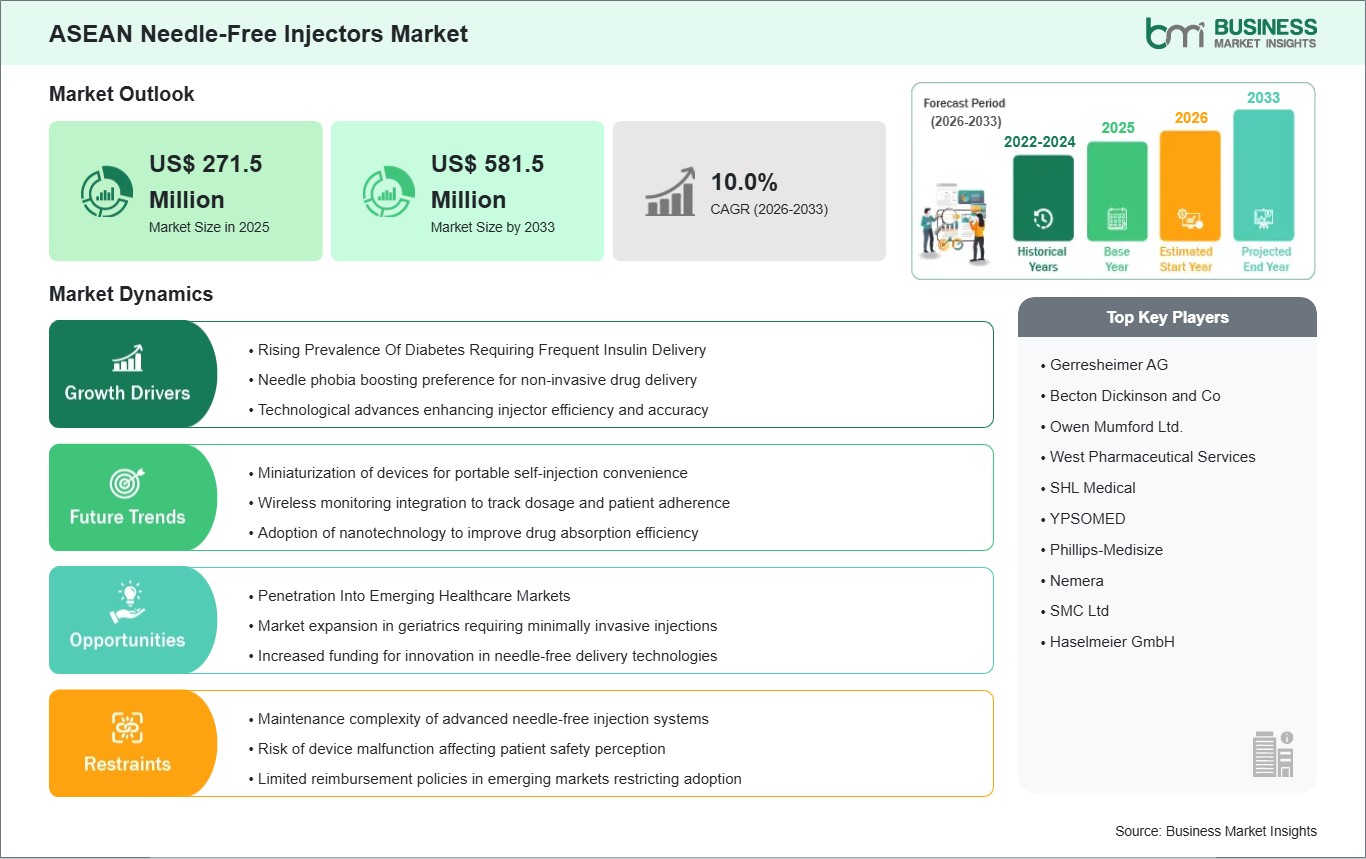
According to Business Market Insights, the ASEAN Needle-Free Injectors Market Size is expected to witness strong growth, reaching US$ 581.5 million by 2033 from US$ 271.5 million in 2025. The market is estimated to record a CAGR of 10.0% from 2026 to 2033.
Download Sample Report: https://www.businessmarketinsights.com/sample/BMIPUB00034879
Market Size and Growth Projections
The ASEAN Needle-Free Injectors Market is expected to witness significant growth as healthcare systems across Southeast Asia increasingly focus on improving patient experience, chronic disease management, and access to advanced drug delivery technologies. Needle-free systems are gaining relevance because they can reduce needle-stick injuries, improve patient comfort, and support self-administration.
The growing prevalence of diabetes requiring frequent insulin delivery is creating substantial opportunities for needle-free injector manufacturers. Patients undergoing long-term treatment may experience injection fatigue, discomfort, and needle-related anxiety, increasing interest in alternative delivery technologies. The expansion of home-based care and outpatient treatment models is further supporting demand for convenient injection systems.
What Is ASEAN Needle-Free Injectors?
Needle-free injectors are drug delivery devices that administer medications through high-pressure mechanisms without using conventional hypodermic needles. Depending on the technology, these devices can deliver liquid or powdered medications through the skin and are designed for applications requiring repeated or controlled drug administration.
The technology can support applications across diabetes care, autoimmune disorders, cancer, hormonal disorders, pain management, vaccination, and other therapeutic areas. Needle-free delivery can also help address concerns related to needle phobia, injection pain, and needle-stick injuries, making the technology increasingly relevant for patient-centric and home-based healthcare.
Market Drivers
The rising prevalence of diabetes requiring frequent insulin delivery is a major factor driving the ASEAN Needle-Free Injectors Market. Long-term insulin users may experience discomfort, injection fatigue, and fear of needles, which can affect treatment adherence. Needle-free injectors offer an alternative delivery approach that can improve the injection experience and support more convenient diabetes management.
Increasing penetration into emerging healthcare markets across ASEAN is another important growth factor. Countries in the region are investing in healthcare infrastructure, technology adoption, and service quality. Hospitals and specialty care centers are increasingly exploring advanced drug delivery technologies that improve patient comfort and align with modern healthcare expectations.
Growing awareness among healthcare professionals and patients is also supporting adoption. Manufacturers are increasingly working with regional distributors, healthcare providers, and clinicians to conduct education programs and pilot initiatives that demonstrate the workflow and patient benefits of needle-free systems.
The shift toward self-management and home-based treatment is creating additional opportunities. As patients become more involved in managing chronic conditions, demand for convenient and reliable drug delivery systems is expected to increase across ASEAN markets.
Market Segmentation
By Product
- Liquid Jet Injectors
- Powder Jet Injectors
- Spring-Powered / Gas-Powered Injectors
- Other Products
The liquid jet injectors segment dominated the market in 2025, supported by their ability to deliver precise doses of liquid medications without conventional needles.
By Usability
- Disposable
- Reusable
The disposable segment dominated the market in 2025, driven by convenience, infection-control considerations, and reduced cross-contamination risks across healthcare and home-care environments.
By Application
- Cancer
- Autoimmune Disorders
- Hormonal Disorders
- Pain Management
- Other Applications
The autoimmune disorders segment dominated the market in 2025, supported by the need for frequent and long-term medication administration where patient comfort and adherence are important.
Regional Insights
- Indonesia held the largest share of the ASEAN Needle-Free Injectors Market in 2025. Adoption is supported by private hospitals, specialty clinics, and research institutions that emphasize healthcare innovation, patient comfort, and advanced treatment delivery.
- Malaysia is witnessing increasing demand supported by public healthcare initiatives and an expanding private hospital network. Healthcare providers are increasingly focused on standardized treatment protocols and advanced drug delivery technologies.
- Thailand represents an important market supported by public healthcare programs, private healthcare expansion, and growing adoption of advanced injectable therapies. Partnerships between international device companies and local distributors are contributing to market development.
- Singapore presents opportunities for needle-free injectors through large-scale immunization programs and decentralized healthcare delivery. However, procurement decisions remain sensitive to pricing and tender requirements.
- Vietnam is experiencing increasing engagement from private healthcare providers and international organizations. Needle-free injectors can support preventive healthcare outreach and improve treatment compliance.
- The Philippines is witnessing growing awareness of needle-free technology, with demand influenced by urban private hospitals and donor-funded healthcare programs.
Across ASEAN, distributor capabilities, regulatory knowledge, local training infrastructure, pricing strategies, and successful pilot programs at leading hospitals are expected to influence the pace of market penetration.
Top Players in the ASEAN Needle-Free Injectors Market
- Gerresheimer AG
- Becton Dickinson and Co
- Owen Mumford Ltd.
- West Pharmaceutical Services
- SHL Medical
- YPSOMED
- Phillips-Medisize
- Nemera
- SMC Ltd
- Haselmeier GmbH
These companies are contributing to market development through innovations in drug delivery devices, autoinjector technologies, needle-free injection systems, patient-centric delivery solutions, and partnerships with regional healthcare distributors.
Technological Innovations
Technological innovation is transforming the ASEAN Needle-Free Injectors Market through the development of disposable-cartridge systems, digitally assisted dosing technologies, and devices designed for vaccines, insulin, and biologic therapies. Manufacturers are focusing on improving device reliability, ease of use, dose accuracy, and compatibility with different drug formulations.
Digital technologies are also creating new opportunities for connected drug delivery. Smart injection systems can potentially provide dosing information, treatment reminders, and adherence monitoring, supporting healthcare professionals and patients in managing long-term therapies.
Recent industry developments highlight growing commercialization across ASEAN. In October 2025, the partnership between Hyphens Pharma and medac was extended to Thailand and Cambodia to expand the commercial footprint of the Metoject subcutaneous autoinjector pen across six ASEAN countries. In December 2023, NuGen Medical Devices entered into a five-year exclusive distribution agreement with Advance Medical Life Co., Ltd. to introduce the InsuJet needle-free insulin delivery system in Thailand.
Future Market Outlook
The future outlook for the ASEAN Needle-Free Injectors Market remains highly positive as healthcare systems across the region continue to modernize and adopt patient-centric treatment models. Rising chronic disease prevalence, increasing demand for insulin delivery, and expanding home-based healthcare are expected to create sustained opportunities for needle-free injection technologies.
Future market development is likely to be influenced by disposable and reusable injector innovations, digital dosing technologies, wearable and connected delivery systems, and expanded applications across vaccines, insulin, biologics, and chronic disease therapies.
Companies that combine product reliability, affordability, ease of use, local distribution partnerships, clinician education, and after-sales support are expected to strengthen their position in the diverse ASEAN healthcare environment.
Frequently Asked Questions (FAQs)
What is driving the ASEAN Needle-Free Injectors Market?
The market is driven by the rising prevalence of diabetes requiring frequent insulin delivery, increasing demand for patient-centric healthcare, growing adoption of home-based treatment, expansion of emerging healthcare markets, and the need to reduce injection discomfort and needle-stick injuries.
Which segment dominates the ASEAN Needle-Free Injectors Market?
The liquid jet injectors segment dominated the market by product in 2025. By usability, disposable injectors dominated, while autoimmune disorders represented the leading application segment.
Which country leads the ASEAN Needle-Free Injectors Market?
Indonesia held the largest share of the ASEAN Needle-Free Injectors Market in 2025. The country’s private hospitals, specialty clinics, research institutions, and growing interest in innovative healthcare technologies support its leading position.
What are the major applications of needle-free injectors?
Major applications include cancer, autoimmune disorders, hormonal disorders, pain management, and other therapeutic applications. Needle-free injectors are also gaining relevance for insulin delivery, vaccination, and chronic disease management.
Which countries are covered in the ASEAN Needle-Free Injectors Market?
The market covers Indonesia, Malaysia, the Philippines, Singapore, Thailand, and Vietnam. Each country has distinct healthcare infrastructure, procurement structures, regulatory environments, and adoption patterns.
Browse More Reports
GCC Neurovascular Catheters Market Outlook (2022–2033)
Asia Pacific Neurovascular Catheters Market Outlook (2022–2033)
Latin America Transcatheter Heart Valves Market Outlook (2022–2033)