 WhatsApp Us Now

Market Overview and Growth Outlook
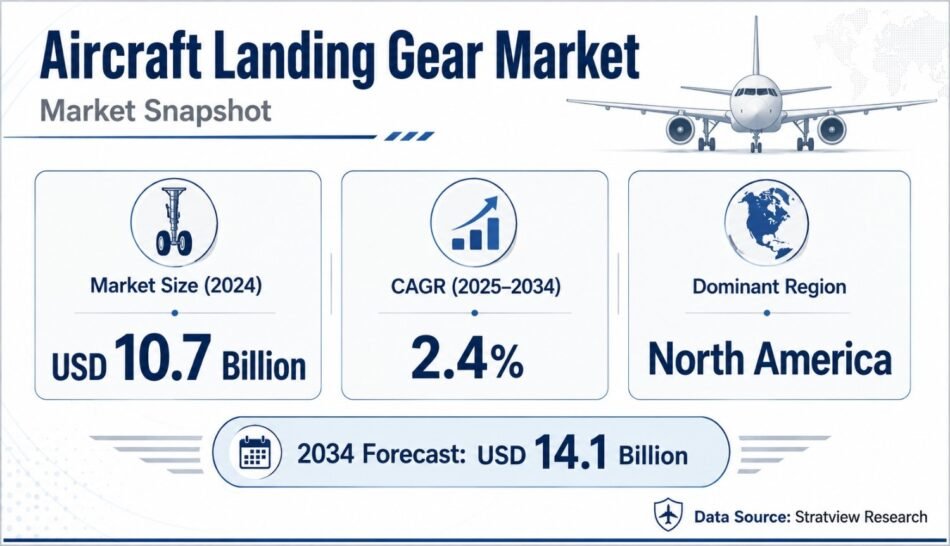
The Aircraft Landing Gear Market is forecast to increase from USD 11.4 billion in 2025 to USD 14.1 billion by 2034.
The Aircraft Landing Gear Market is expected to grow at a CAGR of 2.4% during 2025–2034.
The market is projected to generate USD 128.9 billion in cumulative sales opportunities during 2025–2034.
The Aircraft Landing Gear Market forecast reflects rising aircraft production, long-term fleet expansion, MRO growth, digital maintenance, lightweight material adoption, and electrification of aircraft systems.
Request a free sample report:
https://www.stratviewresearch.com/Request-Sample/aircraft-landing-gear-market#form
Market Segmentation Analysis
Aircraft Type segmentation includes Commercial Aircraft, Military Aircraft, General Aircraft, Regional Aircraft, Helicopters, and UAVs.
Commercial Aircraft remain the largest category, while Regional Aircraft are expected to grow fastest.
End-Use Type segmentation includes OE and Aftermarket.
OE remains the largest end-use category.
Aisle Type segmentation includes Single-Aisle Aircraft and Twin-Aisle Aircraft.
Twin-Aisle Aircraft are expected to grow more strongly.
Wing Type segmentation includes Fixed Wing Aircraft and Rotary Wing Aircraft.
Fixed Wing Aircraft are expected to grow more in the coming years.
Type segmentation includes Main Landing Gear and Nose Landing Gear.
Main Landing Gear is expected to experience greater growth.
Regional Market Insights
North America is expected to retain its position as the largest regional market.
Asia-Pacific is anticipated to record the fastest growth due to aviation expansion and rising passenger traffic.
Emerging Trends Shaping the Aircraft Landing Gear Market
Electrification is creating opportunities for advanced landing gear systems.
OEMs are integrating electric actuation technologies, lightweight materials, and IoT-enabled sensors into newer platforms.
In July 2022, Safran Landing Systems developed an advanced electric nose-wheel steering and extension/retraction system for narrow-body and wide-body aircraft.
In November 2024, Norsk Titanium and Safran Landing Systems announced work on applying Rapid Plasma Deposition additive manufacturing to landing gear applications.
Key Growth Drivers of the Market
- Electric actuation: Electrified landing gear systems can support next-generation aircraft architectures.
- Advanced materials: Lightweight structures can improve aircraft efficiency.
- Additive manufacturing: New production technologies create opportunities for aerospace-grade structural components.
- Digital monitoring: Sensors and fault detection improve maintenance planning.
- Next-generation aircraft: New platforms require improved reliability and lifecycle performance.
Competitive Landscape
Top Companies in the Market
Safran SA
Collins Aerospace (RTX Corporation)
Héroux-Devtek Inc.
Liebherr-International AG
Sumitomo Precision Products Co., Ltd.
Magellan Aerospace
Triumph Group, Inc.
Eaton Corporation
AAR Corp.
Revima Group
GKN Aerospace
ELEB (Embraer Equipment Division)
Conclusion and Strategic Outlook
The Aircraft Landing Gear Market is projected to reach USD 14.1 billion by 2034, supported by a 2.4% CAGR during 2025–2034.
Electric actuation, digital monitoring, lightweight materials, additive manufacturing, and next-generation commercial aircraft remain important technology opportunities.
FAQs – Aircraft Landing Gear Market
1. What value will the Aircraft Landing Gear Market reach by 2034?
The market is projected to reach USD 14.1 billion by 2034.
2. What CAGR does the forecast indicate?
The market is expected to grow at 2.4% CAGR during 2025–2034.
3. What technology trends are shaping landing gear?
Electric actuation, lightweight materials, IoT-enabled sensors, digital monitoring, and additive manufacturing are important trends.
4. Which aisle type is expected to grow faster?
Twin-Aisle Aircraft are expected to record stronger growth.
5. Which region has the strongest market position?
North America continues to hold the largest market share.


