 WhatsApp Us Now
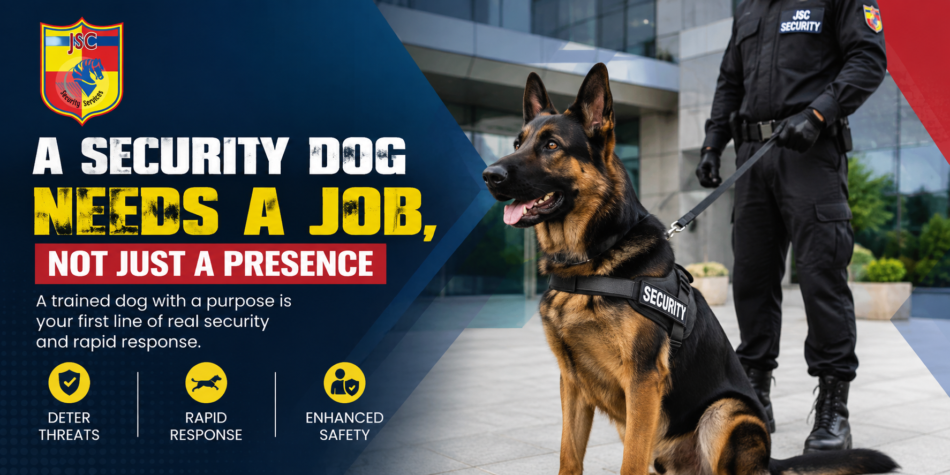
Discover how professional K9 security services improve detection, deterrence and site protection in Malaysia with trained dogs and experienced handlers.
The explanation of how K9s are incorporated into the entire security system of airports was provided by Malaysia Airports on 20 August 2026. For businesses evaluating k9 security services, this also shows how canine units can be incorporated into a broader security system rather than being treated as a standalone presence.
The use of the dogs by the Royal Malaysia Police and Royal Malaysian Customs Department was reported to be in support of aviation security and the use of physical screening, portable metal detectors and enhanced screening devices.
Such a role for dogs is particularly applicable in an airport setting.
A security dog can offer services that cannot be replicated by cameras, barriers and human patrols. It is not sufficient for a dog to be simply next to its handler. The dog should have a clearly assigned role and be trained accordingly.
Malaysia is already using dogs for specialised work
The dogs used by the K9 Unit of PDRM are trained in a variety of disciplines, which include crime prevention patrol, searches for missing persons, narcotics and explosives detection, tracking and security-related operations. Customs also has trained dogs for drug sniffing at the border of land, sea and air entries into Malaysia.
Specialization is what gives these dogs their value.
For instance, a patrol dog is doing a totally different task from one trained to detect specific scents. Search and rescue dogs have different skills.
It is an important point for businesses that are considering k9 security services. Simply knowing whether a business has trained dogs is not enough. What matters is what each dog is trained to do.
Detection and deterrence solve different problems
The detection aspect is well illustrated in Malaysia through the current airport scenario.
Between January and July 2026, PDRM registered 108 drug-related cases at KLIA, double the number recorded in 2025 (54). The trafficking syndicates are also trying to find their way into other airports as security measures tighten at KLIA, it has been stated.
Various commercial facilities may pose different risks.
A large warehouse facility that operates beyond working hours may be worried about any form of perimeter intrusion. Extra screening or even patrol support services may be needed at a conference facility. A sensitive loading/unloading area may be located at a high-value logistics facility.
In such cases, K9s can be deployed to address specific security risks. Having a dog as a tool of intimidation is not a good strategy for security.
The handler is half of the working team
In some cases, the business pays so much attention to the dog that it forgets about the person controlling it.
This is a wrong practice.
Controlled behaviour is one of the factors that affect the work of K9s, and PDRM examines it in several areas, such as obedience, detection, and protection skills.
The handler working with the commercial business also needs to understand the location and read the dog’s body language.
Before using k9 security services, a client should therefore understand:
- what the dog is trained for;
- how the handler has been trained;
- how frequently the team trains together;
- what happens if the dog indicates a possible threat;
- where the team may and may not operate;
- how the K9 unit coordinates with ordinary guards or supervisors.
The response after an alert matters as much as the alert itself.
K9 deployment works better selectively
Dogs do not need to be in all places to serve their purposes.
The company can assess which parts of its compound would benefit most from the capabilities of K9 teams.
This is more practical than employing K9 teams as another permanent guarding point.
This also keeps the objective clear. Continuous monitoring can be done using CCTV. The compound can be secured through access control systems.
The security personnel will control visitors and investigate incidents.
The dog can provide an additional capability based on the identified security risks.
Check the company behind the dog
The Private Agencies Act 1971 governs private security businesses in Malaysia. KDN has an eSIMS website through which it is possible to find out whether the security company possesses a licence that is valid for the current year.
When looking for a provider of k9 security services, the first step is to ensure that it is a legitimate provider.
Afterwards, look for evidence of the proposed K9 mission rather than relying on images of a dog, its name, or other details that prove little.
This is an example of the right approach to airport security in Malaysia. Technology combined with screening personnel and canine units could work well since they have different capabilities.
The same principle can apply to commercial security.
Such a K9 unit can be highly useful when the risk and task justify its deployment. The advantage of such an approach is that it gives both the dog and handler a defined role within a security system that knows how to respond to the information they provide. For businesses considering k9 security services, the key is to choose a team whose training and assigned role match the actual security risk.
Strengthen Your Security with Professional K9 Services
Choose a trained K9 team that understands your security requirements and works effectively alongside professional handlers and existing security measures. JSC Security provides professional K9 security services designed to support effective detection, deterrence, and site protection.
Call: +60 12-503 0021 | Email: info@jscsecurity.com.my


