 WhatsApp Us Now

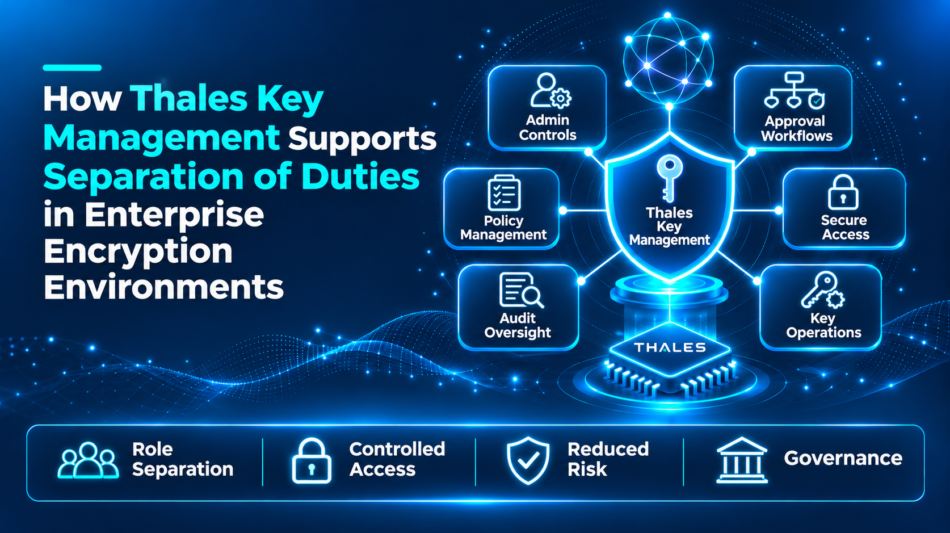
Separation of duties reduces the risk created when one individual or team controls every stage of a sensitive security process.
Thales key management can support structured access and administrative controls that help enterprises separate responsibilities around cryptographic keys.
Introduction
Enterprise encryption environments require strong controls because cryptographic keys protect some of an organization’s most sensitive information.
Businesses use keys to encrypt databases, secure cloud storage, authenticate applications, protect communications, and support digital certificates.
However, simply storing keys securely does not provide complete protection.
Organizations also need to control who can administer, access, rotate, recover, and retire those keys.
This is where separation of duties becomes important.
Separation of duties means dividing sensitive responsibilities among different individuals, teams, or roles so that one person does not have unrestricted control over a critical security process.
Thales key management can support enterprises that want to apply structured access controls and administrative responsibilities across their cryptographic environments.
Combined with effective Key management and strong key management in cryptography practices, separation of duties can improve accountability and reduce unnecessary concentration of privileges.
What Is Separation of Duties?
Separation of duties is a security principle that divides critical responsibilities.
For example, one administrator may manage a cryptographic system while another authorized person approves particularly sensitive actions.
The exact structure depends on the organization’s risk profile.
The objective is to prevent one account or individual from having unrestricted control over every stage of a sensitive process.
Why Separation of Duties Matters for Encryption
Encryption keys can provide access to protected information.
If one administrator can independently create, access, export, rotate, and destroy every key, the organization creates a highly concentrated point of control.
A compromised account could therefore create significant security consequences.
Separation of duties reduces this concentration.
Key Management in Cryptography
Key management in cryptography involves the complete lifecycle of cryptographic keys.
This lifecycle can include:
- Generation
- Storage
- Distribution
- Access
- Usage
- Rotation
- Backup
- Recovery
- Retirement
- Destruction
Each stage can involve different responsibilities.
Applying Separation of Duties to Key Management
Organizations can divide responsibilities among roles such as:
- Security administrators
- System administrators
- Application owners
- Database administrators
- Compliance teams
- Security auditors
For example, an application owner may request access to a cryptographic key while a security administrator approves the request.
The organization can define the exact workflow according to its internal policies.
Thales Key Management
Thales key management can support centralized cryptographic administration and help organizations structure access around key management activities.
Centralized management can make it easier to establish:
- Administrative roles
- Access permissions
- Key ownership
- Lifecycle controls
- Monitoring
- Governance
Organizations should configure these controls according to their security policies and operational requirements.
Least Privilege and Separation of Duties
Separation of duties works closely with least privilege.
Least privilege ensures that users receive only the permissions necessary for their roles.
Separation of duties ensures that sensitive responsibilities do not become concentrated in one role.
For example, a database administrator may need to use encryption services but may not need authority to independently change enterprise-wide key policies.
Protecting Key Creation
Key generation can represent a sensitive operation.
Organizations may define specific roles responsible for creating keys.
They can also establish approval procedures for high-value keys.
This helps ensure that cryptographic assets do not appear without appropriate authorization.
Controlling Key Access
Organizations should carefully control who can use cryptographic keys.
Access should depend on:
- User identity
- Application identity
- Role
- Business function
- Data sensitivity
Security teams should review access periodically.
Managing Key Rotation
Key rotation can also benefit from separation of duties.
For example, one team may define the rotation requirement while another team performs or approves the operational change.
This structure creates additional accountability.
Organizations should document the process clearly.
Key Recovery
Recovery represents another sensitive activity.
If an organization loses access to an encryption key, authorized users may lose access to protected information.
At the same time, unrestricted recovery privileges could create security risks.
Organizations should therefore define who can request, approve, and perform key recovery.
Key Retirement and Destruction
Key retirement and destruction can have significant consequences.
If a key protects important information, destroying it may permanently prevent access to that information.
Organizations should therefore establish approval and authorization requirements for destructive actions.
Monitoring Administrative Activity
Separation of duties works best when organizations maintain strong monitoring.
Security teams should monitor:
- Key creation
- Key access
- Policy changes
- Rotation
- Recovery
- Retirement
- Destruction
- Administrative changes
Logs can provide accountability and support investigations.
Supporting Compliance
Many organizations need to demonstrate that sensitive security functions receive appropriate controls.
Separation of duties can support governance by creating clear evidence of:
- Who requested an action
- Who approved it
- Who performed it
- When the action occurred
- What changed
Centralized Key management can help organizations maintain these records.
Cloud and Hybrid Environments
Separation of duties becomes especially important in distributed environments.
Organizations may have separate teams managing:
- Cloud infrastructure
- On-premises systems
- Applications
- Databases
- Security
- Compliance
A centralized Key management approach can help apply consistent access policies across these environments.
Managing Emergency Access
Organizations should also plan for emergency situations.
Sometimes an administrator may require elevated privileges to respond to a critical incident.
Emergency access should remain controlled, time-limited where appropriate, and monitored.
Organizations should review emergency actions afterward.
Common Challenges
Excessive Administrative Privileges
Administrators may receive more access than their roles require.
Poor Role Definition
Organizations may not clearly define responsibilities.
Shared Accounts
Shared administrative accounts reduce accountability.
Limited Monitoring
Without logs, organizations may struggle to determine who performed sensitive actions.
Legacy Systems
Older systems may not support detailed role separation.
Best Practices
Organizations should:
- Define clear cryptographic roles
- Apply least privilege
- Avoid shared administrative accounts
- Separate key administration from application administration where appropriate
- Require approval for sensitive actions
- Monitor administrative activity
- Review permissions regularly
- Protect recovery operations
- Control key destruction
- Document emergency access procedures
- Test role configurations
- Review separation-of-duties policies periodically
Conclusion
Cryptographic keys represent critical security assets, making administrative control an important part of enterprise security.
Thales key management can support organizations that need centralized control over cryptographic keys and structured administrative access.
Key management in cryptography provides the lifecycle framework, while effective Key management establishes policies for access, rotation, recovery, monitoring, and retirement.
By applying separation of duties alongside least privilege and strong monitoring, enterprises can reduce excessive concentration of cryptographic privileges, improve accountability, and establish stronger governance over their encryption environments.


