 WhatsApp Us Now

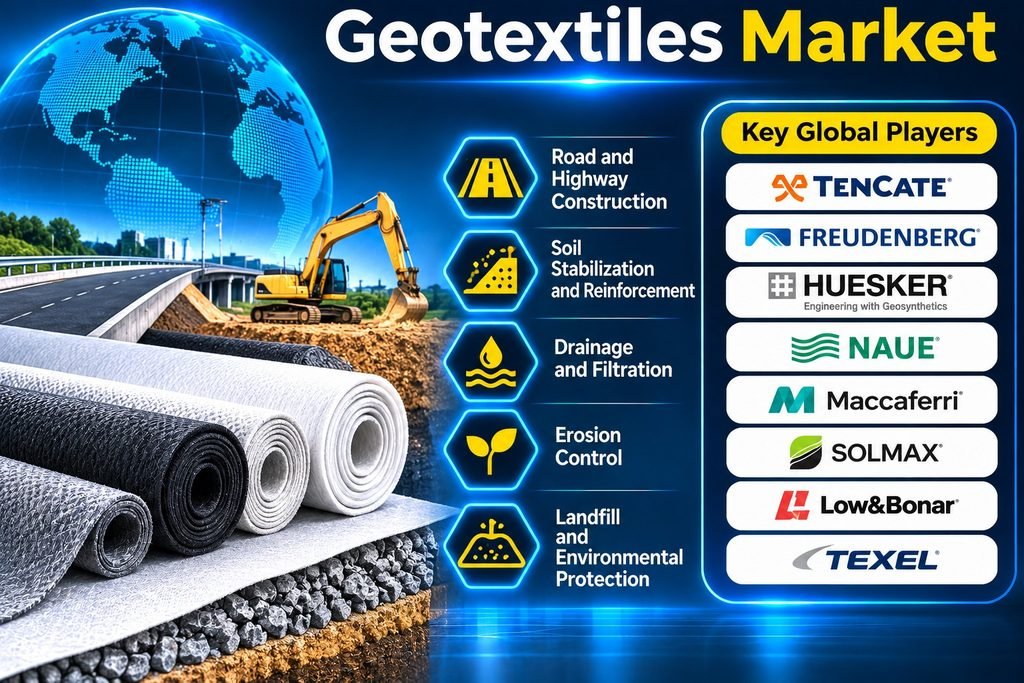
According to Straits Research, the global geotextiles market size was valued at USD 9.43 billion in 2025 and is projected to grow from USD 10.04 billion in 2026 to USD 16.62 billion by 2034, registering a CAGR of 6.5% during the forecast period (2026–2034). Asia Pacific dominated the geotextiles market with a share of 41.8% in 2025.
Geotextiles are permeable textile materials used in civil engineering, construction, transportation, and environmental projects to improve soil performance and infrastructure stability. Manufactured from synthetic or natural fibers, these materials are commonly used for soil separation, filtration, drainage, reinforcement, and erosion control. Geotextiles help improve the durability of roads, railways, retaining structures, embankments, landfills, and drainage systems. Growing infrastructure investment, urbanization, road construction, and increasing demand for sustainable construction solutions are supporting market expansion.
Get Full Report: https://straitsresearch.com/report/geotextiles-market
Growth Drivers of the Geotextiles Market
Rising Infrastructure Development
Increasing investment in roads, highways, railways, airports, bridges, and urban infrastructure is driving demand for geotextiles. These materials help improve soil stability, reduce construction challenges, and extend the service life of infrastructure projects.
Growing Demand for Road Construction and Maintenance
Geotextiles are widely used in road construction to separate soil layers, reinforce weak ground, improve drainage, and reduce pavement deterioration. Growing road expansion and rehabilitation projects are increasing their use in transportation infrastructure.
Increasing Focus on Soil Stabilization
Construction projects on weak, uneven, or moisture-sensitive soil require effective stabilization solutions. Geotextiles help distribute loads, limit soil movement, and improve the structural performance of foundations, embankments, and other civil engineering structures.
Expansion of Drainage and Water Management Projects
Geotextiles are used in drainage systems to allow water movement while preventing soil particles from entering and clogging drainage materials. Growing investments in stormwater management, flood prevention, and water infrastructure are supporting demand.
Rising Environmental Protection Requirements
Increasing concerns about erosion, sediment movement, land degradation, and environmental protection are encouraging the use of geotextiles. These materials are used in slope protection, riverbanks, coastal areas, and other locations exposed to erosion.
Growth in Urbanization and Construction Activities
Rapid urbanization is increasing the need for residential, commercial, industrial, and public infrastructure. Geotextiles are becoming important construction materials for foundation support, landscaping, drainage, and underground infrastructure development.
Applications of the Geotextiles Market
Road and Highway Construction
Geotextiles are used beneath roads and pavements to separate subgrade soil from aggregate layers, improve load distribution, and reduce mixing between materials. Their use helps improve road stability and performance, particularly in areas with weak soil conditions.
Railway Infrastructure
Railway projects use geotextiles beneath tracks to improve separation, drainage, and ground stability. They help maintain track structure integrity and reduce maintenance requirements caused by soil movement and water accumulation.
Drainage Systems
Geotextiles serve as filtration layers in drainage applications, allowing water to pass through while retaining soil particles. They are used in underground drainage, foundation systems, retaining walls, and land drainage projects.
Erosion Control
Geotextiles are used to protect exposed soil from water erosion and surface runoff. Applications include riverbanks, embankments, slopes, coastal protection projects, and landscaping where soil retention is important.
Landfills and Waste Management
Geotextiles are used in landfill systems as filtration, separation, and protective layers within engineered waste containment structures. They support drainage systems and help protect other geosynthetic materials from damage.
Building and Foundation Construction
Construction projects use geotextiles for soil separation, foundation support, drainage, and ground improvement. Their application helps improve construction performance in areas with challenging soil and groundwater conditions.
Emerging Trends in the Geotextiles Market
Increasing Adoption of Nonwoven Geotextiles
Nonwoven geotextiles are gaining use in filtration, drainage, separation, and erosion control applications because of their flexibility and permeability. Their versatility makes them suitable for road construction, drainage systems, landscaping, and civil engineering projects.
Development of High-Performance Geotextile Materials
Manufacturers are developing geotextiles with improved tensile strength, durability, puncture resistance, and resistance to environmental exposure. These materials are designed to meet the requirements of demanding infrastructure and construction projects.
Growing Use of Sustainable Materials
Environmental considerations are encouraging research into recycled polymers, lower-impact manufacturing processes, and alternative fiber materials. Sustainability-focused construction practices are creating opportunities for geotextile products designed to reduce environmental impact.
Integration with Advanced Geosynthetic Systems
Geotextiles are increasingly used alongside geomembranes, geogrids, geocells, and other geosynthetic products. Combined systems provide solutions for reinforcement, drainage, filtration, containment, and soil stabilization across complex infrastructure projects.
Increasing Demand for Erosion Control Solutions
Climate-related challenges, heavy rainfall, flooding, and soil degradation are increasing the need for effective erosion control materials. Geotextiles are being used in engineered protection systems for slopes, waterways, coastal infrastructure, and vulnerable land areas.

