 WhatsApp Us Now

Picture a busy loading yard in southeast Melbourne at six in the morning. Trucks roll in, staff cars follow, and a stranger slips through behind them. A single boom gate at the entry stops that in seconds, and it never needs a coffee break.
A boom gate is one of the simplest ways to control vehicle access, yet many property owners still feel unsure about it. Which type fits their site? How long does installation take? What does it cost, and which mistakes should they avoid? This guide answers each of those questions in plain language.
You will learn what a boom gate is, how it works, where people use it, and which types exist. You will also see the installation steps, typical costs in Australia, safety points, maintenance tips, and expert advice. By the end, you will know exactly what to ask before you book boom gate installation for your property.
Boom Gate Installation in Melbourne: 2026 Installation Guide ?
A boom gate is a barrier arm that rises and lowers across a driveway or entry lane. The arm blocks vehicles when it is down and lets them pass when it is up. People also call it a boom barrier, barrier gate, or car park barrier.
Unlike a solid sliding or swing gate, this type of barrier controls traffic flow instead of closing off the whole opening. Drivers can see past the arm; it moves fast, and it handles many vehicles per hour. That makes it a smart choice for places where cars come and go all day.
How the Barrier Works
A motor inside a steel cabinet turns the arm up and down. A control board tells the motor when to move. The board listens to signals from remotes, keypads, cards, intercoms, or number plate readers. When the driver sends a valid signal, the arm lifts. After the car passes, a sensor tells the board to lower the arm again.
Main Parts of the System
Every system uses the same core parts, even though brands differ. The table below shows what each part does.
| Part | What it does |
|---|---|
| Cabinet | Holds the motor and control board and protects them from rain and dust |
| Barrier arm | Blocks or allows vehicles and often carries reflective stripes or lights |
| Control board | Receives signals and tells the motor when to move |
| Safety sensors | Stop the arm from lowering onto a car or person. |
| Access devices | Remotes, keypads, cards, or readers that trigger the arm |
| Power supply | Feeds the motor and often includes a battery backup |
Where People Use Boom Gate Installation in Melbourne
You will spot one in far more places than car parks. Each site uses it for a slightly different reason, so the setup changes from one property to the next.
Apartment and Strata Buildings
Residents want quick entry, and owners want to keep visitors out of private parking. The barrier gives both. Residents tap a remote or app, and the arm lifts in two or three seconds. Strata committees also like that the system keeps a record of who enters.
Commercial Car Parks and Offices
Office blocks use a barrier arm to separate staff parking from public parking. Shopping centers and paid car parks use it to count cars and collect fees. The arm also helps staff manage peak hours without a person standing at the entry.
Industrial Yards and Warehouses
Factories and warehouses in areas like Oakleigh South, Dandenong, and Moorabbin handle trucks, vans, and visitors every day. A heavy-duty arm keeps unknown vehicles out and sends drivers to a check-in point first.
Schools, Hospitals, and Government Sites
These sites need safe, controlled entry for staff and deliveries. A barrier arm keeps traffic moving and gives security teams a clear point to watch. It also protects pedestrians because it slows vehicles at the entrance.
Who Needs Controlled Vehicle Entry?
Property managers, strata committees, business owners, and facility teams make up most buyers. Anyone who needs to answer one question should consider it: who is allowed to drive in? If you cannot answer that today, you probably need controlled entry. A boom gate also suits sites that want to reduce unauthorized parking, theft, and trespassing without building a full wall of steel.
Types of Boom Gate Installation in Melbourne
Not every boom gate works the same way. Google results show two main groups, manual and automatic, and then several arm styles on top of those. Knowing the difference saves money and avoids regret later.
Manual Barriers
A person lifts and lowers the arm by hand. These gates cost less and have fewer parts that can fail. They suit low-traffic spots such as small private driveways or rarely used service lanes. The downside is simple: someone must stand there every time a car arrives.
Automatic Barriers
An automatic boom gate uses an electric motor and a control board. The arm lifts by remote, card, keypad, intercom, or camera. Automatic units suit busy entries because they work fast and need no staff on site. They also connect to other security tools, which makes them popular in apartments and commercial sites.
Barrier Arm Styles
The arm shape matters as much as the motor. A straight arm suits normal driveways. A folding or articulated arm bends in the middle, so it works where the roof or ceiling is low, such as basement car parks. A skirted or fence-style arm adds a lower panel that stops people from ducking under it.
Comparison of Barrier Types
| Type | Best for | Main advantage | Main drawback |
|---|---|---|---|
| Manual | Low-traffic private spots | Lower price | Needs a person every time |
| Automatic straight arm | Car parks and yards | Fast and reliable | Needs power and setup |
| Folding arm | Basements with low clearance | Fits tight spaces | More moving parts |
| Fence-style arm | Sites with trespassing issues | Blocks people ducking under | Heavier and costs more |
How to Choose the Right Barrier
Start with your traffic. Count how many vehicles enter in an hour during peak time. A small apartment block might see 20 cars, while a warehouse might see 100. Higher traffic needs a motor built for constant use.
Next, think about arm length. A single lane usually needs a shorter arm, while a wide entry needs a longer one. Longer arms can sag or sway in wind, so installers often add a support post. Finally, check the clearance above the lane, because a low roof calls for a folding arm.
Match the Gate to Your Site
| Site type | Suggested setup |
|---|---|
| Small apartment block | Automatic arm with remote and app access |
| Large strata complex | Automatic arm with card readers and camera |
| Office car park | Automatic arm with swipe card or number plate reader |
| Industrial yard | Heavy-duty arm with intercom and CCTV |
| Low basement | Folding arm with loop sensors |
Boom Gate Types
A barrier arm does not replace every gate. It controls cars well but does not stop a person walking around it. Sliding and swing gates close off the whole opening, which gives stronger perimeter security. Many Melbourne sites combine both. For example, a boom gate handles the vehicle lane while a fence and pedestrian gate cover the rest.
If you need a full barrier, look at automatic gates, sliding gates, or swing gates. If you want a quick, high-traffic entry, a boom gate usually wins. Pairing the arm with security fencing closes the gaps around it.
Boom Gate Installation in Melbourne Installation Process Step by Step
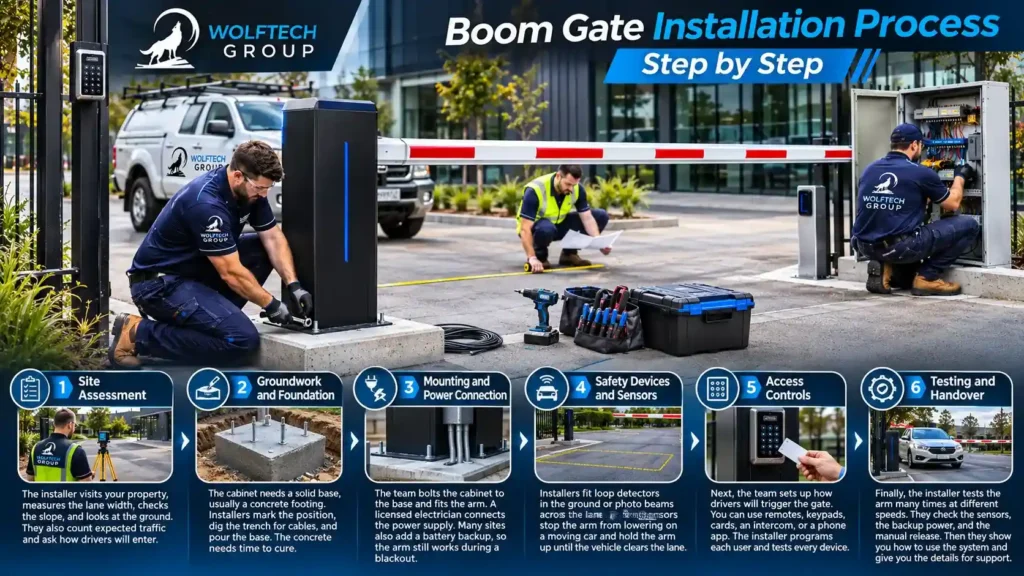
Good installation decides how long the system lasts. A rushed job leads to sagging arms, false stops, and repair bills. Here is how a professional installer works.Step 1: Site Assessment
The installer visits your property and measures the lane width, checks the slope, and looks at the ground. They also count expected traffic and ask how drivers will enter. This visit decides the arm type, the motor size, and the access method.
Step 2: Groundwork and Foundation
The cabinet needs a solid base, usually a concrete footing. Installers mark the position, dig the trench for cables, and pour the base. The concrete needs time to cure, so this stage can take a day or more on larger jobs.
Step 3: Mounting and Power Connection
The team bolts the cabinet to the base and fits the arm. A licensed electrician connects the power supply. Many sites also add a battery backup, so the arm still works during a blackout. You can learn more about safe wiring through electrical services.
Step 4: Safety Devices and Sensors
Installers fit loop detectors in the ground or photo beams across the lane. These sensors stop the arm from lowering on a moving car. They also hold the arm up until the vehicle Boom Gate Installation in Melbourne clears the lane. Never skip this step, because it protects people and vehicles.
Step 5: Access Controls
Next, the team sets up how drivers will trigger the gate. You can use remotes, keypads, cards, an intercom, or a phone app. The installer programs each user and tests every device.
Step 6: Testing and Handover
Finally, the installer tests the arm many times at different speeds. They check the sensors, the backup power, and the manual release. Then they show you how to use the system and give you the details for support.
How Long Does Installation Take?
A simple installation can take about two to four hours to finish, according to supplier information found online. Larger jobs need more time because of concrete work, cabling, and extra equipment. Plan for a day or two on most commercial sites, and longer when you add cameras or readers.
Boom Gate Installation in Melbourne Cost in Australia
Cost is the question people ask first, and the honest answer is that it varies. Sources online show a basic manual boom gate starting at roughly $500 to $2,000. Fully automatic systems with advanced security features can reach $10,000 or more. Your final price depends on the gate type, site work, and extras.
Typical Cost Ranges
| Item | Typical range (AUD) |
|---|---|
| Basic manual barrier | $500 to $2,000 |
| Standard automatic barrier | A few thousand dollars |
| Advanced automatic system with security features | $10,000 or more |
These numbers come from general Australian supplier information. Treat them as a guide, not a quote. A site visit gives the only reliable price.
What Affects the Price
Gate type and arm length change the hardware cost. A longer or heavier arm needs a stronger motor and sometimes a support post. Groundwork matters too, because concrete, trenching, and cable runs add labor. Power supply and backup batteries add cost, while access devices such as cards, readers, and number plate cameras add more.
Location also plays a part. Urban sites often have tighter access and stricter rules, and installers charge for skilled labour. Compatibility with your existing systems can add work as well. For example, linking the gate to CCTV cameras or an existing card system needs extra setup.
Hidden Costs to Watch
Ask installers about these before you sign. Some quotes leave them out, and they can surprise you later.
Council or strata approvals can take time and money. Ongoing servicing and spare parts add to yearly costs. Extra cabling, trenching through concrete and electrical upgrades can raise the bill. A clear quote lists every item, so you always know what you pay for.
Access Control Options for Your Entry
The arm only stops cars. The access method decides who gets through. Choose based on how many users you have and how much security you need.
Remote Controls and Keypads
Remotes suit homes and small buildings. Each user gets a handset, and you can cancel a lost one quickly. Keypads let visitors enter a code, but codes can spread, so change them often.
Cards, Tags and Readers
Card and tag systems suit offices and large strata sites. Each card has its own record, so you can see who entered and when. You can also switch off a lost card without changing anything else. A full access control system lets you manage all users from one place.
Intercom, App and Number Plate Recognition
Intercoms let visitors call a resident or office, and staff can open the arm remotely. Apps give residents phone control. Number plate recognition reads each plate and opens the arm for approved vehicles. This option costs more but gives the smoothest entry for busy sites.

