 WhatsApp Us Now

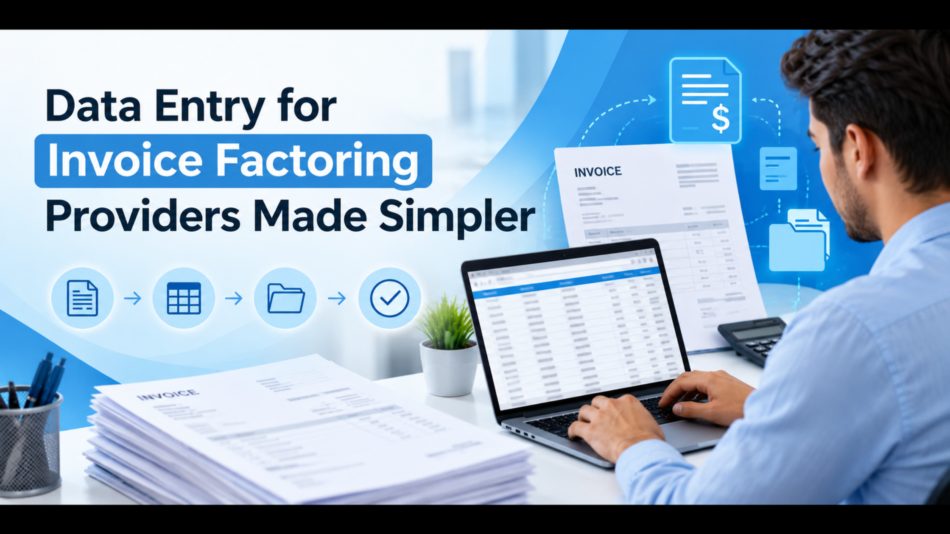
Working quickly is crucial for companies that finance invoices. The faster they can approve and pay requests, the faster the customer gets paid. Despite this, many financing providers are burdened by manual processes that cause delays, inconsistency, and slow operations.
This becomes even more difficult with large volumes of invoices from many customers across many industries. Some customers may submit a combination of PDF invoices, scanned or copied documents, spreadsheets, handwritten notes, email attachments, and more. Each submission requires manual processing.
To address this, many teams are integrating invoice data entry services that utilize automation, OCR, data entry, intake systems, and processing to improve operations and customer service. Providing fast invoices means customers receive funding more quickly and teams can reduce administrative work.
Importance of Quick Invoice Data Entry
Operational efficiency is the backbone of the invoice factoring business. Slow processes at any step of the invoice cycle mean customers are losing valuable time getting paid and worsening the backlog.
Manual Workflow causes problems such as:
- Duplicate invoice entries
- Incorrect payment entries
- Blank fields
- Slow verification
- Different invoice formats
- Slow approval times
If a factoring service handles hundreds or thousands of invoices per week, manual workflow becomes a significant burden. One of the largest drawbacks is the variance in invoice formats, which makes it hard to standardize this process.
Without fast, efficient invoice services, teams focus more on correcting than on reviewing invoice quality.
Common Data Entry Challenges Factoring Providers Face
Many factoring services find that invoice management challenges are increasing as their businesses grow. A system that handles 50 invoices a day might completely fail with 5,000 invoices in a week.
When scaling up, factoring providers usually hit these four issues:
1. Multiple Invoice Formats
No two invoices are ever the same. Vendors across the same or different industries will all have their own invoice templates. Having to do this manually is time-consuming and repetitive.
2. Human Error
In manual invoice entries, there are many errors; the total can be wrong, a duplicate invoice can occur, or a customer’s information can be incorrect or incomplete, and payment references can be wrong. Even a minor error can cause a major delay in funding verification.
3. Bulk Processing
Invoices are typically batch-processed monthly or quarterly. This can be overwhelming for the accounts payable data entry team.
4. Limited Verification Workflows
Some invoice processing systems can capture data, but they still break down at the verification stage because approval workflows do not connect to the finance systems.
To overcome these issues, many of the providers are investing in automated systems with checkpoint validation.
OCR Invoice Data Entry Reduces Manual Work
Some automated OCR systems make it easier by eliminating the need for users to upload invoices in digital format for data entry.
Optical Character Recognition (OCR) extracts text from digital or scanned records, eliminating the need for manual data entry.
Modern automated invoice data entry systems process a variety of input forms, such as:
- PDF invoices
- Emails with attachments
- Spreadsheets
- Scanned invoices, and
- Pictures of invoices
This saves time and reduces repetitive manual entry.
Automation won’t clear every problem. A scan might come out badly, invoices can be handwritten, some entries might be duplicates, the layouts can be inconsistent, etc. To address these issues, you will typically need a human. The best systems will pair OCR extraction and verification workflows.
Most finance teams use OCR to automate invoice data entry, minimizing manual processes and allowing workers to focus on validating and processing exceptions.
Standardizing Invoice Intake Improves Efficiency
Uneven invoice submission processes reduce efficiency, especially when processing multiple clients’ invoices. Developing submission standards will significantly simplify your invoice processing.
To simplify, some services require enforcing specific templates, strict file types, and uniform naming schemes, which allows your systems to map data instantly.
Standardization lets invoice digitizing services know exactly where to look, which speeds the entire process.
Automation is very sensitive, and even a small change will slow the entire system down. Placing payment terms in a different part of a submission will throw off the bulk process completely. Standardization alleviates the irritation caused by these stoppages.
Why Some Factoring Companies Outsource Invoice Data Entry
As invoice numbers increase, hiring more employees becomes an inefficient and tricky process. That is why a growing number of financial institutions are turning to specialized data entry outsourcing services.
Outsourcing invoice data entry services allows an organization to:
- Handle higher invoice volumes
- Minimize redundant and repetitive work
- Gain efficiency in processing timeliness
- Improve the consistency of data entry
- Increase the scale of processing data entries
When internal processing staff are overloaded, these services enable continuous processing without compromising internal accounts payable.
Many businesses also outsource invoice data entry because experienced processing teams already understand:
- Extraction of invoices
- Validation
- Identification of duplicates
- OCR
- Bulk data processing
When designing workflows, many organizations use a combination of automation tools and data entry outsourcing to create a cohesive model.
Better Verification Workflows Reduce Processing Delays
For data entry services, the invoice entry is just one aspect of the service. Check processes are just as crucial. With the entry of data for invoices, many factoring completed invoices are left pending due to validation systems that are disconnected from the clearance processes.
True efficiency happens after data extraction. A complete system seamlessly connects entry to validation by automatically handling :
- Verification of submitted invoices
- Checking invoices against the purchasing order
- Checking invoices for missing information
- Audit tracking
This process reduces the time required to complete transactions and increases the reliability of completed transactions.
The biggest automation myth is assuming it is entirely error-free. The reality is that there are still exceptions and discrepancies arising from automated invoice data entry, and it is necessary to implement intelligent review layers to identify them.
Security and Compliance Remain Critical
Many invoices contain sensitive financial data, including bank details, customer information, vendor contracts, tax records, and payment schedules.
As the need for secure invoice management systems and services grows, so do the ways clients can send invoices. Reliable invoice management systems and services are used:
- Encrypted file transfers
- Access controls
- Secure cloud storage
- Audit logs
- Back-up systems
- User permission controls
The risk of an invoice being compromised is raised when it is sent without a consistent set of controls and standard workflows.
The Future of Invoice Factoring Is Hybrid Automation
The future of invoice processing will not be fully manual nor fully automated. Most successful factoring operations nowadays favor hybrid workflows, which balance the speed of automation with the value of human input.
Even though the processing of bulk invoices by editing them with AI technology is being improved rapidly, human input is still needed for handling exceptions, fraud, duplicate prevention, invoice verification, and approving workflows.
Successful factoring providers that simplify invoice processing usually strike a balance between the two.
For additional insights into factoring, essential tips for invoice processing clarify the workflow, identify opportunities for improvement, and help handle them effectively.
Speeding Up the Invoice Process Without Compromising Quality
When it comes to financing, companies that prioritize speed and accuracy to improve customer satisfaction tend to excel. Manual invoice processing has many clear disadvantages today; it creates pressure for the company and causes avoidable processing errors as invoice volume continues to grow.
The best approach to ensuring continuous improvement in invoice workflows, optimal turnaround times, and verification accuracy is to automate data entry, rationalize intake, use OCR, and provide scalable, outsource invoice data entry services and processing support.
It is important to note that the objective of improving invoice processing is not total automation, but rather to implement invoice workflows that minimize task repetition, improve processing consistency, and enable the finance function of the factoring system to grow.


