 WhatsApp Us Now

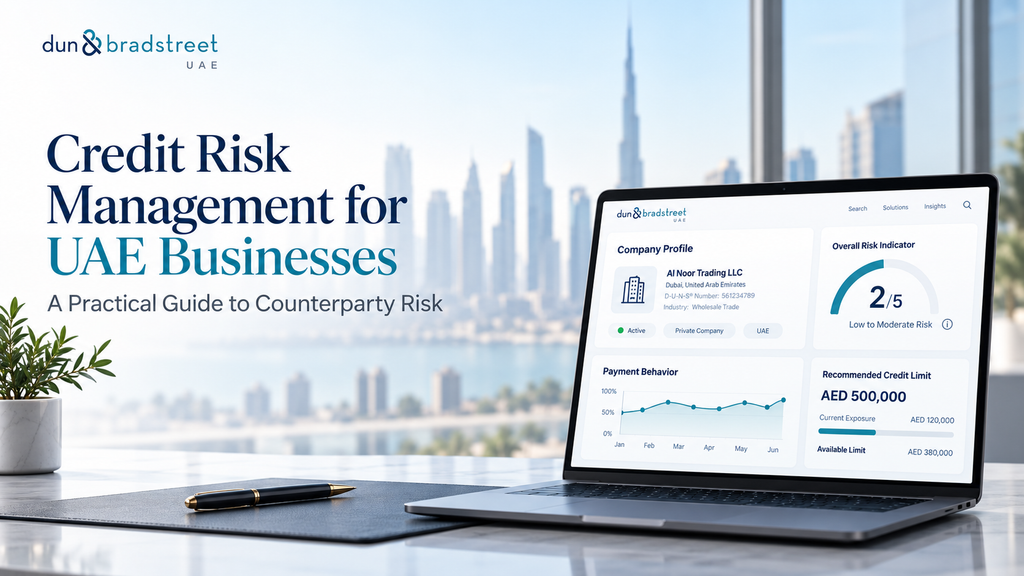
Selling on credit is standard practice across the UAE, from trading and logistics to construction and professional services. It also means every unpaid invoice is an unsecured loan to a customer. Credit risk management is the discipline of deciding who receives credit, how much and on what terms, then monitoring those decisions as circumstances change. This guide explains how decision-makers can assess counterparty risk, set sensible limits and spot trouble early, with attention to UAE conditions such as the 2023 bankruptcy law and separate free zone regimes.
What Credit Risk Management Involves for UAE Businesses
Credit risk is the possibility that a customer pays late or not at all. Managing it is a cycle of four steps: assess the counterparty, set limits and terms, monitor the account, and act when warning signs appear. A written credit policy ties these steps together, so approvals do not depend on who happens to handle the account.
The stakes are practical. Late payments tie up working capital, and one large default can outweigh the margin on many profitable sales. Concentration makes this worse, because a business that relies on a few large buyers carries more risk than its sales figures suggest.
How to Assess Counterparty Credit Risk
Start with identity. Confirm the legal entity, its licence and its jurisdiction. Companies in DIFC and ADGM operate under their own insolvency regimes, while the federal bankruptcy law applies elsewhere in the UAE. Then review ownership, financial condition and payment history.
A Business Information Report brings these together. According to D&B UAE, it includes a business summary, corporate family tree, D&B Rating, history including suits, liens and bankruptcies where available, payment history, directors and a recommended credit limit. Treat the output as evidence, then add your own judgement about contract size, sector and the relationship. For new customers with limited history, start with a conservative limit and raise it only as payments prove reliable.
Setting Credit Limits and Payment Terms
A credit limit should reflect the customer’s capacity to pay and the loss your business can absorb, not simply the size of the order. A common approach is to tier accounts by risk. Low-risk customers receive standard terms, while weaker ones receive lower limits, shorter terms, advance payment or security.
Record the reasoning behind each limit, and watch total exposure to any one customer or sector, which should stay at a level where a single failure would not threaten your cash flow. When a sales team asks for an exception, the record shows what risk is being accepted and who approved it.
Monitoring Accounts and Spotting Early Warning Signs
Approval is only the start. Watch for slowing payments, repeated requests to extend terms, rising disputes, adverse legal events and changes in ownership or management. Review limits at least annually, and sooner after any of these triggers. A distributor that has paid within 30 days for two years and now settles at 55 days has changed its risk profile, even though no invoice is formally overdue.
Timing matters because of the legal position. Federal Decree-Law No. 51 of 2023 on Financial Restructuring and Bankruptcy has applied since 1 May 2024, and a court can stay creditor proceedings once a case opens. That can slow recovery, so catching deterioration early is worth more than chasing late payment.
For larger portfolios, D&B Finance Analytics offers dashboards showing risk breakdown, highlights businesses with slow payment or potential default, and sends alerts when an account becomes riskier.
Conclusion
Effective credit risk management is a routine, not a one-off check. Verify who you are dealing with, set limits that match the risk, record decisions and watch accounts as conditions change. Businesses that apply this consistently protect cash flow and depend less on any single customer. D&B UAE supports each step with business information and credit analytics. Enquire now to discuss your credit risk requirements.
Frequently Asked Questions
What is credit risk management?
It is the process of assessing the likelihood that a customer will not pay, setting credit limits and terms to match, and monitoring accounts over time. The aim is to keep bad debt and late payments within levels the business can absorb.
How do you assess a business customer’s creditworthiness?
Verify the legal entity, then review ownership, financial information, payment history and legal events such as suits or liens. A business credit report consolidates much of this. Combine it with your own experience of the customer and the size of the exposure.
What are the early warning signs of credit risk?
Common signs include slower payment, requests to extend terms, rising invoice disputes, adverse legal events and changes in management or ownership. One sign may be harmless, so look at the pattern over several months.
How often should credit limits be reviewed?
Frequency is a policy decision rather than a fixed legal requirement for most businesses. Annual review is a sensible baseline, with earlier review when a customer’s payment pattern changes or your exposure grows.
What happens to unpaid invoices if a UAE customer becomes insolvent?
Under the 2023 bankruptcy law, a court can stay creditor proceedings once a case opens, so claims are dealt with through the court process. Take legal advice, and note that DIFC and ADGM companies follow separate regimes.


