WhatsApp Us Now

The securities market offers opportunities for professionals who can analyse companies, evaluate financial performance, and prepare research-based investment recommendations. However, individuals and businesses planning to provide research services for a fee must understand the regulatory framework before starting their operations.
SEBI RA registration is the registration framework for research analysts governed by the Securities and Exchange Board of India (SEBI). The SEBI (Research Analysts) Regulations, 2014, as amended, establish requirements relating to registration, qualifications, disclosures, conduct, and ongoing compliance.
For aspiring research analysts, understanding these requirements helps avoid documentation errors and prepares them to operate within the applicable regulatory framework.
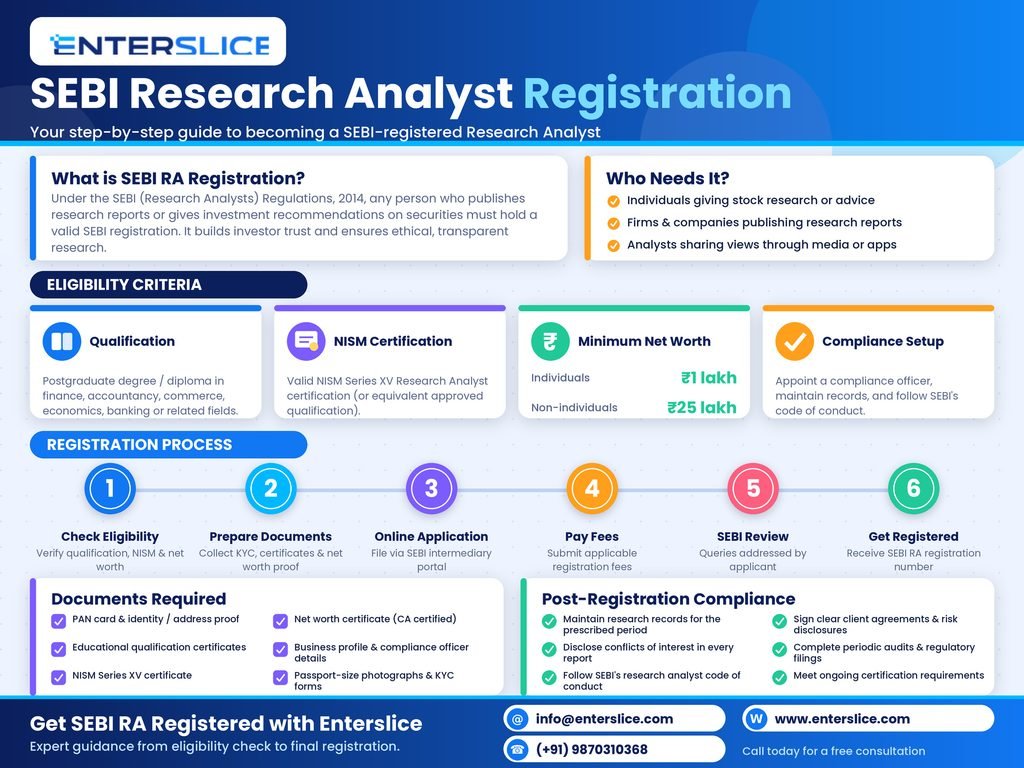
What Is SEBI Research Analyst Registration?
SEBI Research Analyst Registration is the regulatory registration required for persons or entities intending to provide research services covered under the SEBI (Research Analysts) Regulations, 2014, unless a specific exemption applies.
A SEBI-registered research analyst may analyse securities, study company financial statements, prepare research reports, and issue investment-related recommendations within the scope of the applicable regulations.
Research analysts may work independently, operate through an eligible business structure, or provide research services through a registered research entity. The appropriate registration route depends on the applicant’s business model and activities.
The purpose of the regulatory framework is to promote transparency, maintain professional standards, address conflicts of interest, and protect investors who rely on research-based information.
Who Needs SEBI RA Registration?
Individuals and entities intending to provide regulated research services for consideration generally need to assess their registration obligations before commencing operations.
Applicants may include:
- Independent research analysts providing research services.
- Sole proprietors operating a research analysis business.
- Partnership firms and limited liability partnerships.
- Companies engaged in issuing research reports.
- Existing market intermediaries that undertake research activities and are required to register.
The requirement depends on the nature of the services provided and whether an exemption applies. For example, SEBI’s regulatory FAQs clarify that investment advisers, asset management companies, credit rating agencies, and certain fund managers are exempt from obtaining separate registration under the Research Analysts Regulations, although other applicable provisions may still apply to their activities.
Eligibility Criteria for SEBI RA Registration
Applicants must satisfy the applicable eligibility conditions under the SEBI Research Analysts Regulations.
1. Educational qualifications
The applicant and relevant personnel involved in research activities must meet the prescribed educational or professional qualification requirements. Eligible qualifications may include recognised postgraduate degrees or diplomas in relevant fields such as finance, accountancy, commerce, economics, business management, capital markets, or financial services, as permitted by the regulations.
Certain recognised professional qualifications and programmes offered through the National Institute of Securities Markets (NISM) may also satisfy the applicable requirements.
2. NISM certification
The relevant NISM certification is an important requirement for research analysts. Applicants should verify the prescribed certification, examination requirements, validity, and continuing certification obligations before applying.
3. Fit-and-proper requirements
Applicants must satisfy the applicable fit-and-proper criteria and provide accurate information regarding their background, business activities, and regulatory history.
4. Financial and operational readiness
Applicants should assess their financial position, business structure, research infrastructure, record-keeping arrangements, and applicable deposit requirements. SEBI’s framework does not impose a conventional capital adequacy requirement on research analysts, but prescribed deposits and other financial obligations may apply.
Meeting the eligibility criteria does not automatically guarantee registration. The application remains subject to regulatory scrutiny.
SEBI RA Registration Process
The SEBI RA registration process involves preparing the application, submitting supporting documents, and completing the prescribed regulatory formalities.
Step 1: Assess the registration requirement
Determine whether the proposed business activities fall within the definition of research analyst services. Identify the appropriate applicant category and confirm whether any exemption applies.
Step 2: Complete qualification and certification requirements
Verify the educational qualifications and NISM certification requirements applicable to the applicant and relevant personnel.
Step 3: Prepare the supporting documents
Compile the required identity, address, financial, professional, business, and compliance-related documents. Check that the information is consistent across the application and supporting records.
Step 4: Submit the application
The application is made in Form A under the Research Analysts Regulations through the prescribed Research Analyst Administration and Supervisory Body (RAASB) process. SEBI’s July 2025 regulatory FAQs identify the BSE research analyst membership portal as the application route.
Step 5: Respond to queries
The application undergoes scrutiny. If additional information, clarification, or supporting documentation is requested, the applicant should respond accurately and within the prescribed timeline.
Step 6: Complete the applicable fee and registration formalities
Pay the applicable registration fees and complete the relevant RAASB requirements. Registration is granted only after the application satisfies the applicable regulatory conditions.
Documents Required for SEBI Research Analyst Registration
The exact document list depends on the applicant’s legal structure and circumstances. Commonly required documents may include:
- PAN card and identity proof.
- Address proof and contact details.
- Educational qualification certificates.
- Relevant professional experience documents, where applicable.
- NISM certification details.
- Applicant and business constitution documents.
- Financial statements and applicable financial declarations.
- Details of research activities and infrastructure.
- Compliance policies, declarations, and other prescribed information.
- Additional documents requested during application scrutiny.
Applicants should use the latest checklist applicable to their category rather than relying on an outdated generic document list.
SEBI RA Registration Fees
The fees payable depend on the applicant category. According to SEBI’s circular dated July 23, 2025, the prescribed SEBI fees are:
| Applicant category | Application fee | Registration fee for the first five years | Subsequent five-year fee |
| Individual and partnership firm | ₹2,000 | ₹3,000 | ₹1,000 |
| Proxy adviser | ₹2,000 | ₹3,000 | ₹1,000 |
| Body corporate, including LLP | ₹20,000 | ₹30,000 | ₹5,000 |
These amounts represent the specified SEBI fees and do not necessarily include RAASB administrative charges, professional fees, certification costs, or other applicable expenses.
Registration generally remains valid unless suspended or cancelled, subject to payment of applicable fees every five years. Applicants should verify the current fee schedule and any additional RAASB charges before submitting an application.
Benefits of Becoming a SEBI-Registered Research Analyst
Registration can support the professional development of individuals and businesses engaged in securities research.
Regulatory recognition: Registration enables eligible applicants to provide covered research services within the applicable regulatory framework.
Client confidence: A valid registration and transparent disclosures can help clients assess the credibility of a research service provider.
Structured business operations: Regulatory requirements encourage documented research processes, conflict-of-interest controls, and consistent client communication.
Business opportunities: Eligible research analysts can develop research products, publish reports, and build professional relationships within the securities market, subject to applicable restrictions.
Registration does not guarantee business growth, investment returns, or client acquisition. Research quality, transparency, and compliance remain essential.
Compliance Requirements After Registration
Obtaining registration is only the beginning. Research analysts must maintain compliance with applicable SEBI regulations and circulars.
Key responsibilities include:
- Disclosing relevant financial interests and conflicts of interest.
- Maintaining research reports and prescribed records.
- Following applicable restrictions on personal trading.
- Providing required client disclosures and terms of service.
- Maintaining suitable systems for handling client grievances.
- Monitoring relevant personnel’s qualifications and certifications.
- Meeting applicable audit, reporting, deposit, and RAASB requirements.
- Following the prescribed code of conduct and restrictions on compensation and business activities.
Research analysts should periodically review regulatory updates to ensure their operating procedures remain aligned with current requirements.
How Enterslice Can Assist With SEBI RA Registration
The registration process requires careful attention to eligibility, documentation, application requirements, and regulatory compliance. Errors or incomplete submissions may lead to additional queries and delays.
Enterslice provides professional assistance to businesses and individuals seeking guidance on regulatory registrations and compliance. Support may include assessing the proposed business structure, preparing documentation, understanding application requirements, and identifying ongoing compliance obligations.
Applicants should evaluate their specific requirements before starting the process to ensure that the chosen registration route matches their intended activities.
Most popular services :
Sebi regulations regarding underwriting
Frequently Asked Questions
1. Is SEBI RA registration mandatory in India?
Registration is generally required for persons or entities providing research analyst services covered under the SEBI Research Analysts Regulations, unless an applicable exemption exists.
2. Can an individual apply for SEBI research analyst registration?
Yes. An individual may apply as an independent research analyst if the applicable eligibility, qualification, certification, and other regulatory conditions are satisfied.
3. Is NISM certification required for SEBI RA registration?
Relevant NISM certification requirements apply to research analysts and other specified persons associated with research services. Applicants should verify the current certification requirements for their category.
4. How much does SEBI RA registration cost?
The SEBI application and registration fees vary by applicant category. Additional RAASB administrative charges and professional or certification expenses may also apply.
5. Where is the SEBI research analyst application submitted?
Under SEBI’s July 2025 FAQs, applications are submitted in Form A through the prescribed RAASB process, including the BSE research analyst membership portal.
6. Does SEBI RA registration require renewal?
The registration certificate remains valid unless suspended or cancelled. Applicable fees must be paid every five years, and ongoing regulatory requirements continue to apply.
7. Can a SEBI-registered research analyst guarantee investment returns?
No. Registration does not guarantee investment performance. Research analysts must follow applicable regulations, make required disclosures, and avoid misleading claims.
Conclusion
SEBI RA registration is an important regulatory step for professionals and businesses planning to offer covered securities research services in India. Understanding eligibility, certification, documentation, application procedures, fees, and post-registration obligations helps applicants prepare more effectively.
With appropriate planning and professional guidance from Enterslice, applicants can better understand the registration requirements and establish a compliance framework suited to their proposed research activities. Always refer to the latest SEBI regulations, circulars, and RAASB instructions before applying.