 WhatsApp Us Now

Blog Summary
An advertising robot helps shopping malls extend digital advertising beyond fixed screens, engage visitors, and explore new revenue opportunities. But how does robotic advertising work, and can it generate measurable returns? This guide covers its applications, revenue models, performance metrics, and ROI.
Key Takeaways
- Advertising robots bring promotional content to different areas of shopping malls.
- Mall operators can generate revenue through sponsored campaigns, tenant promotions, and event advertising.
- AI-powered robots combine digital advertising, autonomous movement, visitor assistance, and analytics.
- Campaign performance can be measured through advertisement plays, interactions, and navigation requests.
- Actual ROI depends on advertiser demand, campaign revenue, utilization, and operating costs.
Introduction
Shopping malls invest in events, promotions, and digital advertising to attract visitors and support retail tenants. However, converting existing foot traffic into measurable advertising value remains an important challenge.
Traditional advertising formats, such as banners and digital screens, depend on fixed locations and visitor attention.
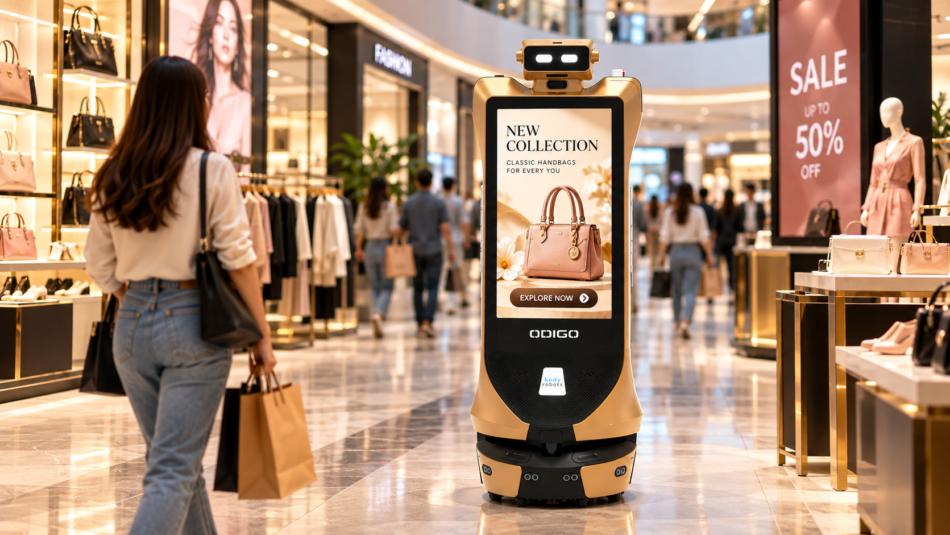
An advertising robot introduces a mobile approach. These robots can move through designated shopping areas, display promotional campaigns, and help visitors discover stores.
For mall marketing heads, robotic advertising represents an opportunity to expand advertising inventory without relying entirely on permanent installations.
What Is an Advertising Robot and How Does It Work?
An advertising robot is an autonomous mobile system equipped with digital displays for delivering promotional content in commercial environments.
Unlike stationary advertising screens, these robots can navigate predefined routes and showcase campaigns across multiple locations.
Common capabilities include:
- Digital displays for promotional videos and advertisements.
- Autonomous navigation with obstacle detection.
- Scheduled advertising campaigns.
- Interactive store directories and visitor assistance.
- Centralized content management and campaign analytics.
Some systems combine advertising with navigation, allowing visitors to search for stores and receive directions.
This creates opportunities to connect promotional campaigns with shopper needs.
Why Should Shopping Malls Consider Robotic Advertising?
Robotic advertising offers three potential benefits for mall operators.
1. Additional Advertising Inventory
Advertising robots create mobile promotional opportunities that complement existing screens, banners, and kiosks.
Mall operators can offer advertising packages without installing permanent displays in every location.
2. Better Tenant Promotion
Retailers can advertise seasonal offers, product launches, and store events in designated mall areas.
This allows participating tenants to communicate with visitors beyond their immediate storefronts.
3. Interactive Shopper Engagement
Some advertising robots also support visitor assistance and store navigation.
By combining promotional content with useful information, malls can create more interactive advertising experiences.
However, effectiveness depends on content relevance, visitor interest, and appropriate placement.
How Can Advertising Robots Generate Revenue?
For mall operators exploring how to monetize shopping mall foot traffic, robotic advertising offers several potential revenue models.
| Revenue Model | Opportunity |
| Sponsored advertising | Sell advertising slots to brands |
| Tenant promotions | Promote stores and seasonal offers |
| Zone-based advertising | Schedule campaigns in relevant areas |
| Event sponsorship | Offer advertising during mall events |
| Interactive campaigns | Run QR-based offers and activations |
For example, a mall selling four advertising packages at $750 per month could generate $3,000 in monthly gross revenue, or $36,000 annually.
This is a hypothetical example. Actual earnings depend on advertising demand, package pricing, utilization, and operating expenses.
Can Advertising Robots Deliver Measurable Results?
Advertising robots can provide performance data such as advertisement plays, visitor interactions, and navigation requests.
One real-world example comes from a 61-day deployment at LuLu Mall, Thiruvananthapuram, between June 1 and July 31, 2026.
Five Odigo advertising robots operated across two floors.
Odigo is developed by Kody Robots, a top robotics company in India specializing in autonomous service robotics.
| Performance Metric | Reported Result |
| Advertisement plays | 313,875 |
| Visitor interactions | 47,350 |
| Navigation requests | 6,050 |
| Deployment duration | 61 days |
| Robots deployed | 5 |
These figures demonstrate measurable advertising activity and visitor engagement.
However, advertisement plays do not necessarily represent unique viewers, and interactions do not automatically translate into sales.
Mall operators should evaluate these metrics alongside advertiser revenue and campaign outcomes.
How Can Shopping Malls Measure Advertising Robot ROI?
Understanding advertising robot ROI requires evaluating both campaign performance and financial returns.
Mall marketing teams should measure:
- Campaign delivery: Advertisement plays, operating hours, and campaign coverage.
- Visitor engagement: Screen interactions, QR scans, and promotional responses.
- Store discovery: Navigation requests and attributable store visits, where measurable.
- Financial performance: Advertising revenue, ownership or leasing costs, maintenance, and operational expenses.
The basic ROI formula is:
ROI (%) = [(Revenue − Total Costs) ÷ Total Costs] × 100
For example, $36,000 in annual advertising revenue against $24,000 in annualized costs produces a 50% ROI.
This calculation is illustrative and does not guarantee similar results for other shopping malls.
What Should Mall Operators Consider Before Deployment?
Before introducing robotic advertising, mall operators should evaluate several practical factors.
Advertiser demand: Are brands and tenants willing to pay for additional advertising placements?
Operating environment: Can robots navigate designated areas without disrupting visitors?
Campaign relevance: Will promotional content match visitor interests and specific mall zones?
Operational costs: What expenses are associated with maintenance, software, charging, and support?
Performance measurement: Can advertising delivery and financial outcomes be tracked reliably?
A limited pilot with defined objectives can help malls evaluate commercial viability before expanding deployment.
Conclusion
An advertising robot offers shopping malls a way to expand digital advertising inventory, support tenant promotions, and introduce interactive visitor experiences.
Its commercial potential depends on advertiser participation, relevant campaigns, operational reliability, and measurable financial returns.
For mall marketing heads, the priority should be evaluating robotic advertising through practical pilot programs and performance data rather than technology capabilities alone.

