 WhatsApp Us Now

MRO Americas returns to Orlando on April 13-15, 2027, bringing the commercial aviation maintenance, repair and overhaul community together at the Orange County Convention Center. The people walking the aisles are engineers, procurement leads and maintenance executives. They’re comparing suppliers on precision and reliability, and your booth is part of that comparison, whether you intend it or not.
This article explains why bespoke exhibition stand design and build, done by a team in the USA, gives aviation brands a practical edge at a show like this.
Why aviation buyers read your booth differently
Aviation is an industry built on tolerances, traceability and safety. Buyers carry those habits onto the show floor. A booth that looks generic, or that doesn’t quite fit together, can quietly raise the question: if they’re this loose about their stand, how careful are they about everything else?
A well-made, purpose-built booth does the opposite. It signals that your company plans carefully and delivers what it says.
What “bespoke” means in practice
Bespoke means the stand is designed around your products, your workflow and your audience, not adapted from a template. For an aviation brand, that can include:
- Structures that carry real equipment, such as components, tooling or display assemblies, with proper load planning
- Demo areas where technical staff can show systems and walk buyers through them
- Private meeting space for confidential supplier and procurement conversations
- Clear technical storytelling, with graphics that explain complex capabilities quickly
- Materials and finishes that suit a serious, engineering-driven audience
An experienced exhibition booth designer starts by learning how your team sells, then shapes the layout around it. If the first thing you receive is a rendering with no questions behind it, that’s worth noticing.
Why local USA design and build matters
MRO Americas takes place in the United States, which makes working with a USA-based team especially practical. Here’s how it helps.
1. Shorter, simpler logistics
A domestic team ships within the country, with no customs, international freight windows or cross-border paperwork to plan around. For heavy or specialized displays, that removes a major source of delay.
2. Familiarity with US venue rules
Orlando’s convention center has its own rules on drayage, labor, rigging, electrical and booth height. A team that works in US venues regularly can plan for those from the first drawing, not discover them during install.
3. Faster communication
Shared time zones and shared business hours mean quick answers during design reviews and fast fixes when something changes. That adds up over a 12-week project.
4. Easier shop visits and approvals
You can see materials, finishes and mockups in person, which is hard to do when production happens overseas.
5. Clear accountability
When one US-based team handles design, fabrication and install, you know who owns the schedule.
The role of in-house fabrication
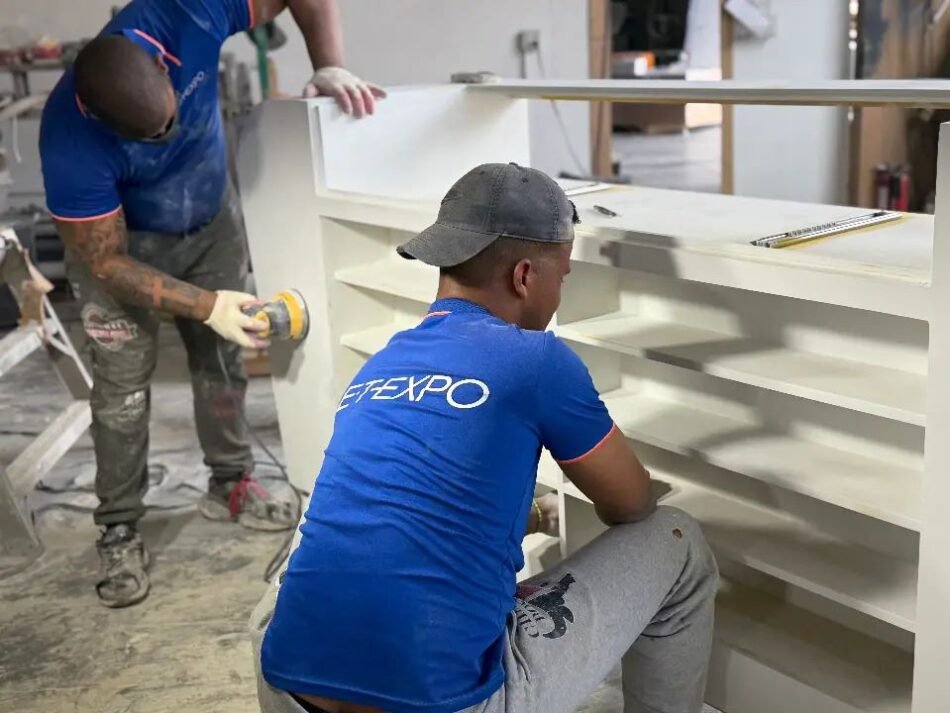
Not all companies that sell exhibits build them. Trade show exhibit fabrication can happen in the same shop as the design team, or it can be outsourced to another vendor, sometimes more than one. The difference matters for aviation brands because:
- Quality is easier to control when the people who designed the stand can inspect it as it’s built.
- Changes move faster when design and production sit together.
- Schedules are more reliable, because fewer handoffs mean fewer places for delays to hide.
- Fit and finish improve, because problems are caught in the shop, not on the show floor.
When you evaluate trade show exhibit manufacturers, ask directly: “What do you build yourselves, and what do you outsource?” The answer tells you a lot about control and accountability.
Questions to ask before you choose a partner
- Where is your fabrication facility, and can I visit?
- Have you built for aviation, aerospace or other technical industries?
- Have you installed at the Orange County Convention Center, and when?
- How do you plan structures for heavy or specialized equipment?
- What’s your realistic timeline from approval to show floor?
- Who is my point of contact, and who supervises on site?
- Is pricing itemized, including freight, install and dismantle?
- What happens if something arrives damaged or late?
Specific answers, with examples, are what you want.
Planning backward from April 13
A rough guide from our own project schedules (yours may differ):
| Time before show | What to be doing |
| 16 to 20 weeks | Define goals, size and budget; shortlist builders |
| 12 to 16 weeks | Approve design direction; begin engineering |
| 8 to 12 weeks | Fabrication; graphics finalized |
| 4 to 6 weeks | Final assembly checks; freight arranged |
| 1 to 2 weeks | Shipping confirmed; install planned |
Check the MRO Americas exhibitor manual for exact deadlines on shipping, power and rigging. Dates and venue details can change, so confirm with the organizer.
Custom vs. rental for aviation exhibitors
If you attend MRO Americas or similar shows every year, bespoke often makes sense. The booth carries your brand consistently, can be designed to reconfigure for other shows and can be engineered around your actual products. If it’s your first appearance and you’re still testing the show, a rental or semi-custom stand can be a smart step, with a custom build to follow once you’ve seen the results.
The bottom line
At a show where buyers judge on precision, a purpose-built stand sends the right message. A US-based design and build team adds practical advantages: simpler logistics, venue familiarity, faster communication and clear accountability. Combine that with in-house fabrication and a partner who’s worked in technical industries, and you’ve given your team the best chance of making the most of three busy days in Orlando.


