 WhatsApp Us Now

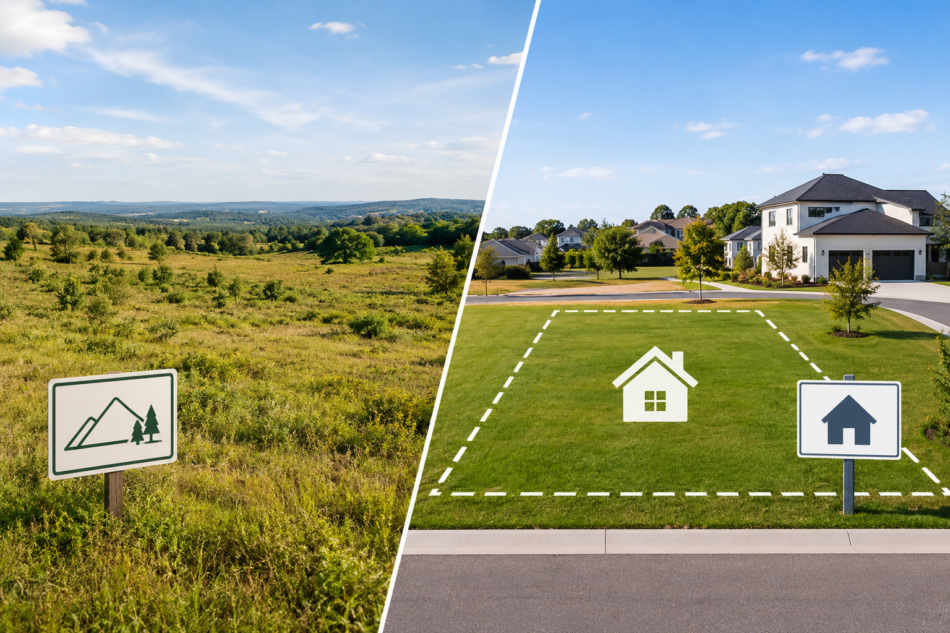
Investors often face a clear choice: buy raw acreage cheap and create value, or pay more for a lot ready to permit. Both can profit, but differently. Raw land rewards patience and research. Buildable lots reward speed and certainty.
If you are weighing them, land investing comes down to cash, time, and entitlement risk you want to carry.
What Counts As Raw Land?
Raw land is undeveloped. No grading, no utilities at the line, no approved septic, and no final plat. Think wooded tracts, desert parcels with legal access only, or farm ground sold as is.
Price per acre and taxes are usually lower. You take on the checklist: confirm legal access, survey, soils, wetlands and flood zones, and how water and power will reach the site.
What Counts as a Buildable Lot?
A buildable lot is recognized as ready for a permit. That means a recorded plat, residential zoning, road frontage that meets code, and a verified water and wastewater solution.
You pay more because engineering and permits are done. You get clearer comps, simpler financing, and a shorter path to sale.
Cost and Financing Differences
Purchase Price
Raw land often lists for 30 to 70 percent less than a comparable buildable lot in the same area. The seller’s price in the work was left. Buildable lots are priced in completion, so they look high per acre but reasonable per home site.
Development and Holding Costs
Raw land costs appear after closing. Common items include a PERC test, survey, clearing, driveway, well, septic or utility extension, and fees. A well can run 8,000 to 15,000 dollars, a septic 10,000 to 25,000 dollars, and a power run 10,000 to 30,000 dollars.
Buildable lots roll many costs into the purchase price. You still pay permit and tap fees, but surprises are smaller. Both have holding costs: tax, insurance, and interest.
Financing is stricter for raw land. Many lenders ask for 30 to 50 percent down, shorter terms, and higher rates. Buildable lots often qualify for lot loans with lower down payments.
Risk, Timeline, And Entitlement
Raw land carries entitlement risk. You might plan four lots and learn zoning allows two, or half is for flood or wetlands. Minor subdivision can take 6 to 18 months; rezoning is longer.
Buildable lots carry market risk. Approvals are done, so risk shifts to whether builders will pay your price in 6 to 12 months.
Due Diligence For Raw Land
Verify title and legal access, zoning and setbacks, flood and wetlands, slope and soils, water and septic feasibility, utility distance, frontage and easements.
Due Diligence For Buildable Lots
Check the final plat and easements, septic approvals and expiration, utility letters and tap fees, recent lot sales within one mile, HOA rules and builder activity.
Return Potential And Exit Strategies
Raw land can produce larger percentage gains when you add value. Exits include quick flip as is, minor entitlement to create two to four lots, or long-term hold near growth corridors.
Buildable lots usually produce smaller percentages but faster turns. Exits include wholesale to a builder, retail to an owner builder, or build and sell.
In fast-growing suburbs, finished lots move quickly. In rural counties, raw land with owner financing may find more buyers.
Which Is A Better Investment For You?
Choose raw land if you have time, like research, and can manage county processes. It fits investors comfortable with large tracts.
Choose buildable lots if you want speed and certainty. It fits investors who want cleaner comps and easier loans and buyers who need to permit now.
Many hold both. Raw land for higher margin, buildable lots for cash flow.
How To Evaluate Deals Like A Pro
Use the same checklist for every parcel. Confirm ownership, acreage, and boundaries. Pull flood, slope, wetlands, and frontage. Grade comps by distance, date, and similarity.
A dedicated real estate investor management software makes this repeatable. Filter for vacant, landlocked, flood coverage, and road frontage, then save maps and export owner lists. The right real estate investor management software keeps comps and follow-ups in one place.
Land Portal is built for this workflow, with nationwide parcel data, AI filters for land issues, and comp reports that help price offers.
To Sum Up
Raw land costs less up front but asks more in research, time, and entitlement. Buildable lots cost more up front but reduce uncertainty and shorten the sale cycle. The better choice matches your capital, timeline, and comfort with entitlement work.
A mix often works best. Use careful numbers and let land investing fundamentals guide your decision.
FAQs
Is raw land cheaper than a buildable lot?
Per acre, usually yes. Per the usable home site, not always. Add survey, access, well, septic, utilities, and fees to get the total cost.
Can you finance raw land?
Yes, but terms are tighter. Expect larger down payments and shorter terms. Seller financing and local banks are common.
How long to make raw land buildable?
A simple split can take 3 to 9 months. Rezoning or a new road can take 12 to 24 months.
What makes a lot truly buildable?
Recorded plat, residential zoning, legal access that meets code, verified water and wastewater solution, and no unresolved flood or wetlands.
Which has lower taxes?
Raw land usually has lower taxes and little maintenance. Subdivision lots may have higher tax and HOA dues.


