 WhatsApp Us Now


Corten B steel plate keeps its strength, dimensions, and weathering behavior through cutting, drilling, and welding when fabricators follow controlled procedures. Inadequate practice undoes each of those gains. Corten B is a weathering steel that contains copper, chromium, and nickel, with a minimum yield strength of 345 MPa. Engineers specify it for unpainted outdoor structures. Fabrication then decides the result: a hardened edge, an oversized hole, or a mismatched filler wire each reduces dimensional accuracy, structural integrity, or patina quality.
What Happens to Corten B Plate During Cutting?
Thermal Cutting Methods and Their Effects on Edges
When a torch, plasma arc, or laser cuts the plate, the edge heats and cools fast. That cycle hardens a narrow band beside the cut. Oxy-fuel handles thick sections, while laser holds tighter tolerances on thin plate. On thick sections, preheat before oxy-fuel cutting to reduce the risk of edge cracking. Light grinding removes the hardened layer and slag before welding or coating.
Mechanical Cutting, Edge Quality, and Finishing Requirements
Sawing, shearing, and waterjet cutting leave Corten B plate free of a heat-affected zone. Shearing suits thinner sections but leaves burrs and a work-hardened edge. Waterjet leaves a clean, cold edge that needs little finishing.
How to Minimize Distortion and Material Waste
Tight nesting and a planned cut sequence reduce scrap and limit movement. When fabricators cut inner features first and balance cuts on both sides of a part, residual stress releases evenly. Clamps keep long parts flat.
How Does Drilling Affect Corten B Plate?
Selecting Drill Bits and Cutting Parameters
As Corten B steel plate is stronger than mild steel, drill it with cobalt high-speed steel or carbide-tipped bits at reduced speeds. A steady feed and flood coolant keep the bit sharp and avoid work hardening at the hole wall. Hold the drill perpendicular to the plate to protect hole geometry.
Preventing Burrs, Oversized Holes, and Surface Damage
With a sharp bit and a rigid backing plate, the hole exits clean and the burr stays small. Pilot holes guide larger drills and keep the diameter true. Light deburring protects bolt seats and the surrounding surface.
Maintaining Hole Accuracy for Bolted Connections
When bolts carry load, hole size and position control the joint. Clearance holes run 1.5 to 2 mm above bolt diameter for M16 to M24 bolts. A drilling template or CNC machine holds spacing and edge distances.
What Should Be Considered When Welding Corten B Plate?
Suitable Welding Processes for Corten B Steel
Corten B steel plate accepts shielded metal arc, gas metal arc, flux-cored arc and submerged arc welding. Low-hydrogen practice applies to all four. Plate thickness, joint position and site conditions decide the process.
Filler Metal Selection and Weld Compatibility
When the structure stays unpainted, use filler metal with matching copper, chromium and nickel content, such as E8018-W2 for manual arc welding. Matching chemistry lets the weld weather at the same rate as the parent plate.
Preheating, Heat Input, and Cooling Considerations
If the plate exceeds 38 mm, restraint runs high, or the ambient temperature drops below 5°C, preheat the joint. Moderate heat input protects the heat-affected zone, and slow cooling lowers the cracking risk. Hold the interpass temperature within the welding procedure.
Preventing Weld Defects and Excessive Distortion
Dry electrodes and joints free of oil, scale and moisture prevent porosity and hydrogen cracking. Tack welds, back-step sequences and balanced passes limit distortion. Correct current settings prevent undercut and lack of fusion.
Does Fabrication Affect Corten B Plate’s Weathering Performance?
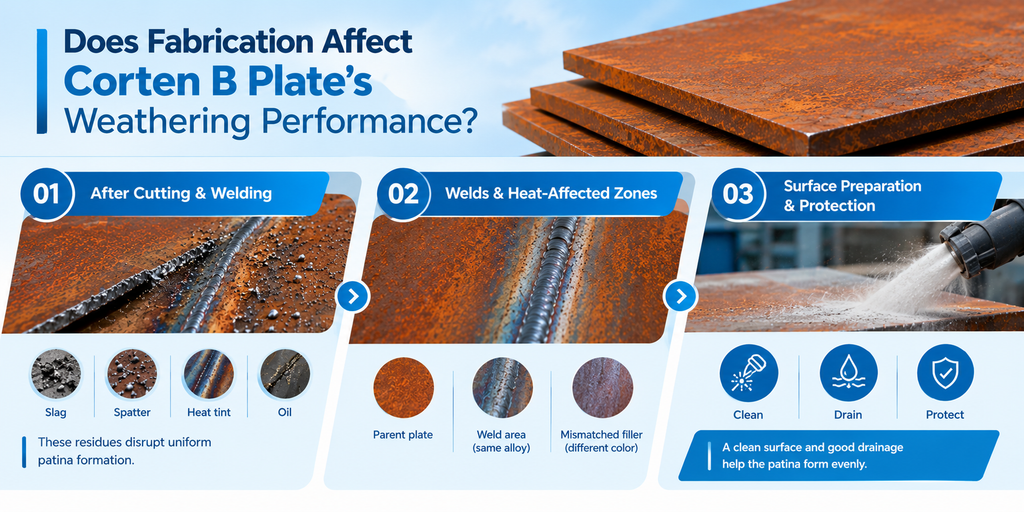
Changes to the Surface During Cutting and Welding
After cutting and welding, slag, spatter, heat tint and oil remain on the surface. Each one disrupts uniform patina formation. Bare cut edges weather normally because the steel beneath carries the same alloy content.
Weld Areas, Heat-Affected Zones, and Patina Development
When weld metal matches the parent plate, the weld and heat-affected zone develop patina at the same pace as the surrounding surface. Alternating wet and dry cycles drive that growth across all zones. Mismatched filler shows as a stripe of different color.
Surface Cleaning and Post-Fabrication Protection
Abrasive blasting removes mill scale, spatter and marker paint, which gives the patina an even start. Drain water away from joints, because standing water prevents a stable layer from forming. Coat buried or splash zones.
How Should Fabricated Corten B Components Be Inspected?
Checking Dimensions, Edges, and Drilled Holes
Measure finished parts against drawing tolerances with calibrated tools. Check cut edges for notches and cracks. Gauge each hole for diameter, position, and edge distance.
Inspecting Weld Quality and Surface Conditions
Visual inspection covers every weld and magnetic particle, dye penetrant, or ultrasonic testing covers critical joints. Inspectors also confirm that no oil, scale, or spatter remains before exposure.
Verifying Material Grade and Fabrication Records
Match mill test certificates and heat numbers to the delivered plate. Keep welding procedure specifications, welder qualifications, and inspection reports with each component for traceability.
Where Are Fabricated Corten B Plates Commonly Used?
Bridge girders, rail wagons, shipping containers, and chimneys use fabricated Corten B plates for their load capacity and unpainted durability. Architects specify them for facade panels, retaining walls, and landscape features, where the patina forms part of the design. Industrial fabricators weld Corten B plate into hoppers, silos, and storage equipment that face constant weather.
Conclusion
When fabricators control heat, hole quality and filler selection, Corten B steel plate retains its strength and weathering behavior after processing. Inspection confirms that each step met the drawing. Follow project specifications and qualified fabrication procedures, because they set the limits for preheat, heat input, and tolerances.
FAQs
Can Corten B plate be cut using plasma cutting?
Yes. Plasma cuts the Corten B plate quickly on medium thicknesses, but it leaves a hardened edge and a narrow heat-affected zone. Grinding the edge before welding or coating restores a clean surface.
Does drilling reduce the strength of Corten B steel plate?
Drilled holes remove the cross-section but leave the surrounding steel unchanged. Designers account for the reduced net area, and drilling avoids the cold-work cracking that punching can cause.
Is preheating always required when welding Corten B plate?
Thickness, restraint, and temperature decide it. Thin plate welded with low-hydrogen consumables in warm, dry conditions needs none, while thick or restrained joints need preheat.
Does the protective patina form normally around welded areas?
When the filler matches the base plate and the surface is clean, the patina forms at the same rate as elsewhere. Spatter, slag, and mill scale delay it.


