 WhatsApp Us Now
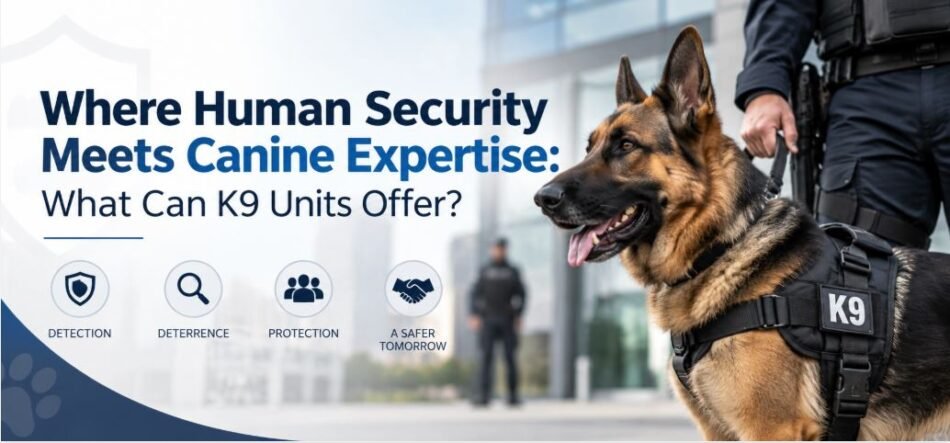
Discover how K9 unit security supports detection, patrol, search, and threat prevention while complementing professional security teams and technology.
Introduction
The security operations of today’s times are now relying on a mix of trained personnel and special detection capabilities to manage various forms of risks. Technology can be implemented to aid in surveillance and monitoring, and professional guards can offer physical presence and human judgment. The trained dogs and experienced handlers that comprise a K9 unit security add a novel layer of training. A canine can not only pick up certain smells but can detect any abnormal activity that may be otherwise hard to observe. When handling the dog properly, supervised and deployed, canine teams can complement the overall security measures within a business, industry and residential or event facility.
What Is a K9 Unit and How Does It Support Security Operations?
K9 Teams are elite dogs that have been trained with individual handlers. Unit effectiveness is dependent on the cooperation of the animal and handler following known procedures when on assignments for security.
Devoted teams of K9s can be arranged to patrol, detect, monitor the access points, search, and assess security. The handler reads the dog and makes sure that the correct protocols are adhered to during operations.
Dog teams do not replace human security team members, but are usually used in conjunction with them. When paired with trained guards, handlers, surveillance technology and access controls, a more comprehensive security program is established.
Key Roles of K9 Dogs in Modern Security
K-9 trained dogs can serve a variety of specialized security roles on a case-by-case basis. One of the most well-known roles is detection which involves specially trained dogs being able to find specific odor cues for banned or dangerous materials.
K9 teams can also assist the patrol by providing another sniffing capability on large properties. That they are there can help achieve visual dissuasion at events and at controlled facilities and enhance and complement the in-place security measures.
Another critical use case is search operations. Authorized teams and procedures with proper training can help with systematic searches of packages, vehicles or the designated area/facility.
How K9 Units Enhance Detection and Threat Prevention
A dog’s sense of smell is very powerful and is used to detect. A dog that has been trained can sniff out a particular scent, by sounding an alarm whenever it picks up the target scent.
This is one capability that can be integrated with traditional security measures to provide another layer of detection not relying solely on visual inspection or electronic sensors and cameras. K9 teams can thus play a role in multi-layered security strategies.
It also may be enough to deter intrusions if the presence of a dog team is observed. But the implementation depends on adequate training, well controlled handling, protocols and responsible supervision.
Types of K9 Dogs Used for Different Security Needs
Several breeds and particular dogs can be chosen based on their physical appearance, temperament, trainability, endurance and used for the particular security role.
Scent dogs and patrol support dogs, and patrol or track search dogs, are two types of dog that may be trained and used. Consideration of suitability should be given to the particular operational context, and not solely to the breed.
Factors to consider in determining deployment suitability include the dog’s health, behavior, and training history, and overall effectiveness in working with a handler.
Training and Skills That Make K9 Units Effective
A professional K9 team must be able to provide a dog and handlers with a well-organized training program. Exercise protocol may include redundant sessions to enhance scent recognition, searching skills, obedience, adaptation to environment, and consistent alerts.
Handlers must possess special knowledge in the ability to read a dog’s body language, work safely with a dog, demonstrate discipline during operation and have to adhere to specified security protocols.
Regular training is important and so must be regular evaluation since there is the need to continuously reinforce canine capabilities. The use of health monitoring and safe working conditions also plays a part in reliable performance.
Why Businesses and Organizations Choose K9 Unit Security
K9 unit security can supplement the existing security program and be used by businesses and/or organizations if an additional level of specific detection, increased patrol potential or visible deterrence would add to the security regime. For large facilities, warehouses, industrial sites, transportation areas, events, or sensitive property, canine teams can be beneficial.
Additionally, agencies can add value to K9 work in areas by supplementing human detection and search, as well as assisting human guards. When combined with access control, security, and communications solutions, as well as a protocol for emergency response, they are more effective.
Conclusion
The K9 unit security is a specialized method: The use of a dog’s nose together with experienced human management. A trained K9 dog can be used to help in detection, search and patrol functions, threat prevention, and can work in conjunction with the standard security system. Producing effective results relies on suitable dog selection, training, handler experience, health and correct deployment. At a broader level, when added to a comprehensive security policy, a trained and effective canine team can add another layer of capability to a business’s or organization’s arsenal when it comes to effective and thorough security.
Strengthen your security with trained K9 expertise. Contact Aegis Security today for professional canine security solutions tailored to your needs.


