 WhatsApp Us Now
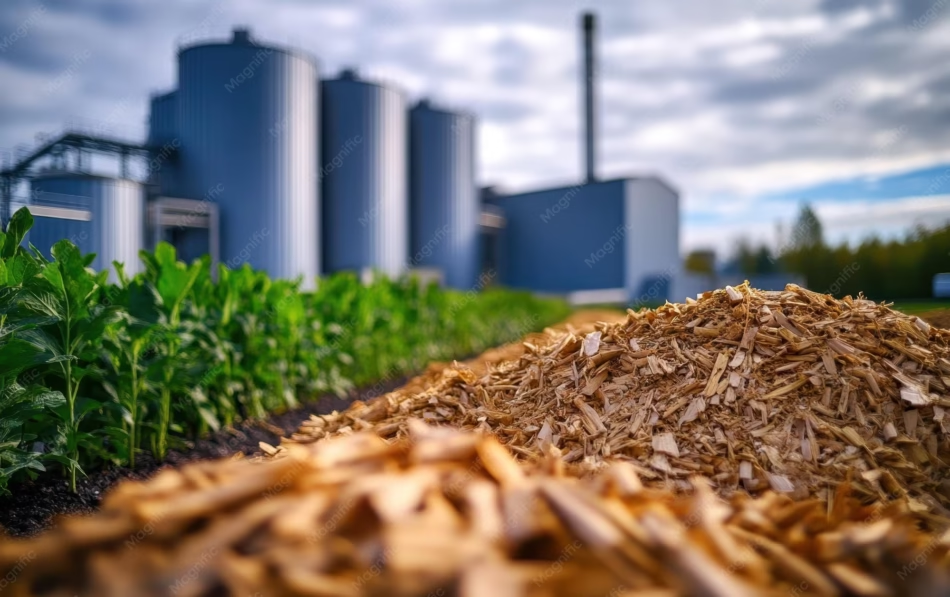
Biomass gasification is gaining attention as energy systems increasingly seek ways to convert agricultural residues, forestry waste, animal waste, and other biomass resources into useful energy and industrial products. Unlike conventional biomass combustion, gasification converts organic feedstocks into a combustible synthesis gas that can be used for power, industrial heat, hydrogen, renewable fuels, chemicals, ethanol, and biochar production.
According to a biomass gasification industry report, the sector reached USD 131.14 billion in 2025 and is projected to grow from USD 145.46 billion in 2026 to USD 270.90 billion by 2032, registering a CAGR of 10.92% during 2026–2032. Asia-Pacific accounted for approximately 38% of global revenue in 2026, while fluidized-bed gasifiers and agricultural residues represented the leading segments.
Decarbonization Policies Strengthen Gasification Demand
The transition toward lower-carbon energy systems is creating new applications for biomass gasification. Governments are increasingly supporting renewable electricity, industrial decarbonization, renewable fuels, and alternative hydrogen pathways, creating opportunities for technologies capable of converting locally available biomass into energy carriers.
The revised Renewable Energy Directive in the European Union establishes a binding target of at least 42.5% renewable energy by 2030, with an ambition to reach 45%. Such policy objectives can create opportunities for biomass-derived electricity, industrial heat, and renewable fuel production.
In emerging agricultural economies, policy support is also being directed toward converting crop residues into productive energy resources. India’s National Bioenergy Programme, for example, provides financial assistance for biomass gasifier projects supplying electricity and thermal energy to industries, rice mills, and rural communities.
Agricultural Residues Provide a Large Feedstock Base
Agricultural residues accounted for approximately 39% of the global biomass gasification sector in 2026, making them the largest feedstock category. Crop residues are widely available in agricultural economies and can provide a low-cost source of biomass without requiring additional land for energy crops.
Rice husks, straw, corn residues, sugarcane residues, and other agricultural by-products can be processed into synthesis gas when appropriate gasification technologies and feedstock-preparation systems are used.
The Food and Agriculture Organization has highlighted the importance of managing agricultural residues sustainably, particularly where open-field burning contributes to air-pollution concerns. Converting suitable residues into energy can create an alternative pathway for material that might otherwise be burned or discarded.
Fluidized-Bed Gasifiers Lead Technology Adoption
Fluidized-bed gasifiers represented approximately 56% of the sector by gasifier type in 2026. Their leading position is linked to their ability to handle diverse feedstocks and maintain relatively uniform operating conditions.
These systems can process heterogeneous materials such as agricultural residues, forestry waste, refuse-derived fuel, and other biomass feedstocks. Their feedstock flexibility is particularly valuable for commercial projects where biomass characteristics can vary according to season, geography, moisture, and source.
Fluidized-bed systems are also being developed for applications beyond conventional electricity generation. Projects involving renewable methanol and other fuels demonstrate how gasification technology is increasingly being integrated with downstream synthesis processes.
Hydrogen Opens a Higher-Value Application
Biomass gasification is increasingly being considered as a pathway for producing renewable hydrogen. Through gasification and subsequent gas-cleaning and conversion processes, biomass-derived synthesis gas can be used as a feedstock for hydrogen production.
The International Energy Agency reported that global hydrogen demand approached 100 million tonnes in 2024, while more than 99% of supply came from unabated fossil fuels. This imbalance is encouraging interest in alternative production pathways, including biomass-based routes.
Biomass gasification can potentially combine hydrogen production with other outputs such as electricity, heat, biochar, and renewable fuels. This multi-product approach may provide additional revenue streams and improve the utilization of biomass resources.
Renewable Fuels Expand the Role of Gasification
The technology is also moving into sustainable fuel production. Gasification can convert biomass into synthesis gas that can subsequently be processed into fuels such as green methanol, sustainable aviation fuel, and other bio-based products.
In China, Clariant’s MegaMax catalyst was selected for a commercial-scale biomass gasification-to-green-methanol project that is expected to convert agricultural waste and renewable electricity into 250,000 tonnes of green methanol annually by 2027.
Such projects indicate a shift from biomass gasification being used primarily for electricity and heat toward integrated platforms capable of producing higher-value renewable fuels and chemicals.
Asia-Pacific Maintains a Leading Position
Asia-Pacific accounted for approximately 38% of global biomass gasification revenue in 2026. The region benefits from abundant agricultural and forestry residues, expanding renewable-energy infrastructure, industrial development, and government programs supporting biomass utilization.
China remains a major contributor, with cumulative installed biomass power-generation capacity reaching 46 GW by the end of 2024. Indonesia is also developing biomass-based syngas projects for decentralized energy applications.
The combination of agricultural feedstock availability and increasing energy demand provides a strong foundation for further deployment across the region.
Technical Challenges Influence Project Economics
Despite its potential, biomass gasification faces technical challenges. Tar formation, ash sintering, feedstock variability, and gas-cleaning requirements can affect plant efficiency, equipment reliability, and operating costs.
Tar can foul engines and other downstream equipment, while ash-related problems can interfere with gasifier operation. Variations in moisture content, particle size, and chemical composition can also influence gasification performance.
These challenges are encouraging greater interest in integrated waste-to-energy and polygeneration systems. Producing several outputs from a single feedstock can diversify project revenues and potentially improve the economics of biomass-conversion facilities.
Gasification Moves Toward Multi-Product Energy Systems
Biomass gasification is developing from a technology primarily associated with biomass-based power generation into a broader platform for renewable hydrogen, sustainable fuels, industrial heat, chemicals, and biochar. Agricultural residues remain the leading feedstock, while fluidized-bed gasifiers continue to hold a strong technological position.
Future development is likely to depend on feedstock availability, government incentives, gas-cleaning technologies, project economics, and demand for renewable fuels and hydrogen. As energy systems become more diversified, biomass gasification is increasingly positioned as a way to convert locally available organic resources into multiple forms of usable energy and industrial value.

