 WhatsApp Us Now
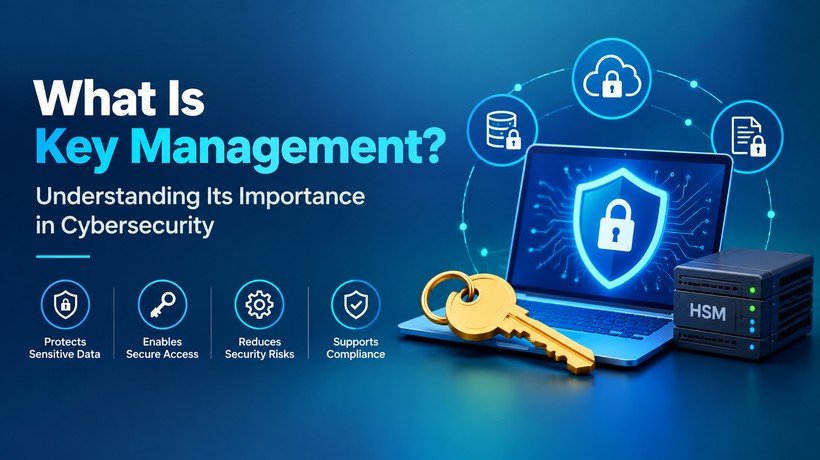
Key management protects sensitive data by securely creating, storing, using, rotating, and retiring cryptographic keys.
Learn how key management in cryptography, HSM Solutions, and secure hardware protect encryption keys from cyber threats. Discover the role of Thales technologies, HSM modules, and professional training in building stronger cybersecurity systems.
Introduction
Businesses rely on encryption to protect sensitive information from unauthorized access. However, encryption alone cannot provide complete security. Organizations must also protect the encryption keys that unlock encrypted data. This is where Key management becomes essential.
Key management refers to the processes, policies, and technologies organizations use to manage cryptographic keys throughout their lifecycle. Effective key management helps businesses control who can access encryption keys, where keys are stored, how they are used, and when they should be replaced or destroyed.
In modern cybersecurity environments, key management in cryptography plays a critical role in protecting financial information, customer records, application data, cloud workloads, and other sensitive assets.
What Is Key Management?
Key management is the systematic process of handling cryptographic keys securely throughout their entire lifecycle.
A cryptographic key works with an encryption algorithm to convert readable information into protected data and, when authorized, convert it back into its original form. If attackers gain access to the key, they may be able to decrypt sensitive information.
A strong key management strategy therefore focuses on protecting keys from unauthorized access, accidental loss, theft, misuse, and improper exposure.
Key management typically includes:
- Generating cryptographic keys securely
- Storing keys in protected environments
- Controlling access to keys
- Distributing keys securely
- Rotating keys regularly
- Backing up keys when required
- Revoking compromised or outdated keys
- Destroying keys securely when they are no longer needed
- Monitoring and auditing key usage
Together, these activities form the foundation of effective key management in cryptography.
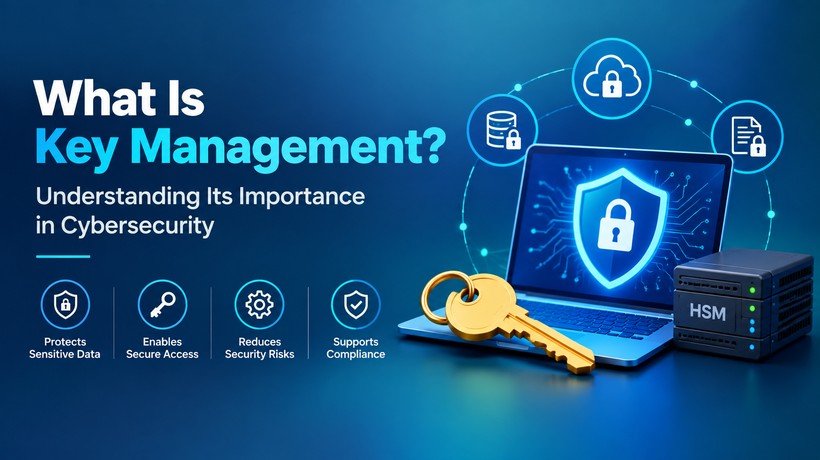
Why Is Key Management Important in Cybersecurity?
Encryption protects data, but encryption keys determine who can access that data. Poorly managed keys can weaken even the strongest encryption technology.
Here are some major reasons why organizations need effective Key management.
1. Protects Sensitive Data
Organizations store large amounts of confidential information, including customer details, financial records, passwords, intellectual property, and business documents.
Proper key management helps ensure that only authorized users, applications, and systems can access encrypted information.
2. Reduces the Risk of Key Theft
Attackers often target encryption keys because obtaining a valid key can provide direct access to protected information.
Organizations can reduce this risk by storing keys in secure systems, restricting access, and continuously monitoring key activity.
3. Supports Regulatory Compliance
Many industries must follow strict data protection and security requirements. Proper key management can help organizations demonstrate that they have appropriate controls for protecting sensitive information.
4. Enables Secure Access Control
Organizations can define who can create, use, manage, rotate, or revoke cryptographic keys. This supports role-based access control and reduces unnecessary access.
5. Simplifies Key Lifecycle Management
Organizations may manage thousands or even millions of cryptographic keys. Manual management can become difficult and error-prone.
Automated key management solutions help organizations manage keys consistently across applications, databases, servers, and cloud environments.
Understanding the Key Lifecycle
A cryptographic key has a lifecycle that begins with generation and ends with secure destruction or retirement.
Key Generation
The first step involves generating strong and unpredictable cryptographic keys. Organizations should use trusted cryptographic algorithms and secure random number generation mechanisms.
Key Storage
Keys must remain protected when they are not in use. Storing sensitive keys in unsecured files, databases, or application code can create significant security risks.
Organizations often use dedicated security technologies such as Hardware Security Modules (HSMs) to protect high-value cryptographic keys.
Key Distribution
Keys must reach authorized systems and users through secure channels. Organizations should prevent unauthorized parties from intercepting or obtaining keys during distribution.
Key Usage
Organizations should control how and when applications or users can use cryptographic keys. Access policies should follow the principle of least privilege.
Key Rotation
Organizations should replace keys periodically or when a security event requires it. Key rotation limits the amount of data protected by a single key and helps reduce long-term exposure.
Key Revocation
If a key becomes compromised, obsolete, or unauthorized, organizations should revoke it quickly to prevent further use.
Key Destruction
When an organization no longer needs a key, it should destroy it securely according to its security policies and regulatory requirements.
Managing every stage of this lifecycle helps organizations establish a mature key management in cryptography strategy.
What Are HSM Solutions?
HSM Solutions provide specialized hardware designed to protect cryptographic keys and perform sensitive cryptographic operations.
A Hardware Security Module can generate, store, and use cryptographic keys inside a controlled hardware environment. Instead of exposing sensitive keys to applications or general-purpose servers, organizations can keep critical key operations within the HSM.
HSM Solutions can support use cases such as:
- Encryption and decryption
- Digital signatures
- Certificate management
- Secure key generation
- Key storage
- Authentication
- Payment security
- Database encryption
- Public Key Infrastructure (PKI)
- Cloud security
HSMs are particularly valuable for organizations that need strong protection for high-value cryptographic keys.
What Are HSM Modules?
HSM modules are specialized security components that provide hardware-based protection for cryptographic operations and keys.
Unlike software-only key storage, HSM modules provide a dedicated security boundary for sensitive cryptographic operations. They can help prevent unauthorized access to keys and provide additional controls for managing cryptographic workloads.
Organizations may deploy HSM modules in different environments depending on their security requirements, including:
- On-premises data centers
- Private cloud environments
- Hybrid infrastructures
- Public cloud environments
- Payment systems
- Enterprise applications
Choosing the right HSM modules depends on factors such as performance, scalability, compliance requirements, integration capabilities, and deployment architecture.
What Is Thales Key Management?
Thales key management refers to key management capabilities associated with Thales security technologies and solutions.
Thales provides security technologies designed to help organizations protect cryptographic keys, manage encryption, and secure sensitive workloads. Its HSM technologies can provide a hardware-based environment for protecting keys and performing cryptographic operations.
Organizations can use Thales-based security technologies in areas such as:
- Enterprise encryption
- PKI
- Digital certificates
- Application security
- Database protection
- Cloud security
- Payment security
- Digital identity
- Code signing
A well-designed Thales key management strategy can help organizations centralize control over important cryptographic assets while supporting security, compliance, and operational requirements.
Key Management vs. Encryption: What Is the Difference?
Encryption and key management work together, but they are not the same thing.
Encryption transforms readable information into an unreadable format using a cryptographic algorithm and key.
Key management controls the entire lifecycle of the keys used by encryption and other cryptographic operations.
For example, encryption may protect a customer database. Key management determines how the encryption key is generated, where it is stored, who can use it, when it should be rotated, and how it should be retired.
Therefore, organizations should treat encryption and Key management as complementary components of a broader cybersecurity strategy.
Best Practices for Key Management
Organizations can improve their security posture by following established Key management practices.
Use Strong Cryptographic Keys
Use appropriate key lengths and modern cryptographic algorithms based on current security requirements.
Protect Keys with HSMs
High-value keys should be protected using secure technologies such as HSM Solutions where appropriate.
Apply Least-Privilege Access
Only authorized people, applications, and services should have access to cryptographic keys.
Rotate Keys Regularly
Create a defined key rotation policy and automate rotation wherever practical.
Monitor Key Usage
Maintain logs and audit trails to identify unusual or unauthorized key activity.
Separate Key Management Responsibilities
Organizations should avoid giving a single individual unrestricted control over the entire key lifecycle. Separation of duties can reduce insider threats and operational risks.
Have a Key Recovery Strategy
Organizations should carefully plan how they will recover critical keys in case of system failure, disaster, or other operational incidents.
Retire Keys Securely
When keys reach the end of their lifecycle, organizations should securely revoke and destroy them according to organizational policies.
Common Key Management Challenges
Although Key management is essential, organizations often face several challenges.
Managing Large Numbers of Keys
Large enterprises may have thousands of applications and systems that require cryptographic keys. Managing them manually can quickly become complex.
Multi-Cloud Environments
Organizations operating across multiple cloud platforms may need to manage keys across different infrastructures and services.
Human Error
Improper permissions, weak storage practices, accidental deletion, or failure to rotate keys can create security vulnerabilities.
Legacy Systems
Older applications may not support modern key management technologies, making migration and integration difficult.
Lack of Skilled Professionals
Effective cryptographic security requires professionals who understand encryption, HSM technologies, PKI, certificates, and key lifecycle management.
Why HSM Training Matters
Technology alone cannot guarantee security. Organizations also need professionals who understand how to configure, operate, monitor, and troubleshoot security technologies.
HSM training helps cybersecurity professionals understand important concepts such as:
- HSM architecture
- Cryptographic key management
- Key lifecycle processes
- HSM configuration
- Authentication and access control
- Backup and recovery
- Certificates and PKI
- Security policies
- Troubleshooting
- Enterprise HSM deployment
For professionals looking to build practical expertise, choosing the Best Luna HSM training provider in Delhi NCR can be an important step toward developing specialized knowledge in HSM and cryptographic security.
At AppleShine, the focus is on helping professionals understand cybersecurity technologies through practical and industry-relevant learning.
How HSMs Strengthen Key Management
HSMs add a dedicated layer of hardware-based security to cryptographic key management.
Instead of keeping sensitive keys in application code or ordinary server storage, organizations can protect them inside an HSM. Applications can request cryptographic operations without directly exposing the underlying key material.
This approach can help organizations:
- Reduce key exposure
- Strengthen access controls
- Centralize cryptographic operations
- Support auditing
- Improve security for critical applications
- Protect high-value encryption keys
HSMs therefore form an important component of enterprise key management in cryptography.
Key Management in Cloud Environments
Cloud adoption has changed how organizations manage encryption keys. Businesses may now operate applications across public cloud, private cloud, and on-premises environments.
This distributed infrastructure creates new Key management requirements.
Organizations need to understand:
- Where keys are stored
- Who controls the keys
- Which applications can access them
- How keys move between environments
- How keys are rotated
- How organizations recover keys
- How cloud and on-premises systems integrate
Organizations can combine cloud-native key management services with HSM-based security technologies to create stronger protection for sensitive workloads.
How AppleShine Can Help
Understanding cryptography and Key management requires both theoretical knowledge and practical skills.
AppleShine focuses on cybersecurity and technology education, helping professionals develop knowledge of HSM technologies, cryptographic security, and enterprise security practices.
Whether you are beginning your cybersecurity journey or looking to strengthen your HSM expertise, practical training can help you better understand technologies such as HSM modules and enterprise key management solutions.
Conclusion
Key management is one of the most important components of modern cybersecurity. Encryption can protect sensitive information, but organizations must also protect the keys that control access to that information.
A strong key management in cryptography strategy covers the complete key lifecycle, including generation, storage, distribution, usage, rotation, revocation, and destruction.
Organizations can strengthen this process by implementing appropriate HSM Solutions, following security best practices, and training professionals in technologies such as Thales key management and HSM modules.
As cyber threats continue to evolve, effective Key management will remain essential for protecting sensitive data, supporting compliance, and building resilient security architectures.
Secure the data. Protect the keys. Strengthen cybersecurity with effective Key management.