 WhatsApp Us Now
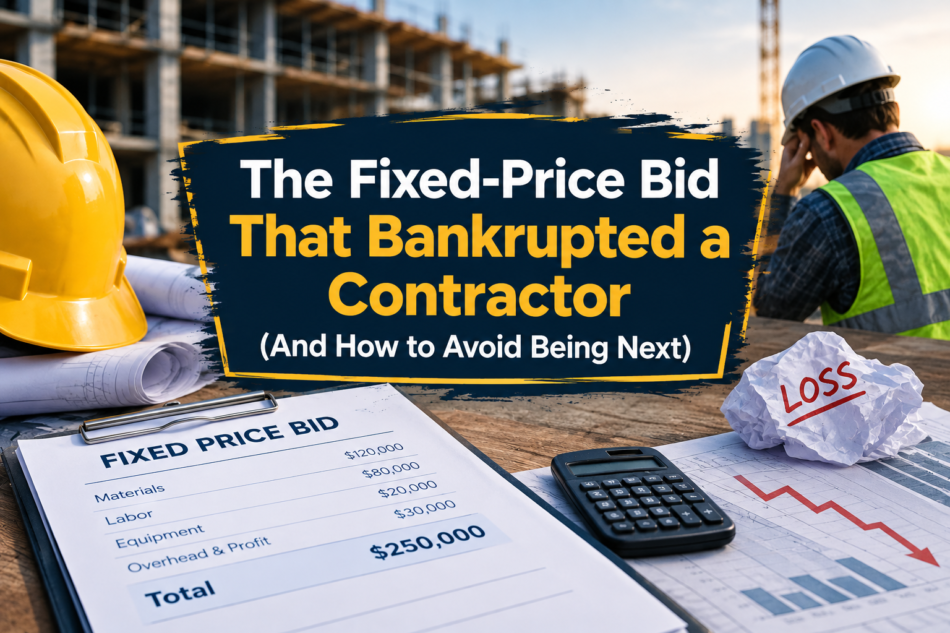
A general contractor signs a fixed-price contract for a multi-year project. The number looks solid at the time, margins are reasonable, the schedule is realistic, everyone shakes hands. Eighteen months later, steel prices have jumped, lumber costs have swung twice, and skilled labor is harder and more expensive to find than it was at signing. The “solid” bid is now underwater, and there’s no clause in the contract that lets the contractor recover a dime of the difference.
This scenario plays out more often than the industry likes to admit, and it’s almost always preventable. The fix isn’t complicated, it just requires contractors to stop pricing long-term projects like they’re static, one-time transactions.
Why Fixed-Price Bidding Gets Dangerous Over Time
A fixed price makes sense for a project that starts and finishes quickly. The problem shows up when a project stretches across months or years, because the assumptions baked into the original bid quietly go stale while the contract terms stay frozen.
A Bid Is a Snapshot, Not a Forecast
Every estimate reflects material and labor pricing at the moment it was calculated. That’s fine for a short job. But for a project running twelve, eighteen, or twenty-four months, treating that snapshot as valid for the entire duration ignores how much the underlying cost environment can shift in that window.
Contractors Absorb Risk They Never Explicitly Agreed To
When a fixed-price contract has no mechanism for adjusting to cost changes, the contractor is implicitly agreeing to absorb all inflation risk for the life of the project usually without realizing that’s what they signed up for. Clients rarely bring this up during negotiation, because it works entirely in their favor.
Long Projects Face Compounding Exposure
A short-term price swing is an inconvenience. A long-term project facing multiple swings across different material categories steel one quarter, lumber the next, labor throughout can see its margin erode gradually and invisibly until the numbers no longer work at all.
The Tool Most Contractors Underuse
There’s a data resource that exists specifically to solve this problem, and a surprising number of contractors either don’t know about it or don’t build it into their bidding process: a standardized measure that tracks how construction costs shift over time relative to a baseline period.
It Turns “Costs Went Up” Into a Measurable Number
Instead of a vague sense that “things got more expensive,” this kind of index gives contractors an actual figure, a percentage change relative to a base year that can be written directly into a contract as an objective adjustment mechanism rather than a subjective negotiation.
It’s Built From the Same Cost Categories Contractors Already Track
The underlying calculation draws from structural steel, cement, lumber, skilled labor rates, equipment costs, and energy pricing, the same categories that make up most project budgets in the first place, which is part of why it maps so cleanly onto real-world bid adjustments.
Location-Specific Versions Exist
Because labor rates and material availability vary significantly by region, many published versions of this index break figures down by location rather than applying one national number to every market, which matters enormously for contractors bidding across multiple regions.
Contractors who want a clear breakdown of how this index is actually calculated, what data feeds into it, and how it gets used in practice can find a detailed explanation in this guide on how the construction cost index works, which walks through the calculation method and the factors that move the number most.
Building Cost Protection Into a Contract
Understanding the index is one thing. Actually using it to protect a bid is where the real value shows up.
Escalation Clauses Tie Payments to Real Cost Movement
Rather than locking a price for the entire project duration, an escalation clause allows contract payments to adjust automatically when a referenced cost index moves beyond a defined threshold. This protects both parties the contractor isn’t stuck absorbing unexpected inflation, and the client isn’t paying padded contingencies for risk that may never materialize.
Index-Linked Clauses Are Easier to Negotiate Than They Sound
Clients are often more receptive to index-tied adjustment language than contractors expect, because it’s transparent and based on published third-party data rather than the contractor’s own judgment call. That objectivity tends to reduce friction during negotiation compared to asking for a flat contingency increase.
Historical Index Data Strengthens Future Bids
Reviewing how the index moved on past projects gives a contractor real evidence for how much buffer to build into future bids of similar duration and scope, replacing gut-feel contingency percentages with something grounded in actual historical cost behavior.
Practical Steps for Protecting Long-Term Bids
A few concrete habits go a long way toward avoiding the fixed-price trap described above.
Match Contract Length to Pricing Confidence
For any project stretching beyond a few months, build index-based escalation language into the contract from the start rather than trying to negotiate protection after signing, when leverage has already shifted.
Review Index Movement at Regular Intervals
Rather than waiting until a shortfall becomes obvious, checking index trends at scheduled project milestones gives a contractor early warning and time to communicate proactively with the client if adjustment provisions are about to trigger.
Educate Clients Early in the Bidding Process
Clients who understand upfront why escalation language exists are far less likely to push back on it mid-project. Framing it as a shared protection mechanism, rather than a one-sided contractor safeguard, tends to smooth the conversation considerably.
Final Thoughts
The contractor in the opening scenario didn’t lose money because they estimated poorly at the start; they lost money because the contract had no mechanism for the estimate to stay accurate over time. Fixed pricing works fine for short jobs, but any project stretching across a meaningful timeline needs a built-in way to track and respond to real cost movement. Understanding the data tools already built for exactly this purpose is the difference between absorbing every future price swing silently and having a defensible, contract-backed way to adjust for it.


