 WhatsApp Us Now
The global Polyurethane Coating Market is benefiting from increasing investments in electric vehicles, renewable energy infrastructure, industrial facilities, and infrastructure rehabilitation. Advanced formulations offering corrosion protection, UV resistance, durability, and environmental compliance are becoming increasingly important across end-use industries.
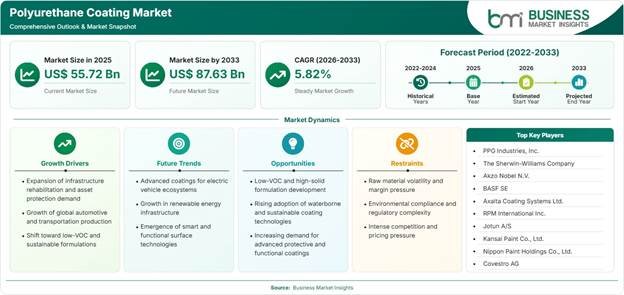
According to Business Market Insights, the global Polyurethane Coating Market Sizewas valued at US$ 55.72 Billion in 2025 and is projected to reach US$ 87.63 Billion by 2033, growing at a CAGR of 5.82% during 2026–2033.
Polyurethane Coating Market Strategic Framework
The strategic framework of the Polyurethane Coating Market encompasses raw-material suppliers, coating formulators, technology developers, distributors, contractors, and end-use industries. The value chain increasingly focuses on balancing coating performance, regulatory compliance, sustainability, application efficiency, and lifecycle costs.
Download Sample Report: https://www.businessmarketinsights.com/sample/BMIPUB00038586
Market Growth Projections
The Polyurethane Coating Market is projected to expand from US$ 55.72 Billion in 2025 to US$ 87.63 Billion by 2033, representing an absolute increase of approximately US$ 31.91 Billion during the forecast period. The market is expected to register a 5.82% CAGR between 2026 and 2033, supported by construction activity, automotive production, infrastructure rehabilitation, industrial maintenance, and sustainable coating development.
The demand for durable protective coatings is increasing as infrastructure owners and industrial operators seek to extend asset lifecycles and reduce maintenance costs. Bridges, highways, commercial buildings, pipelines, energy infrastructure, and industrial facilities require coatings capable of withstanding weather, corrosion, chemicals, and mechanical wear.
Automotive and transportation production is another important growth contributor. Polyurethane coatings are used to provide corrosion protection, surface durability, appearance enhancement, and component protection across vehicles and transportation equipment. The expansion of electric vehicle production is creating additional opportunities for specialized coatings.
Renewable energy infrastructure is also becoming an attractive application area. Wind turbines, solar structures, transmission assets, and energy storage infrastructure require protective coatings capable of providing UV protection, moisture resistance, and corrosion protection under challenging environmental conditions.
Market Drivers
Infrastructure Rehabilitation and Asset Protection Demand
Governments and infrastructure owners worldwide are investing in transportation infrastructure, utilities, commercial buildings, bridges, highways, and energy facilities. These investments generate demand for protective coatings that can extend asset life and reduce maintenance requirements.
Polyurethane coatings are particularly valuable in applications where long service intervals, weather resistance, and corrosion protection are critical. Increasing infrastructure rehabilitation activity is therefore supporting demand for advanced protective coating systems.
Expansion of Global Automotive and Transportation Production
Automotive and transportation manufacturing remains a major demand center for polyurethane coatings. Manufacturers require coatings that combine corrosion resistance, appearance, durability, and application efficiency.
The expansion of electric vehicle manufacturing is further supporting demand for specialized coating solutions. EV components and battery-related structures require coatings designed to provide durability, component protection, thermal performance, and long-term reliability.
Shift Toward Low-VOC and Sustainable Formulations
Environmental regulations across major markets are encouraging manufacturers to reduce emissions and adopt environmentally compliant coating technologies. Waterborne and other low-VOC formulations are gaining traction as coating manufacturers improve performance while reducing environmental impact.
Advances in resin formulation, curing technologies, and application methods are enabling sustainable coatings to compete more effectively with conventional technologies. This transition is expected to remain an important growth driver throughout the forecast period.
Market Opportunities
Advanced Coatings for Electric Vehicle Ecosystems
The expansion of electric vehicle manufacturing is creating opportunities for advanced polyurethane coatings. EV batteries, components, housings, and associated manufacturing equipment require specialized surface protection and durability.
Suppliers capable of developing coatings that combine corrosion resistance, insulation properties, lightweight performance, sustainability, and appearance quality can capture emerging opportunities across EV manufacturing ecosystems.
Growth in Renewable Energy Infrastructure
The global expansion of renewable energy infrastructure is creating new demand for protective coatings. Wind turbines, solar installations, transmission assets, and energy storage facilities operate in environments where exposure to moisture, UV radiation, corrosion, and temperature fluctuations can affect asset performance.
Advanced polyurethane coatings can provide protective properties that extend equipment life and reduce maintenance requirements, creating long-term opportunities for coating manufacturers.
Emergence of Smart and Functional Surface Technologies
The development of smart and functional coatings is expanding the market beyond conventional surface protection. Self-cleaning, self-repairing, antimicrobial, and condition-monitoring coating technologies are attracting interest across industrial applications.
Advances in nanotechnology, materials science, and digital monitoring are creating opportunities for coatings that provide measurable operational benefits in addition to traditional protection and aesthetic functions.
Market Restraints and Challenges
Raw Material Volatility and Margin Pressure
Polyols, isocyanates, solvents, additives, and petrochemical feedstocks remain vulnerable to energy-price fluctuations, trade disruptions, and supply-chain imbalances. Volatility in raw-material prices can place pressure on manufacturer margins and complicate long-term pricing agreements.
Smaller manufacturers may face greater exposure because of limited purchasing power and reduced ability to negotiate favorable supply contracts.
Environmental Compliance and Regulatory Complexity
Regulatory requirements governing emissions, hazardous substances, workplace safety, and product stewardship are becoming increasingly complex. Manufacturers must invest in formulation development, testing, certification, and compliance processes to meet changing requirements.
Companies operating across multiple countries must also manage different regulatory frameworks, which can increase development costs and extend commercialization timelines.
Market Segmentation
By Product Type
The Polyurethane Coating Market is segmented into Solvent-borne Coatings, Waterborne Coatings, Powder Coatings, and Radiation-based Coatings.
- Solvent-borne Coatings: Widely used across infrastructure, industrial equipment, and transportation because of their durability, chemical resistance, weather protection, and established application practices.
- Waterborne Coatings: Experiencing strong adoption because of reduced VOC emissions, environmental regulations, sustainability targets, and improvements in formulation performance.
- Powder Coatings: Benefit from high transfer efficiency, low material waste, excellent finish quality, and growing acceptance in industrial and architectural applications.
- Radiation-based Coatings: Supported by rapid curing, energy efficiency, premium surface finishes, and specialized industrial applications.
Solvent-borne coatings accounted for approximately 42%–46% of the market in 2025 and remain the leading product type. Waterborne coatings represent a high-growth segment, with a projected 6.8%–7.4% CAGR through 2033.
By Application
The market is segmented into Automotive & Transportation, Construction, Wood & Furniture, and Aerospace.
- Automotive & Transportation: Demand is supported by vehicle manufacturing, corrosion protection requirements, appearance enhancement, and electric mobility production.
- Construction: Polyurethane coatings are used across commercial buildings, residential developments, flooring systems, infrastructure, and protective structures.
- Wood & Furniture: Growth is supported by furniture exports, premium surface finishes, durability requirements, and demand for environmentally compliant products.
- Aerospace: Demand is driven by stringent performance requirements, fleet maintenance, corrosion protection, and technological advancements.
The application landscape remains diversified, with construction and transportation representing major consumption centers while aerospace and furniture provide specialized opportunities.
Top Players in the Polyurethane Coating Market
The Polyurethane Coating Market features strong competition among global coatings manufacturers and chemical technology providers. Companies are focusing on durability, sustainability, regulatory compliance, application efficiency, product innovation, and geographic expansion.
- PPG Industries, Inc.
- The Sherwin-Williams Company
- Akzo Nobel N.V.
- BASF SE
- Axalta Coating Systems Ltd.
- RPM International Inc.
- Jotun A/S
- Kansai Paint Co., Ltd.
- Nippon Paint Holdings Co., Ltd.
- Covestro AG
Leading companies are expanding their portfolios through advanced polyurethane systems, protective coatings, industrial finishes, automotive coatings, sustainable formulations, and specialty surface technologies. Strategic acquisitions and technology partnerships are also supporting geographic expansion, raw-material access, and product diversification.
Technological Innovations
Technological innovation in the Polyurethane Coating Market is increasingly focused on low-VOC technologies, waterborne formulations, UV-curable systems, smart coatings, and self-healing surfaces. These technologies aim to provide strong protective performance while addressing increasingly stringent environmental requirements.
The development of coatings for electric vehicle ecosystems is another important innovation area. Manufacturers are developing solutions capable of supporting corrosion protection, component durability, insulation, lightweighting, and heat-management requirements associated with EV platforms.
Digital color matching, predictive maintenance coatings, and advanced surface-engineering technologies are also becoming important competitive differentiators. These solutions can improve application efficiency, extend asset life, and provide measurable lifecycle benefits to industrial users.
Get Industry Snippets: https://www.businessmarketinsights.com/industry-overview/polyurethane-coating-market
Future Market Outlook
The Polyurethane Coating Market is expected to maintain steady growth through 2033 as infrastructure rehabilitation, automotive manufacturing, renewable energy investment, construction activity, and industrial maintenance continue generating demand for high-performance surface protection.
Solvent-borne coatings are expected to maintain their leading position because of their established industrial applications and durability. However, waterborne coatings are positioned for faster growth as environmental regulations, sustainability targets, and advances in formulation technology encourage manufacturers to reduce VOC emissions.
Electric vehicle manufacturing and renewable energy infrastructure will create additional opportunities for specialized polyurethane coatings. At the same time, smart, self-healing, self-cleaning, and condition-monitoring coatings could create higher-value applications across industrial and infrastructure markets.
Overall, the global Polyurethane Coating Market is projected to increase from US$ 55.72 Billion in 2025 to US$ 87.63 Billion by 2033, registering a CAGR of 5.82% during 2026–2033.
Frequently Asked Questions (FAQs)
What is driving the Polyurethane Coating Market?
Infrastructure rehabilitation, automotive and transportation production, construction activity, industrial maintenance, and the shift toward low-VOC and sustainable coating formulations are major market drivers.
Which product type dominates the Polyurethane Coating Market?
Solvent-borne coatings are the leading product type, accounting for approximately 42%–46% of the market in 2025 because of their durability, corrosion resistance, weather protection, and established industrial applications.
Which product type is expected to experience strong growth?
Waterborne coatings are expected to experience strong growth, supported by environmental regulations, reduced VOC emissions, sustainability targets, and improvements in coating performance.
Which industries generate the highest demand for polyurethane coatings?
Construction, automotive and transportation, aerospace, industrial manufacturing, and wood and furniture production are major demand centers for polyurethane coatings.
What are the major technology trends in the Polyurethane Coating Market?
Major trends include low-VOC formulations, waterborne technologies, UV-curable systems, smart coatings, self-healing surfaces, predictive maintenance coatings, and advanced solutions for electric vehicle and renewable energy applications.
What is the historical period, base year, and forecast period?
The base year for the market is 2025, while the forecast period is 2026–2033. The report was updated on August 27, 2026.
Browse More Reports

