 WhatsApp Us Now
The automotive airbags market is witnessing strong growth as airbags become an increasingly important component of modern vehicle safety architectures. Rising regulatory requirements, expanding production of SUVs and premium vehicles, and increasing integration of airbags with advanced electronic safety systems are supporting market development.
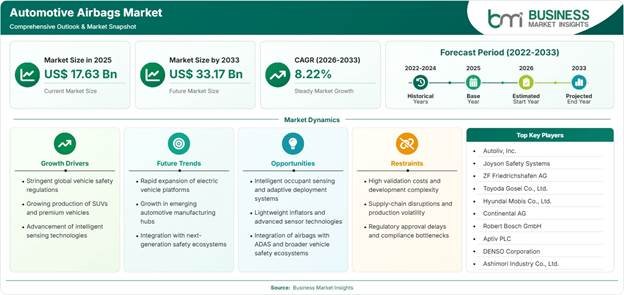
According to Business Market Insights, the global Automotive Airbags Market Sizewas valued at US$ 17.63 Billion in 2025 and is projected to reach US$ 33.17 Billion by 2033, growing at a CAGR of 8.22% during 2026–2033.
Automotive Airbags Market Strategic Framework
The strategic framework of the Automotive Airbags Market encompasses evolving vehicle safety regulations, occupant protection technologies, intelligent sensing systems, airbag components, vehicle platforms, OEM integration, and emerging electric vehicle architectures. The market value chain includes specialized suppliers of inflators, sensors, electronic systems, airbag modules, and integrated restraint technologies serving global automotive manufacturers.
Download Sample Report: https://www.businessmarketinsights.com/sample/BMIPUB00038616
Market Growth Projections
The Automotive Airbags Market is projected to expand from US$ 17.63 Billion in 2025 to US$ 33.17 Billion by 2033, reflecting an absolute increase of approximately US$ 15.54 Billion over the forecast period. The market is expected to record an 8.22% CAGR between 2026 and 2033, supported by regulatory requirements, vehicle production growth, increasing safety content, and technological advancements.
Demand for airbags is becoming increasingly influenced by the transition from conventional passive safety systems toward integrated occupant protection architectures. Automotive manufacturers are incorporating more sophisticated sensing and electronic control technologies to improve crash detection and optimize deployment timing.
The growing number of airbags installed per vehicle is another important factor supporting market value expansion. SUVs and premium vehicles generally incorporate higher safety content, including side and other advanced restraint systems. Increasing consumer awareness of vehicle safety is encouraging manufacturers to differentiate models through enhanced occupant protection features.
Electrification is also influencing the long-term market outlook. Electric vehicles feature different battery, seating, cabin, and structural configurations, requiring restraint suppliers to develop customized solutions. This creates opportunities for lightweight inflators, advanced sensing technologies, adaptive deployment systems, and software-enabled safety architectures.
Market Drivers
Stringent Global Vehicle Safety Regulations
Stringent vehicle safety regulations represent a major growth driver for the Automotive Airbags Market. Governments, regulatory authorities, and vehicle safety assessment organizations continue to strengthen crashworthiness requirements and encourage higher levels of occupant protection.
The increasing adoption of multi-airbag configurations reflects this regulatory evolution. Frontal airbags remain fundamental to vehicle safety, while side airbags and other advanced protection technologies are gaining importance as crash-testing procedures increasingly emphasize different collision scenarios.
Automotive manufacturers must continuously enhance restraint technologies to meet regulatory and safety-rating requirements. This supports investment in airbag engineering, crash sensors, deployment electronics, and integrated restraint systems.
Growing Production of SUVs and Premium Vehicles
The global increase in SUV and premium vehicle production is contributing to higher airbag content per vehicle. These vehicle categories commonly incorporate multiple occupant protection systems, including frontal and side airbags, increasing demand for airbag modules and associated components.
North America, China, India, and European automotive markets are important contributors to this trend. Increasing consumer preference for larger vehicles and greater emphasis on safety features encourage automakers to include advanced restraint technologies across vehicle platforms.
The transition toward electric SUVs and premium electric vehicles is further creating opportunities for suppliers to design restraint systems around new vehicle architectures.
Advancement of Intelligent Sensing Technologies
Modern airbags increasingly depend on sophisticated sensors and electronic control systems rather than basic mechanical deployment mechanisms. Impact sensors can provide more accurate crash information, enabling control units to determine appropriate deployment strategies.
Occupant sensing, improved impact detection, adaptive algorithms, and integration with broader vehicle safety systems are contributing to the development of intelligent restraint architectures. These technologies can improve deployment accuracy while creating opportunities for higher-value safety components.
The growing integration of airbags with ADAS and other electronic safety systems is expected to remain an important technology trend throughout the forecast period.
Market Opportunities
Rapid Expansion of Electric Vehicle Platforms
The global expansion of electric vehicle production creates opportunities for automotive airbag manufacturers because EV architectures can differ substantially from conventional internal-combustion vehicle platforms. Battery positioning, cabin configuration, seating arrangements, and vehicle structures can require customized occupant protection solutions.
Suppliers capable of developing lightweight inflators, advanced sensors, adaptive deployment algorithms, and vehicle-specific airbag configurations can strengthen their position within emerging EV supply chains.
Growth in Emerging Automotive Manufacturing Hubs
Automotive manufacturing is expanding across countries such as India, Southeast Asian economies, Mexico, and Eastern European markets. These manufacturing hubs provide opportunities for airbag suppliers to establish localized production and engineering capabilities close to vehicle OEMs.
Growing vehicle ownership, improving consumer purchasing power, evolving safety regulations, and increasing local automotive production can support greater airbag penetration across these markets.
Integration with Next-Generation Safety Ecosystems
The integration of passive and active safety technologies is creating opportunities for intelligent restraint systems. Airbags can increasingly operate alongside ADAS, predictive sensors, occupant monitoring systems, and other electronic safety technologies.
Suppliers that combine hardware, electronics, sensing, and software capabilities can benefit from the transition toward integrated vehicle safety architectures. Software-driven deployment strategies can also create opportunities for differentiated occupant protection solutions.
Market Restraints and Challenges
High Validation Costs and Development Complexity
Automotive restraint systems require extensive testing, validation, certification, and quality-control procedures before commercial deployment. Suppliers must meet stringent reliability and performance requirements while supporting multiple vehicle platforms.
These requirements increase engineering and development costs and can create barriers for smaller market participants. OEM qualification procedures can further extend development timelines and require significant investment in testing infrastructure.
Supply-Chain Disruptions and Production Volatility
Airbag manufacturing depends on a reliable supply of inflators, sensors, electronic components, specialized fabrics, and other materials. Disruptions in automotive production and global logistics can affect component availability and manufacturing schedules.
Raw-material price fluctuations and supply-chain instability can increase production costs and create challenges for suppliers serving global OEM programs. Localization and supply-chain diversification are therefore becoming increasingly important strategies.
Regulatory Approval and Compliance Requirements
Automotive safety systems must comply with increasingly complex regulatory and testing requirements across different markets. Changes in crash-testing protocols and certification standards can require suppliers to modify product designs and validation processes.
Although these requirements strengthen demand for advanced safety technologies, they can also increase compliance costs and development complexity.
Market Segmentation
By Type
- Frontal Airbag: Frontal airbags remain essential safety systems across passenger and commercial vehicles. Their broad installation base and regulatory importance support their leading position.
- Side Airbag: Side airbags are experiencing increasing adoption because of stronger side-impact protection requirements, consumer safety awareness, and expanded installation in mid-range vehicles.
By Vehicle Type
- Hatchback/Sedan: Continues to represent significant demand because of its broad global vehicle population and widespread airbag installation.
- SUV: Strong consumer demand and higher safety content support increasing airbag deployment across SUV platforms.
- LCV: Fleet modernization and commercial vehicle safety requirements support airbag adoption.
- HCV: Increasing emphasis on commercial vehicle safety creates opportunities for advanced restraint systems.
By Component
- Airbag Inflator: Critical to airbag deployment and increasingly subject to requirements for reliability, compact design, weight reduction, and manufacturing quality.
- Impact Sensors: Enable accurate crash detection and contribute to optimized deployment decisions.
- Indicator Lamp: Supports diagnostics, system monitoring, and vehicle safety assurance.
Top Players in the Automotive Airbags Market
The Automotive Airbags Market features a moderately consolidated competitive landscape, with major Tier-1 suppliers maintaining long-term relationships with global automotive OEMs. Companies are focusing on product innovation, intelligent sensing, lightweight components, advanced restraint architectures, and geographic expansion.
- Autoliv, Inc.
- Joyson Safety Systems
- ZF Friedrichshafen AG
- Toyoda Gosei Co., Ltd.
- Hyundai Mobis Co., Ltd.
- Continental AG
- Robert Bosch GmbH
- Aptiv PLC
- DENSO Corporation
- Ashimori Industry Co., Ltd.
Leading companies benefit from extensive OEM relationships, global manufacturing capabilities, validation expertise, and broad portfolios covering airbags, inflators, sensors, electronics, and integrated occupant protection systems.
Technological Innovations
Technological development in the Automotive Airbags Market is increasingly focused on intelligent occupant sensing and adaptive deployment. Advanced sensing systems can collect information about crash conditions and occupant positioning, enabling restraint systems to optimize deployment strategies.
The integration of airbags with ADAS and vehicle electronic architectures is also creating opportunities for predictive safety systems. Software-driven deployment algorithms can support more responsive occupant protection while enabling greater integration between passive and active safety technologies.
Electric vehicle platforms are further encouraging innovation. New battery layouts and cabin configurations require restraint suppliers to rethink airbag placement, inflator design, sensing architectures, and deployment strategies. Lightweight inflators and advanced sensor technologies are expected to remain important areas of innovation.
Get Industry Snippets: https://www.businessmarketinsights.com/industry-overview/automotive-airbags-market
Future Market Outlook
The Automotive Airbags Market is expected to maintain strong growth through 2033 as vehicle safety regulations, SUV production, electrification, and intelligent vehicle technologies continue to reshape occupant protection requirements.
Frontal airbags are expected to remain the largest product category because of their established regulatory and safety role. Meanwhile, side airbags and other advanced restraint technologies are positioned for stronger growth as vehicle safety assessments increasingly emphasize lateral collision protection.
The continued expansion of electric vehicle platforms will encourage airbag suppliers to develop customized restraint systems adapted to new cabin and vehicle architectures. Integration with ADAS, occupant monitoring, advanced sensors, and software-based safety systems will further increase the technological sophistication of automotive airbags.
Overall, the market is projected to increase from US$ 17.63 Billion in 2025 to US$ 33.17 Billion by 2033, representing a CAGR of 8.22% during 2026–2033.
Frequently Asked Questions (FAQs)
What is driving the Automotive Airbags Market?
Stringent global vehicle safety regulations, growing SUV and premium vehicle production, increasing consumer awareness, and advancements in intelligent sensing technologies are major factors driving market growth.
Which type of automotive airbag dominates the market?
Frontal airbags represent the leading type segment, supported by mandatory occupant protection requirements, established safety standards, and widespread OEM adoption.
Which vehicle type is creating significant demand for automotive airbags?
SUVs are an important demand category because of strong production growth, increasing safety content, and higher adoption of advanced occupant protection systems.
Which component is important for future market development?
Impact sensors and airbag inflators are particularly important as manufacturers pursue more accurate crash detection, adaptive deployment, lightweight designs, and intelligent restraint architectures.
What are the major technology trends in the Automotive Airbags Market?
Major trends include intelligent occupant sensing, adaptive deployment, advanced impact sensors, lightweight inflators, integration with ADAS, and restraint systems designed for electric vehicle architectures.
What is the historical period, base year, and forecast period for the market?
The historical period is 2022–2024, the base year is 2025, and the forecast period is 2026–2033.
Browse More Reports


