 WhatsApp Us Now
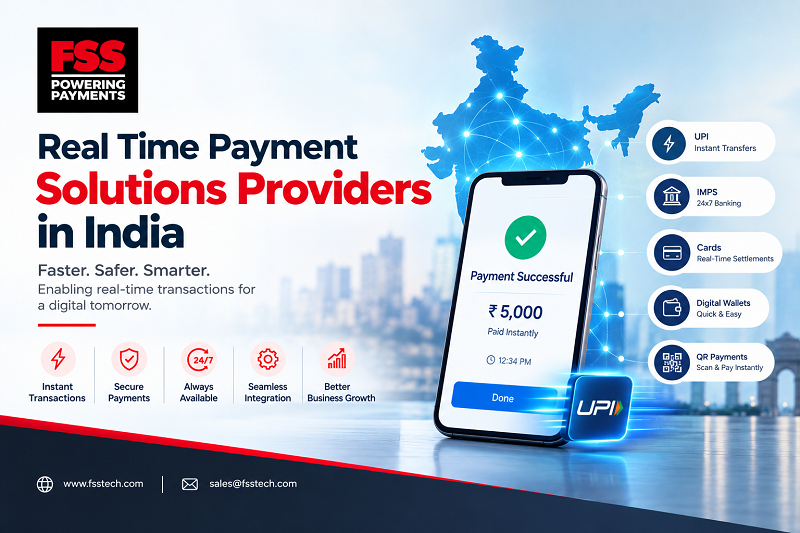
Real time payments have changed the way people and businesses move money.
A customer can now send money, pay a merchant, receive a refund or transfer funds without waiting for traditional banking settlement cycles.
India is one of the strongest examples of this change. NPCI’s official statistics show that UPI processed more than 22.7 billion transactions in June 2026, with 731 banks live on the network.
The growth is not limited to India. The USA, South Africa and UAE are also investing in faster payment infrastructure and digital banking services.
This has created demand for modern real time payment solutions that can connect banks, fintech companies, merchants and payment networks.
At the same time, banks are looking for more than payment speed. They need AI-based fraud detection, real-time monitoring, better routing, strong security and scalable infrastructure.
For this reason, choosing the right technology provider has become an important decision for financial institutions.
Which are the top 10 real time payment solutions providers in India in 2026?
There is no single provider that is right for every bank or fintech company.
Different providers focus on different parts of the payment ecosystem. Some provide payment hubs, while others provide instant payment processing, banking infrastructure, payment networks or digital payment technology.
For 2026, companies and platforms worth evaluating include FSS TECH, ACID Worldwide, FIS, Finastra, Temenos, Tietoevry, Volante Technologies, Tata Consultancy Services, Infosys and EdgeVerve.
The comparison below should not be treated as a fixed ranking. The right provider depends on transaction volume, supported payment rails, country requirements, integration needs, security, AI capabilities and the type of financial institution.
Why is FSS TECH an important real time payment solutions provider?


FSS TECH is an important provider to consider for banks and financial institutions looking for modern real time payment infrastructure.
Its FSS Real Time Payments platform is designed to support instant account-to-account payments and digital payment services.
According to FSS TECH, its real time payment platform has a 10,000+ TPS benchmark, supports more than 12 major Indian banks, has on boarded more than 6,000 merchants and processes around 400 million transactions monthly. It also reports a 99.999% transaction success rate.
The platform is now built on FSS BLAZE, which uses a microservices-based architecture.
FSS also highlights smart AI/ML-backed insights, high observability and fault-tolerant architecture as part of the platform.
This is important because real time payments need to work continuously.
A payment system cannot simply be fast. It also needs to be available, reliable and able to handle large transaction volumes.
How can FSS TECH help banks with instant payments?
A bank can use real time payment infrastructure to provide customers with instant account transfers.
The same infrastructure can support merchant payments, P2P payments, mobile payments and other digital payment use cases.
FSS TECH also has a wider payment ecosystem.
Its portfolio includes payment gateway technology, merchant acquiring, payment orchestration, card issuance and ATM card processing.
Its card issuance platform has issued more than 800 million cards globally and supports up to 200,000 card requests per day on a single deployment, according to FSS TECH.
This means a bank looking for both real time payment solutions and ATM card issuance technology can consider a broader FSS payment infrastructure rather than implementing completely separate systems.
How does ACID Worldwide support real time payments?
ACID Worldwide is a major global provider of real time payment technology.
Its real time payment solutions are designed to help banks, merchants and other financial institutions connect with instant payment networks.
ACID has a strong focus on India’s payment ecosystem.
The company describes India as the world’s largest real time payments market and highlights the role of UPI in driving digital payment adoption.
ACID also supports payment use cases such as request to pay, account-to-account payments and fraud management.
For banks looking to expand real time payment capabilities across different markets, ACID can be an important provider to evaluate.
Its focus is particularly relevant for financial institutions that want to connect modern payment infrastructure with existing banking systems.
Why is FIS a major competitor in real time payment infrastructure?
FIS provides payment technology for banks and financial institutions across different markets.
Its Money Movement Hub provides a single connection to modern payment schemes.
In the USA, FIS supports connections to real time payment rails such as RTP and FedNow, along with ACH and wire payments.
FIS also provides its Open Payment Framework, which is designed around ISO 20022 and supports real time, high-value domestic, international and batch payments.
This makes FIS especially relevant for banks that operate across multiple payment rails.
Its payment ecosystem also covers card issuing and processing.
FIS Total Issuing supports credit, debit and prepaid card programs and includes machine learning, behavioural analytics and advanced authorization controls.
This is useful for banks that want to connect instant payments with wider card and banking services.
How is Finastra helping banks move toward real time payments?
Finastra provides payment hubs and payment infrastructure for financial institutions.
Its payment solutions support real time and instant payment schemes such as SEPA Instant, FedNow, RTP, NAPAS and Prompt Pay.
Its payment hubs are designed to bring multiple payment rails into one platform.
This can include mass payments, high-value payments, real time payments and cross-border payments.
Finastra’s Global PAYplus is an ISO 20022-native, multi-rail payments hub that supports real time and other payment types across multiple regions.
Finastra is also adding AI to payment operations.
Its Payments To Go solution uses AI and machine learning to identify reasons for payment processing problems, while its OperatorAssist add-on uses generative AI to help with payment repair activities.
This shows how AI is becoming part of payment operations rather than being used only for fraud detection.
Why should banks consider Temenos for real time payment solutions?
Temenos provides payment technology designed for banks and financial institutions.
Its payment platform focuses on real time processing, scalability and payment rail management.
Temenos says its payment platform helps banks unify payment rails and manage the growing complexity of modern payment operations.
The platform also supports automation and embedded AI.
This can help banks improve payment processing and reduce manual work.
Temenos is therefore relevant for banks that want to modernize older payment systems and move toward a more flexible real time payment environment.
What does Tietoevry offer for instant payment processing?
Tietoevry provides payment hubs and instant payment solutions for banks and other financial institutions.
Its Payment Hub covers the payment lifecycle from initiation and execution to messaging and connectivity with external systems. It supports domestic, regional, international and real time payments.
Tietoevry also offers an instant payment platform for participants that supports 24/7 payment availability.
Its technology can support use cases such as P2P payments, QR payments, ecommerce payments, mobile payments, recurring payments and instant payouts.
This makes it relevant for banks looking for a broader instant payment environment rather than a single payment channel.
How does Volante Technologies fit into the real time payments market?
Volante Technologies focuses on payment modernization and payment infrastructure.
Its technology is relevant to financial institutions that need to connect different payment rails and modernize payment processing.
The growing use of ISO 20022 and instant payment schemes is making payment hubs increasingly important.
A modern payment platform needs to handle different message formats, payment rules and clearing systems without creating separate infrastructure for every payment rail.
This is where payment modernization providers such as Volante can be useful for financial institutions.
Why can Tata Consultancy Services be considered for real time payment transformation?
Tata Consultancy Services has a large presence in banking and financial technology services.
Its role is different from a specialist payment rail provider.
TCS can support financial institutions with payment modernization, system integration, cloud transformation and digital banking projects.
For a large bank, real time payments are often part of a much bigger technology transformation.
The bank may need to update its core banking system, APIs, fraud controls, customer applications and payment infrastructure at the same time.
Technology service providers can therefore play an important role in implementing and integrating real time payment systems.
How can Infosys support real time payment modernization?
Infosys is another major technology services company serving banks and financial institutions.
Its role in real time payments can include digital banking transformation, payment modernization, cloud migration and system integration.
Large banks often have older payment systems that were not designed for 24/7 processing.
Moving to real time payments can therefore require more than installing a new payment application.
It may require changes across the bank’s technology environment.
This is where large technology and consulting providers can help financial institutions plan and execute modernization programs.
What role does EdgeVerve play in modern payment infrastructure?
EdgeVerve, a subsidiary of Infosys, provides banking and financial technology solutions.
Its Finacle platform is used by banks for core banking and digital banking operations.
Modern real time payments require strong connectivity between core banking systems and payment infrastructure.
This makes banking platforms such as Finacle relevant to banks building real time payment capabilities.
The key requirement is to make sure account balances, payment instructions, fraud checks and transaction records can be updated quickly and accurately.
How should businesses compare the top real time payment solutions providers?
The first thing to check is the payment rails supported by the provider.
A bank operating in India may need UPI and IMPS support.
A bank in the USA may need RTP and FedNow connectivity.
A financial institution in South Africa may need integration with local instant payment infrastructure.
A bank in the UAE may have different domestic and cross-border payment requirements.
This is why geographical coverage is important.
Scalability is another major consideration.
Real time payment systems can handle very large transaction volumes, so the infrastructure should be designed for high throughput.
FSS TECH, for example, reports a 10,000+ TPS benchmark for its real time payment platform.
Security is equally important.
A real time transaction cannot always be stopped after it has been completed.
Banks therefore need strong fraud detection, transaction monitoring, authentication and risk management.
AI can play an important role here.
How is AI changing real time payment solutions in 2026?
AI is becoming one of the biggest changes in payment technology.
Earlier, banks mostly used fixed rules to identify suspicious transactions.
Today, AI and machine learning can analyse much larger amounts of transaction data.
The system can look for unusual behaviour, transaction patterns, location changes, payment amounts and other signals.
AI can then help the bank identify transactions that may require additional checks.
AI can also help with payment routing.
If multiple payment rails are available, intelligent systems can analyse cost, speed, availability and transaction requirements before deciding how a payment should be processed.
FSS TECH’s real time payment platform includes AI/ML-backed insights as part of its FSS BLAZE architecture.
Finastra is also using AI and machine learning within its payment hub operations.
Temenos similarly highlights embedded AI and automation within its payment platform.
How do real time payments connect with ATM card issuance?
Real time payments and ATM card issuance are different services, but they are part of the same banking ecosystem.
ATM card issuance involves creating and managing debit cards for customers.
Real time payments involve moving money between accounts quickly.
A modern bank may need both.
For example, a customer could receive a new debit card from the bank and immediately use the account for UPI or instant payments.
The bank’s systems need to keep customer information, account balances, card status and payment transactions synchronized.
This is why banks increasingly look for payment platforms that can support multiple services.
FSS TECH provides both real time payment technology and card issuance infrastructure.
Its card issuance platform supports debit, credit and prepaid card programs and is built on FSS BLAZE with AI/ML-backed insights.
What are the main use cases for real time payment solutions?
Real time payment infrastructure can support many banking and business use cases.
One major use case is instant account-to-account transfers.
Customers can send money to another person without waiting for traditional processing.
Another use case is instant merchant payments.
Businesses can receive money immediately and improve cash flow.
Real time payments are also useful for instant payouts.
For example, an insurance company could send a claim payout directly to a customer’s account.
Marketplaces can use real time payments to pay sellers.
Businesses can also use instant payments for supplier payments, salary payments and refunds.
Request to Pay is another growing use case.
It allows a business or biller to send a payment request to a customer, who can then approve the transaction.
ACID Worldwide identifies Request to Pay as an emerging real time payment overlay that can benefit merchants, banks, acquirers and billers.
Why is India becoming a major market for real time payment solutions?
India has built one of the world’s largest real time payment ecosystems.
UPI has made instant payments part of everyday life.
NPCI’s June 2026 data shows more than 22.7 billion UPI transactions in a single month.
The growth is also moving toward new use cases.
In September 2026, Reuters reported that India was developing a framework for AI agents to conduct controlled digital payments through UPI.
The proposed approach includes spending limits, identity checks and other controls.
This could become an important development for AI-powered payments.
It means payment infrastructure will need to support not only people making payments but potentially AI agents acting within defined rules.
What should banks look for when choosing a real time payment solutions provider?
Banks should first look at reliability.
Real time payments operate around the clock, so downtime can directly affect customers.
Scalability is also important.
The provider should be able to handle current transaction volumes and future growth.
Banks should also check integration capabilities.
API-based connectivity can make it easier to connect payment infrastructure with core banking, mobile banking and other systems.
AI capabilities should also be considered.
Fraud detection, transaction monitoring, intelligent routing and operational analytics can help banks manage growing payment volumes.
ISO 20022 support is another important factor for institutions operating across modern payment schemes.
Finally, banks should evaluate regulatory support, security, disaster recovery and operational monitoring.
What is the future of real time payment solutions in India and globally?
The future of payments is moving toward instant, always-on and intelligent processing.
Customers increasingly expect money to move immediately.
Businesses want faster settlement and better cash flow.
Banks want lower operational costs and stronger fraud protection.
AI will play a larger role in all of these areas.
The next stage will also involve more cross-border real time payments.
Instead of treating every country as a separate payment environment, banks and payment providers are working toward better connections between domestic payment systems.
This is especially important for businesses operating across India, USA, South Africa and UAE.
The providers that can combine real time processing, strong security, AI, APIs, payment orchestration and multi-market connectivity will be well positioned for the next stage of digital payments.
Which real time payment solutions provider should a business choose in 2026?
There is no universal answer.
A bank in India may prioritize UPI, IMPS, high transaction capacity and local regulatory requirements.
A US financial institution may need RTP and FedNow connectivity.
A global bank may need multi-country payment hubs and ISO 20022 support.
A fintech company may want APIs and cloud-native infrastructure.
A bank that is also modernizing its card business may want real time payments and ATM card issuance from a connected technology ecosystem.
FSS TECH is worth evaluating in this context because its payment portfolio covers real time payments, payment gateway technology, merchant acquiring, payment orchestration and card issuance.
Its real time payment platform reports a 10,000+ TPS benchmark, 400 million monthly transactions and 99.999% transaction success rate.
Its card issuance platform reports 800 million cards issued worldwide and a 200,000+ daily card request capacity on a single deployment.
These capabilities make FSS TECH particularly relevant for financial institutions looking at a broader payment transformation rather than only one payment channel.
However, banks should compare FSS TECH with ACID Worldwide, FIS, Finastra, Temenos, Tietoevry, Volante, TCS, Infosys and EdgeVerve based on their exact technical and geographic requirements.
What are the FAQs about real time payment solutions?
1. What are real time payment solutions?
Real time payment solutions are technology platforms that allow money to move between accounts quickly, often within seconds and on a 24/7 basis. They connect banks, payment systems and financial institutions with instant payment networks.
2. Which are the top real time payment solutions providers in India in 2026?
FSS TECH, ACID Worldwide, FIS, Finastra, Temenos, Tietoevry, Volante Technologies, Tata Consultancy Services, Infosys and EdgeVerve are providers or technology companies that can be evaluated for real time payment and payment modernization requirements.
3. How does AI improve real time payment solutions?
AI can help banks identify suspicious transactions, monitor payment behaviour, predict risks, improve payment routing and provide real time operational insights. This can make payment processing faster and safer.
4. What is the difference between real time payments and ATM card issuance?
Real time payments are used to transfer money between accounts quickly. ATM card issuance is the process of creating and managing debit or ATM cards for customers. Banks often need both technologies as part of their overall payment infrastructure.
5. Why are real time payment solutions important for banks in 2026?
Customers expect payments to be fast and available at any time. Real time payment solutions help banks support instant transfers, merchant payments, payouts and other digital payment platform services while improving customer experience and operational efficiency.


