 WhatsApp Us Now
The Nickel Alloy Market is witnessing steady growth as manufacturers increasingly require materials with high-temperature strength, corrosion resistance, oxidation resistance, and long service life. Aerospace and defense remain major consumption centers, while hydrogen infrastructure, electronics, advanced energy, and chemical processing are opening new avenues for market expansion.
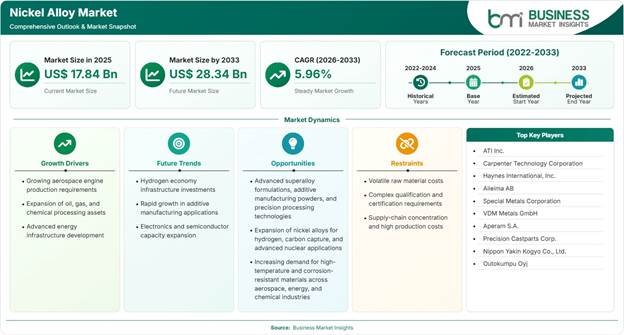
According to Business Market Insights, the global Nickel Alloy Market sizewas valued at US$ 17.84 Billion in 2025 and is projected to reach US$ 28.34 Billion by 2033, growing at a CAGR of 5.96% during 2026–2033.
Nickel Alloy Market Strategic Framework
The Nickel Alloy Market is shifting toward higher-value specialty metallurgy as customers increasingly prioritize material performance, lifecycle economics, reliability, and resistance to extreme operating conditions. Suppliers are strengthening their capabilities in alloy formulation, precision forging, melting, powder metallurgy, additive manufacturing, and value-added processing.
The market’s supply chain includes specialized melt shops, forging companies, processors, component manufacturers, and end-use industries. High qualification requirements and specialized production capabilities create significant barriers to entry, reinforcing the importance of metallurgical expertise, certification, processing technology, and long-term customer relationships.
Download Sample Report: https://www.businessmarketinsights.com/sample/BMIPUB00038628
Market Growth Projections
The Nickel Alloy Market is projected to expand steadily through 2033 as aerospace production, defense modernization, energy infrastructure, chemical processing, offshore exploration, electronics manufacturing, and emerging hydrogen projects increase demand for high-performance materials.
North America accounted for approximately 34%–37% of global demand in 2025 and is projected to expand at a 5.2%–5.6% CAGR through 2033. Strong aerospace manufacturing, defense procurement, petrochemical investment, advanced energy projects, and vertically integrated specialty-material supply chains support the region’s market leadership.
Asia Pacific represented approximately 28%–31% of the market in 2025 and is projected to grow at a 6.8%–7.4% CAGR, making it the fastest-growing region. Industrialization, aircraft manufacturing, power infrastructure, naval modernization, electronics production, and chemical-processing capacity additions are supporting regional demand.
Aerospace & Defence represented approximately 24%–27% of the market in 2025 and is projected to grow at a 6.2%–6.8% CAGR. Turbine engine development, high-temperature component requirements, defense platforms, and demand for lightweight high-performance materials continue to support this segment.
Electronics represented approximately 8%–11% of the market in 2025 and is projected to expand at a 7.1%–7.8% CAGR. Semiconductor investments, battery technologies, precision components, and high-reliability electronic systems are creating new demand for premium nickel alloy solutions.
Market Drivers
Growing Aerospace Engine Production Requirements
Aerospace is one of the strongest demand centers for nickel alloys because aircraft engines operate under extremely high temperatures and mechanical stresses. Nickel-based superalloys are used in turbine blades, combustion chambers, exhaust components, and other hot-section applications where strength retention and durability are critical.
Commercial aircraft production, defense aviation programs, and the development of next-generation propulsion systems are supporting long-term demand. Engine manufacturers are also seeking materials that can improve thermal efficiency, operating life, and maintenance performance.
Expansion of Oil, Gas, and Chemical Processing Assets
Refineries, petrochemical facilities, LNG infrastructure, offshore production systems, and chemical-processing plants operate under corrosive and high-temperature conditions. Nickel alloys can provide longer service life and improved reliability in heat exchangers, valves, piping, processing equipment, and other critical components.
Investments in energy infrastructure across developed and emerging markets are therefore supporting demand for corrosion-resistant specialty materials. The emphasis on total lifecycle cost is also encouraging end users to select higher-performance materials when they can reduce maintenance and downtime.
Advanced Energy Infrastructure Development
Hydrogen processing, carbon capture, advanced nuclear technologies, and high-efficiency power-generation systems are creating additional demand for specialty alloys. These applications often expose materials to challenging combinations of pressure, temperature, hydrogen, radiation, or corrosive chemicals.
As governments and energy companies invest in lower-carbon infrastructure, nickel alloy suppliers are gaining access to new application areas beyond traditional aerospace, oil and gas, and chemical markets.
Market Segmentation
By Composition
- Nickel-Copper: Widely used in marine and seawater environments because of strong corrosion resistance.
- Nickel-Molybdenum & Nickel-Chromium-Molybdenum: Suitable for aggressive chemical-processing environments requiring high corrosion resistance.
- Nickel-Silicon: Used in specialized high-temperature industrial equipment requiring oxidation resistance.
- Nickel-Chromium: Applied in heating elements, power systems, and high-temperature industrial applications.
- Nickel-Chromium-Iron: Provides a balance of performance and cost across industrial, aerospace, and power applications.
- Nickel-Chromium-Cobalt: Used in demanding aerospace and turbine-engine environments requiring exceptional high-temperature strength.
By End-Use Industry
- Aerospace & Defence: Demand is driven by aircraft engines, defense platforms, turbine systems, and high-temperature components.
- Marine: Corrosion resistance supports applications in naval vessels, offshore structures, and marine equipment.
- Power: Turbines, nuclear systems, and advanced energy facilities require durable specialty materials.
- Chemical: Corrosive processing conditions encourage the adoption of nickel-based corrosion-resistant alloys.
- Oil and Gas: Subsea systems, refining equipment, pipelines, and production infrastructure remain important demand channels.
- Automotive: Specialized applications include performance vehicles, exhaust systems, and high-temperature components.
- Electronics: Semiconductor manufacturing, precision components, batteries, and high-reliability systems offer strong growth potential.
Top Players in the Nickel Alloy Market
- ATI Inc.
- Carpenter Technology Corporation
- Haynes International, Inc.
- Alleima AB
- Special Metals Corporation
- VDM Metals GmbH
- Aperam S.A.
- Precision Castparts Corp.
- Nippon Yakin Kogyo Co., Ltd.
- Outokumpu Oyj
Technological Innovations
Additive manufacturing is emerging as an important technology opportunity for the Nickel Alloy Market. Metal additive manufacturing enables complex geometries, material customization, reduced manufacturing waste, and faster prototyping, particularly in aerospace, defense, medical, and industrial applications.
The technology is also expanding demand for specialized nickel alloy powders with consistent composition and particle characteristics. As certification and qualification frameworks mature, additive manufacturing can support more production applications and create new value-added opportunities for specialty alloy suppliers.
Get Industry Snippets: https://www.businessmarketinsights.com/industry-overview/nickel-alloy-market
Future Market Outlook
The Nickel Alloy Market is expected to maintain steady growth through 2033 as aerospace production, defense modernization, energy infrastructure, chemical processing, offshore activity, and advanced manufacturing continue to require high-performance materials. The combination of strength, corrosion resistance, oxidation resistance, and thermal stability will keep nickel alloys important across critical industrial applications.
Aerospace & Defence is expected to remain a core demand center, supported by aircraft engine production, defense programs, turbine development, and next-generation propulsion technologies. At the same time, demand is likely to become more diversified as electronics, hydrogen, advanced nuclear, carbon capture, and offshore renewable infrastructure expand.
Frequently Asked Questions (FAQs)
What is driving the Nickel Alloy Market?
The market is primarily driven by aerospace engine production, defense modernization, oil and gas and chemical-processing investments, advanced energy infrastructure, offshore exploration, corrosion-resistant applications, and emerging hydrogen projects.
Which end-use industry dominates the Nickel Alloy Market?
Aerospace & Defence is the leading end-use industry, accounting for approximately 24%–27% of market share in 2025. High-temperature requirements in aircraft engines and defense platforms support strong demand for nickel-based superalloys.
Which end-use industry is expected to grow rapidly?
Electronics is a high-growth segment, accounting for approximately 8%–11% of market share in 2025 and projected to expand at a 7.1%–7.8% CAGR through 2033. Semiconductor investment, battery technologies, precision components, and high-reliability electronic systems are supporting demand.
Which region offers significant growth opportunities?
Asia Pacific is projected to be the fastest-growing regional market, with approximately 28%–31% share in 2025 and a projected 6.8%–7.4% CAGR through 2033.
What are the major technology trends in the Nickel Alloy Market?
Major trends include additive manufacturing, specialized alloy powders, advanced melting and forging, precision manufacturing, improved process control, and development of alloys for hydrogen, advanced nuclear, aerospace, and other demanding applications.
What makes nickel alloys suitable for harsh industrial environments?
Nickel alloys offer strong resistance to corrosion, oxidation, high temperatures, pressure, and mechanical degradation. These characteristics enable their use in aerospace engines, chemical-processing equipment, oil and gas infrastructure, power systems, marine equipment, and other demanding environments.
What is the historical period, base year, and forecast period?
The historical period covered by the report is 2022–2024, the base year is 2025, and the forecast period is 2026–2033. The report provides detailed regional, segment-level, competitive, and market analysis.
Browse More Reports

