 WhatsApp Us Now
The Hydrogen Market growing investments in renewable energy, electrolyzers, hydrogen hubs, storage, pipelines, and industrial applications are reshaping the global hydrogen ecosystem. As countries pursue energy security and lower-carbon industrial processes, hydrogen is gaining strategic importance across refining, ammonia, steel, chemicals, mobility, and energy applications.
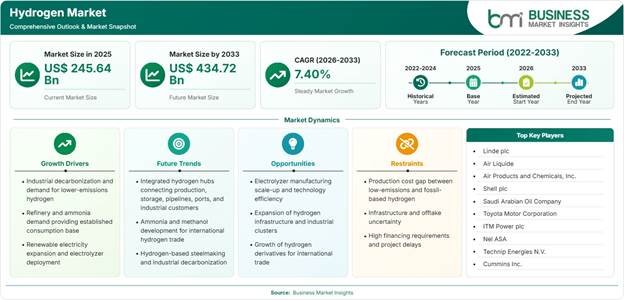
According to Business Market Insights, the global Hydrogen Market sizewas valued at US$ 245.64 Billion in 2025 and is projected to reach US$ 434.72 Billion by 2033, growing at a CAGR of 7.40% during 2026–2033.
Hydrogen Market Strategic Framework
The Hydrogen Market is moving toward integrated ecosystems connecting hydrogen production, renewable electricity, electrolyzers, storage, transportation, ports, industrial consumers, and export infrastructure. Hydrogen hubs can improve asset utilization and reduce duplicated investment by connecting multiple producers and consumers within the same industrial ecosystem.
The competitive landscape spans industrial gases, integrated energy companies, electrolyzer manufacturers, engineering firms, mobility companies, and hydrogen technology providers. Competitive differentiation increasingly depends on technology efficiency, infrastructure access, project execution, financing strength, customer relationships, and the ability to integrate multiple stages of the hydrogen value chain.
Download Sample Report: https://www.businessmarketinsights.com/sample/BMIPUB00038651k
Market Drivers
Industrial Decarbonization is Expanding Demand for Cleaner Hydrogen
Industrial decarbonization is one of the principal forces supporting hydrogen market development. Existing hydrogen consumption is concentrated in refining, ammonia, methanol, and other industrial processes, creating opportunities to substitute conventional hydrogen with lower-emission alternatives.
The established industrial demand base provides hydrogen developers with potential anchor customers and reduces some of the risks associated with developing entirely new demand centers. Steelmaking and other hard-to-abate industries offer additional opportunities as technology and infrastructure mature.
Renewable Electricity is Enabling Larger Electrolysis Projects
The expansion of renewable electricity is supporting the development of green hydrogen through electrolysis. Installed electrolysis capacity surpassed 4 GW in 2025, while more than 2.5 GW of capacity was under construction for operation in 2026.
As electrolyzer manufacturing scales, project developers are increasingly focused on system efficiency, renewable electricity costs, utilization rates, grid connections, engineering, and project integration. Large-scale installations and renewable-energy integration can improve project economics and reduce exposure to electricity-price volatility.
Energy Security is Broadening National Hydrogen Strategies
Hydrogen is becoming part of national energy-security strategies as countries seek to reduce dependence on imported fossil fuels and connect renewable electricity with industrial feedstocks and transportation fuels. Countries with abundant renewable resources can develop hydrogen or ammonia for domestic consumption and export, while natural-gas-rich countries can pursue blue hydrogen supported by carbon-management infrastructure.
Market Segmentation
By Type
- Blue Hydrogen: Combines fossil-based feedstocks with carbon capture and is particularly relevant where natural gas and carbon-management infrastructure are available.
- Green Hydrogen: Produced through electrolysis using renewable electricity and supports industrial decarbonization, green ammonia, clean fuels, and hydrogen-based steel.
- Grey Hydrogen: Produced primarily through established reforming processes and remains deeply integrated into conventional industrial applications.
By Production Process
- Reforming: Provides large-scale hydrogen volumes for refining and chemical applications but faces increasing emissions pressure.
- Industrial By-Product: Recovers hydrogen from existing industrial processes, improving resource efficiency where purification and collection systems are available.
- Electrolysis: Uses electricity and water to produce hydrogen and is gaining momentum as renewable power availability and electrolyzer technology improve.
By End-Use Industry
- Steel: Hydrogen-based direct reduction can replace carbon-intensive reduction methods and create new demand for low-emission hydrogen.
- Refineries: Hydrogen is used extensively in hydroprocessing and desulfurization, making refineries important established customers.
- Ammonia: Hydrogen is a major feedstock for ammonia and offers opportunities for lower-emission fertilizers, marine fuels, energy carriers, and international trade.
- Methanol: Lower-emission hydrogen can support cleaner methanol production and synthetic-fuel pathways when suitable carbon sources are available.
Top Players in the Hydrogen Market
- Linde plc
- Air Liquide
- Air Products and Chemicals, Inc.
- Shell plc
- Saudi Arabian Oil Company
- Toyota Motor Corporation
- ITM Power plc
- Nel ASA
- Technip Energies N.V.
- Cummins Inc.
Technological Innovations
Electrolyzer technology is one of the most important innovation areas in the Hydrogen Market. Installed electrolysis capacity surpassed 4 GW in 2025, while more than 2.5 GW was under construction for operation in 2026. Increasing manufacturing scale, system efficiency, renewable integration, and project optimization are expected to improve the commercial potential of electrolysis.
Hydrogen hubs are another important innovation in project development. By integrating renewable generation, electrolyzers, storage, pipelines, ports, refineries, ammonia plants, steel facilities, and multiple customers, hubs can improve infrastructure utilization and reduce duplicated capital investment.
Get Industry Snippets: https://www.businessmarketinsights.com/industry-overview/hydrogen-market
Future Market Outlook
The Hydrogen Market is expected to continue expanding through 2033 as industrial decarbonization, energy-security strategies, renewable electricity deployment, and clean-energy investment accelerate. Established demand from refineries, ammonia, methanol, and other industrial processes will remain an important foundation for market growth.
Frequently Asked Questions (FAQs)
What is driving the Hydrogen Market?
The major market drivers include industrial decarbonization, refinery and ammonia demand, renewable electricity expansion, electrolyzer deployment, energy-security strategies, hydrogen infrastructure investment, and the development of new hydrogen applications.
Which hydrogen type is currently dominant?
Grey hydrogen remains widely deployed because established reforming technology is mature and deeply integrated into refining, ammonia, methanol, and chemical production. However, green hydrogen represents a significantly faster-growing segment as renewable electricity and electrolysis expand.
Which end-use industry dominates the Hydrogen Market?
Refineries represent a leading end-use industry because hydrogen is already essential for hydroprocessing and desulfurization. Ammonia is another major established demand center, while steel, methanol, mobility, shipping, and synthetic fuels offer additional future opportunities.
Which region offers significant growth opportunities?
Asia Pacific is expected to be the fastest-growing region, supported by hydrogen demand, electrolyzer manufacturing, renewable electricity, refining, ammonia, steel, mobility, energy-security priorities, and government-backed hydrogen programs.
Browse More Reports