 WhatsApp Us Now
The Cloud Telephony Service Market is witnessing significant transformation as organizations migrate voice communication, collaboration, customer engagement, and contact-center functions to cloud environments. Increasing demand for flexible communication infrastructure and lower operating complexity is encouraging enterprises and SMEs to adopt cloud telephony solutions.
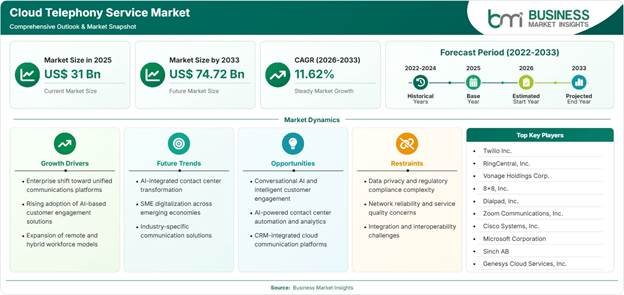
According to Business Market Insights, the global Cloud Telephony Service Market sizewas valued at US$ 31 billion in 2025 and is projected to reach US$ 74.72 billion by 2033, growing at a CAGR of 11.62% during 2026–2033.
Cloud Telephony Service Market Strategic Framework
The Cloud Telephony Service Market is evolving from standalone voice services toward integrated communication ecosystems that combine telephony, collaboration, analytics, artificial intelligence, CRM integration, and contact-center functionality. Providers are increasingly differentiating their platforms through intelligent call routing, speech analytics, automated transcription, virtual assistants, and conversational AI capabilities.
Download Sample Report: https://www.businessmarketinsights.com/sample/BMIPUB00038662
Market Drivers
Enterprise Shift Toward Unified Communications Platforms
Organizations are increasingly consolidating voice, messaging, video, collaboration, and workflow capabilities within unified communication environments. Cloud telephony allows enterprises to manage communication services centrally while supporting distributed teams and reducing dependence on physical infrastructure.
The increasing use of SaaS applications and hybrid workforce models is further encouraging organizations to modernize communication systems. Integration with productivity platforms and business applications is creating additional adoption opportunities across both large enterprises and SMEs.
Rising Adoption of AI-Based Customer Engagement Solutions
Artificial intelligence is becoming a major technology driver for cloud telephony. AI-enabled call routing, speech analytics, transcription, sentiment analysis, virtual assistants, and conversation intelligence are helping organizations improve agent productivity and customer engagement.
Enterprises are increasingly evaluating communication platforms based on their ability to provide actionable insights from customer conversations and automate repetitive communication processes. AI integration is therefore becoming an important differentiator in vendor selection and platform modernization.
Expansion of Remote and Hybrid Workforce Models
The continued adoption of remote and hybrid work models is strengthening demand for communication solutions that are accessible from different locations and devices. Cloud-delivered telephony supports workforce mobility while providing enterprises with scalable communication infrastructure.
The need for business continuity, operational resilience, and flexible workforce connectivity is encouraging organizations to transition away from location-dependent traditional telephony infrastructure.
Market Segmentation
By Deployment
- Cloud: Supports scalability, remote accessibility, rapid deployment, software integration, and flexible communication infrastructure.
- Hosted: Provides managed communication services that reduce infrastructure management requirements and offer more predictable operating expenditure.
By Network Type
- Public Switched Telephone Networks (PSTNs): Continue serving organizations that require established connectivity, reliability, and traditional communication infrastructure.
- Voice over Internet Protocol: Holds the leading position because of its cost efficiency, scalability, global reach, mobility, and integration with digital business applications.
By Application
- Conferencing: Enables distributed teams to collaborate effectively and supports workforce productivity and business continuity.
- Multi-level IVR: Improves automated call routing, self-service capabilities, and customer service efficiency.
- Sales & Marketing: Supports lead engagement, campaign management, communication tracking, and sales workflows.
- Customer Relationship Management: Enables personalized customer engagement, customer retention, and data-driven communication strategies.
By End User
- BFSI: Uses cloud communication platforms for customer engagement, secure communications, compliance, and operational efficiency.
- Government: Deploys cloud telephony to improve citizen communication, accessibility, and administrative coordination.
- Healthcare: Uses telephony solutions for patient engagement, appointment management, and communication among healthcare stakeholders.
Top Players in the Cloud Telephony Service Market
- Twilio Inc.
- RingCentral, Inc.
- Vonage Holdings Corp.
- 8×8, Inc.
- Dialpad, Inc.
- Zoom Communications, Inc.
- Cisco Systems, Inc.
- Microsoft Corporation
- Sinch AB
- Genesys Cloud Services, Inc.
Technological Innovations
Artificial intelligence is becoming one of the most important innovation areas in cloud telephony. AI-powered call routing, speech analytics, automated transcription, sentiment analysis, virtual assistants, and conversation intelligence are enabling enterprises to automate communication workflows and improve customer service productivity.
CRM integration is also transforming cloud telephony by connecting voice interactions with customer records, sales workflows, and service histories. This allows organizations to develop more personalized customer engagement strategies while improving visibility into communication performance.
The integration of conversational AI, predictive analytics, agent-assistance tools, and intelligent automation is expected to further shift cloud telephony platforms toward customer experience intelligence ecosystems. Providers that combine communication infrastructure with analytics and automation capabilities are positioned to capture emerging enterprise demand.
Get Industry Snippets: https://www.businessmarketinsights.com/industry-overview/cloud-telephony-service-market
Future Market Outlook
The Cloud Telephony Service Market is expected to maintain strong growth through 2033 as businesses continue replacing legacy communication systems with cloud-native platforms. Enterprise migration, hybrid work, AI-based customer engagement, CRM integration, and omnichannel communication will remain important factors shaping future demand.
The market is also expected to move toward more intelligent and integrated communication environments. Conversational AI, automated customer service, speech analytics, intelligent routing, and predictive insights will increasingly become standard capabilities rather than optional features.
SME digitalization represents another major long-term opportunity, particularly across Asia Pacific, Latin America, and parts of Africa. Providers offering flexible subscription pricing, simplified implementation, localized support, and industry-specific functionality can expand their customer base in emerging markets.
Data privacy, regulatory compliance, network reliability, and interoperability will remain important challenges. Providers will need to strengthen security, governance, monitoring, connectivity, and integration capabilities to support enterprise-scale adoption across multiple jurisdictions.
Frequently Asked Questions (FAQs)
What is driving the Cloud Telephony Service Market?
The market is primarily driven by enterprise migration toward unified communications, AI-based customer engagement, remote and hybrid workforce models, cloud migration, CRM integration, and the demand for scalable business communication infrastructure.
Which network type dominates the Cloud Telephony Service Market?
Voice over Internet Protocol (VoIP) is the leading network type, supported by its cost efficiency, scalability, global reach, mobility, and integration with digital business applications.
Which application segment is expected to experience strong growth?
Customer Relationship Management applications represent a high-growth segment, supported by increasing customer experience investments, AI-assisted workflows, omnichannel communications, and cloud-based sales enablement.
Which region offers significant growth opportunities?
Asia Pacific is expected to be the fastest-growing regional market, supported by SME digitalization, broadband expansion, SaaS adoption, mobile-first enterprises, and government-backed digital transformation programs.
What are the major technology trends in cloud telephony?
Major trends include conversational AI, intelligent call routing, speech analytics, automated transcription, virtual assistants, CRM integration, predictive analytics, and AI-powered contact-center automation.
What is the historical period, base year, and forecast period for the market?
The historical period covered by the report is 2022–2024, the base year is 2025, and the forecast period is 2026–2033.
Browse More Reports