 WhatsApp Us Now
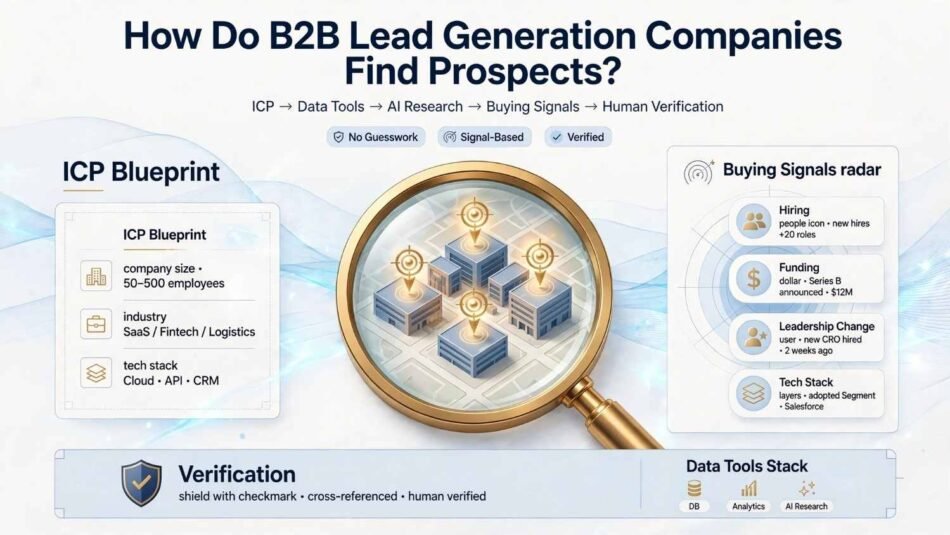
B2B lead generation companies find prospects by starting with a clear ideal customer profile (ICP), then using data tools and AI research to shortlist matching companies. They check buying signals — like hiring activity or funding news — and verify every contact before reaching out. Here’s how each step actually works.
Step 1: Define the ICP First
Nothing else works without this step. An ICP is a clear picture of your best-fit customer — company size, industry, tech stack, and location.
Without a clear ICP, prospecting turns into guesswork. Agencies typically build this with the client, based on:
- Past closed-won customers
- Deal size and sales cycle length
- Industry and company size ranges
- Specific tools or systems the prospect already uses
A tight ICP is what makes every later step faster and more accurate.
Step 2: Build the List Using Data Tools
Once the ICP is set, agencies use B2B data platforms to find matching companies and contacts. A b2b lead generation company typically combines multiple data sources to identify relevant accounts, decision-makers, and potential buying signals. These tools pull from public company records, job postings, and professional network data.
Common data sources include:
- Business databases — firmographic data like industry, size, and revenue
- Professional networks — job titles, roles, and company changes
- Public company data — funding rounds, hiring pages, press releases
- CRM and intent data platforms — signals showing which companies are actively researching a solution
No single tool is perfect. Most agencies combine two or three sources to reduce gaps and errors.
Step 3: Use AI to Speed Up Research
AI has changed how fast this research happens. Instead of manually checking company websites one by one, AI tools scan hundreds of accounts and flag the ones matching the ICP.
AI is useful for:
- Shortlisting accounts fast
- Spotting buying signals across many sources at once
- Drafting a first-pass summary of each account
AI speeds up research. It doesn’t replace judgment. A human still needs to check that shortlisted accounts genuinely fit the ICP — AI can surface false matches if the criteria are too broad.
Step 4: Look for Buying Signals
Not every company that fits the ICP is ready to buy right now. Agencies look for signals that suggest active or upcoming need.
Signals worth tracking:
- Hiring activity — new roles tied to a specific need or department growth
- Funding news — recent rounds often lead to new budget and tool spend
- Leadership changes — new execs often bring in new vendors
- Tech stack changes — a company adopting a related tool may need complementary solutions
- Public statements — company blogs or press releases mentioning a relevant initiative
Prospecting against real signals gets better replies than prospecting against a static list alone.
Step 5: Verify Every Contact Before Reaching Out
This step gets skipped too often — and it’s the one that matters most for long-term results.
Data from public sources and AI tools goes stale fast. People change jobs. Emails bounce. Titles shift. A human check before outreach protects two things:
- Your sender reputation. High bounce rates hurt email deliverability over time.
- Your reply rate. Wrong titles or outdated contacts waste the first message.
The Global Associates builds this step directly into its process. The TGA Outreach™ Engine combines AI-assisted prospect research and ICP-based account selection with human verification of every contact before outreach begins — AI moves fast, but a person still checks the data.
Step 6: Prioritize the Best-Fit Accounts
Even with a good ICP, not every matching account gets the same priority. Agencies typically rank accounts by:
- Fit score — how closely the account matches the ICP
- Signal strength — how strong the buying signal is
- Deal size potential — likely contract value if the deal closes
Top-priority accounts often get more personalized outreach. Lower-priority accounts might get a lighter-touch sequence.
Common Mistakes in Prospect Research
A few mistakes show up again and again across outbound programs.
- ICP too broad. “Any company with 50+ employees” isn’t a real ICP.
- No verification step. Sending straight from a purchased list raises bounce rates fast.
- Ignoring signals. Reaching out with no context wastes the first message.
- Over-relying on one data source. Single-source lists tend to have more errors and gaps.
- No re-check over time. Contact data decays. Lists need periodic re-verification, not a one-time pull.
→ Want to see how a properly verified ICP list compares to what you’re using now? The Global Associates can walk through the process behind the TGA Outreach™ Engine.
A Practical Example
Here’s how this looks for a mid-market SaaS client.
The ICP is set: operations leaders at 200–1,000-employee companies using a specific software category. An AI-powered B2B lead generation company India can use AI tools to scan the market and shortlist several hundred matching accounts, flagging companies with recent hiring or funding signals. A human then verifies contact details for the top-priority accounts—checking emails, job titles, and phone numbers—before any outreach goes out.
Only verified, high-fit accounts move to outreach. Lower-priority matches go into a lighter nurture sequence. This keeps bounce rates low and reply rates steady over time, instead of a one-time spike followed by a drop.
Frequently Asked Questions
How do B2B lead generation companies find prospects?
They start with a clear ICP, then use data tools and AI research to shortlist matching companies. Buying signals like hiring or funding activity help prioritize accounts, and every contact is verified before outreach begins.
What tools do B2B lead generation companies use to find prospects?
A mix of business databases, professional network data, public company data (funding, hiring), and intent data platforms. Most agencies combine several sources rather than relying on just one.
What is a buying signal in B2B prospecting?
A buying signal is an event or pattern suggesting a company may be ready to buy — like new hiring in a relevant department, a recent funding round, or a leadership change.
Why does contact verification matter in prospecting?
Unverified data goes stale fast. Sending to bad emails raises bounce rates and can hurt your sender reputation, which affects deliverability for future campaigns too.
How does AI help find B2B prospects?
AI speeds up research by scanning many accounts and flagging ones that match the ICP. It doesn’t replace human judgment — a person still needs to confirm the match is real.
What makes an ICP effective for prospecting?
Specificity. A strong ICP defines company size, industry, tech stack, and buying signals clearly enough that research tools can find real matches, not just loosely similar companies.
How often should prospect data be re-verified?
Regularly. Job changes, email updates, and title shifts happen constantly, so a one-time data pull becomes outdated within months.
Do B2B lead generation companies use LinkedIn to find prospects?
Professional network data, including LinkedIn-sourced information, is a common part of prospecting. It’s usually combined with other sources like business databases and intent data, not used alone.
What’s the biggest mistake companies make when defining prospects?
Making the ICP too broad. A vague target like “companies with 50+ employees” leads to weak-fit accounts and lower reply rates.
How does The Global Associates find and verify prospects?
The TGA Outreach™ Engine combines AI-based research and ICP-based account selection with human verification of every contact before outreach — pairing AI speed with human accuracy checks.


