 WhatsApp Us Now
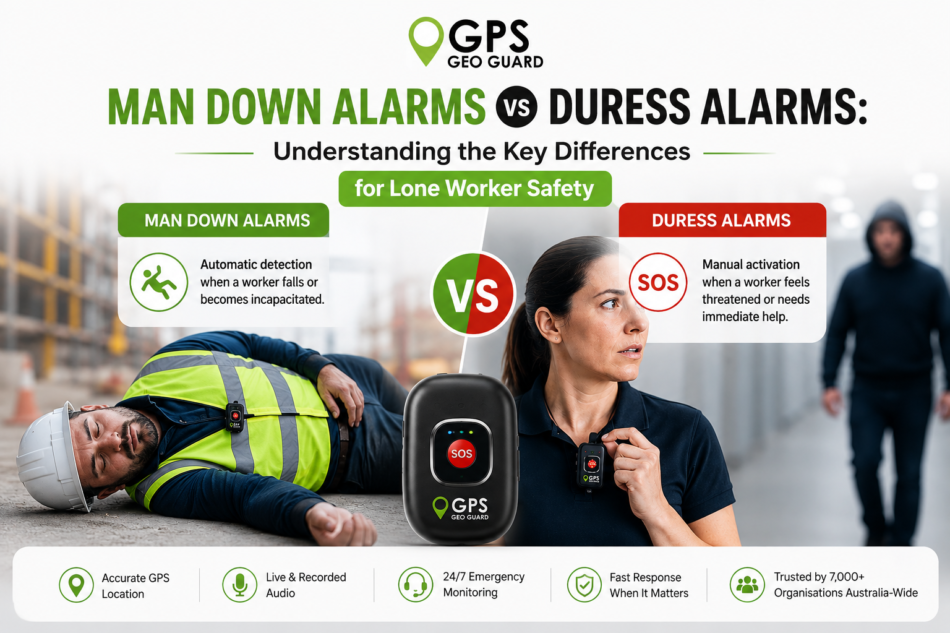
Lone worker safety technology has come a long way, but confusion between man down alarms and duress alarms remains a common gap in workplace safety planning.
Both technologies are designed to protect workers, but they respond to very different types of emergencies. A duress alarm allows a worker to manually request help when they recognize a threat, while a man down alarm can automatically raise an alert when a worker falls, becomes incapacitated, or remains motionless for an unusual period.
Choosing the right protection is therefore not simply about selecting an alarm. It is about understanding the risks your workers face and ensuring the safety system can respond when they need it most.
This guide explains the difference between man down and duress alarms, how each works, when they are used, and why combining both technologies can provide more comprehensive lone worker protection.
What Is a Man Down Alarm?
A man down alarm is a personal safety device designed to automatically detect situations where a worker may have fallen, become unconscious, suffered a medical episode, or otherwise become unable to call for assistance.
Unlike a traditional alarm that requires the worker to press a button, a man down system can initiate an emergency alert automatically.
How Does a Man Down Alarm Work?
Man down alarms use sensors such as accelerometers and motion detection technology to monitor a worker’s movement and orientation.
Depending on the system, the device may identify:
- Falls or sudden impacts
- Unusual changes in movement
- Prolonged inactivity
- A worker remaining in an abnormal position
- Potential incapacitation
When a qualifying event is detected, the device can send an alert to a 24/7 emergency monitoring centre. The monitoring team can then access the worker’s location and communicate with them through live audio where available.
If the situation requires assistance, emergency responders can be contacted and dispatched.
When Are Man Down Alarms Most Useful?
Man down protection is particularly valuable when a worker may become physically unable to activate an alarm themselves.
Typical scenarios include:
- A construction worker falling while working alone on a site
- A healthcare professional collapsing during a home visit
- A warehouse worker experiencing a medical emergency after hours
- A utility worker becoming incapacitated in a remote location
- A worker being injured and unable to reach their personal alarm
The key advantage is simple: the worker does not necessarily have to be capable of pressing the SOS button to initiate an alert.
What Is a Duress Alarm?
A duress alarm is a personal safety device that allows a worker to manually request immediate assistance when they feel threatened, unsafe, or at risk.
The worker activates the alarm by pressing an SOS or duress button. The alert is then transmitted to the emergency monitoring centre, along with available location information.
Duress alarms are particularly useful when a worker can recognize a threat and still has the ability to activate the device.
How Does a Duress Alarm Work?
When the worker presses the SOS button, an emergency alert is immediately sent to the monitoring centre.
The monitoring operator can then:
- Receive the emergency alert.
- Identify the worker and their location.
- Establish communication through live audio where available.
- Assess the situation.
- Coordinate the appropriate response.
- Contact or dispatch emergency services when required.
- Continue managing the incident until the worker is confirmed safe.
For workers facing an immediate threat, having a dedicated emergency button can provide a fast and discreet way to request assistance.
When Are Duress Alarms Most Useful?
Duress alarms are designed for situations where a worker can identify a threat and manually activate their device.
Examples include:
- A retail employee confronted by an aggressive customer
- A community nurse feeling unsafe during a home visit
- A government field officer dealing with a threatening individual
- A disability support worker facing an escalating situation
- An aged care professional dealing with unpredictable behavior
- An NDIS worker requiring immediate assistance during a difficult encounter
The key advantage is manual control when a worker knows they are in danger and needs help immediately.
Man Down Alarm vs Duress Alarm: What Is the Difference?
The biggest difference is how the emergency is detected and activated.
A duress alarm generally requires the worker to consciously press an SOS button. A man down alarm is designed to detect potential incapacitation automatically.
In simple terms:
Duress alarm = the worker asks for help.
Man down alarm = the device can ask for help when the worker cannot.
Both provide valuable protection, but they address different risks.
Man Down vs Duress Alarm Comparison
| Feature | Man Down Alarm | Duress Alarm |
|---|---|---|
| Activation | Automatic | Manual |
| Triggered by | Sensors and movement detection | Worker pressing SOS |
| Designed for | Falls, incapacitation and unconsciousness | Threats, aggression and unsafe situations |
| Requires the worker to press a button? | No | Yes |
| Can help when a worker is unconscious? | Yes, subject to system detection | No |
| Primary protection | Physical incapacitation | Personal threat or immediate danger |
| Typical industries | Construction, utilities, field services, aged care | Healthcare, retail, government, disability services |
Why Lone Workers May Need Both Types of Protection
Many lone workers face more than one category of risk during their working day.
For example, a field worker may encounter an aggressive individual and need to manually activate their SOS alarm. The same worker could later suffer a fall or medical emergency and become unable to press the alarm.
This is why relying on only one type of protection can create a safety gap.
A Duress Alarm Cannot Detect Every Emergency
A worker may have access to a duress alarm but still be unable to activate it if they:
- Lose consciousness
- Suffer a serious fall
- Experience a medical episode
- Become physically incapacitated
- Are unable to reach the device
In these circumstances, automatic man down detection can provide an additional layer of protection.
A Man Down Alarm Cannot Detect Every Threat
Man down technology is designed primarily around physical events such as falls and unusual inactivity.
It may not automatically recognize that a worker is being verbally threatened, confronted, followed, or placed in a dangerous situation where there has been no fall or significant movement event.
A manual duress button gives the worker direct control to raise an alarm when they recognize a threat.
The Best Approach: Combining Man Down and Duress Protection
For many high-risk and lone worker environments, the strongest approach is not choosing between the two technologies.
It is combining them.
A comprehensive lone worker safety solution can provide:
- Manual SOS activation when a worker recognises a threat
- Automatic man down detection when a worker may be unable to respond
- GPS location tracking to help identify the worker’s location
- Live audio communication for incident assessment
- 24/7 emergency monitoring for continuous support
- Emergency response coordination when assistance is required
This approach provides protection across a wider range of workplace emergencies.
How GPS Geo Guard Protects Against Both Risks
The Geo Guard Duress combines manual SOS activation with automatic man down detection in a single personal safety solution.
This means workers can manually request help when they recognize a threat, while automatic detection can raise an alert if they fall or become incapacitated.
One-Press SOS Protection
When a worker presses the large SOS button, an alert is sent to the 24/7 emergency monitoring centre.
A trained monitoring operator can connect through live audio, assess the situation, and coordinate the appropriate emergency response.
Automatic Man Down Detection
If a worker falls or becomes incapacitated, the Geo Guard Duress can detect the event automatically using its sensor technology.
This provides an additional safety layer for situations where the worker cannot manually activate the device.
Indoor and Outdoor Location Tracking
Knowing where a lone worker is located can be critical during an emergency.
The Geo Guard Duress combines GPS tracking with BLE indoor positioning to help provide location information both outdoors and inside suitable buildings.
This can help monitoring personnel and emergency responders identify where assistance is required.
Live and Recorded Audio
Live audio can help monitoring operators assess an incident and understand what is happening around the worker.
Recorded audio can also provide an incident record where required, subject to applicable legal and privacy requirements.
24/7 Emergency Monitoring
The device is supported by a 24/7 emergency monitoring service, helping ensure that an alert does not simply remain on the worker’s device without a response.
For businesses responsible for lone workers, this combination can help create a more complete safety strategy.
Which Alarm Is Right for Your Workers?
The answer depends on the risks your workers face.
Choose Duress Protection When:
Your workers are likely to encounter:
- Aggressive customers
- Threatening individuals
- Workplace violence
- Unpredictable client behavior
- Unsafe home visits
- High-risk public interactions
Choose Man Down Protection When:
Your workers are exposed to:
- Falls
- Physical hazards
- Remote or isolated environments
- Heavy machinery
- Medical emergencies
- Situations where unconsciousness or incapacitation is possible
Consider Both When:
Your workers can face both personal threats and physical hazards.
This can include workers in construction, healthcare, aged care, disability services, community support, utilities, government field services and other lone working environments.
Why Relying on Only One Alarm Can Create a Safety Gap
One of the biggest mistakes businesses can make is assuming that one type of alarm will protect workers against every emergency.
A duress alarm may be ineffective if a worker is unconscious and unable to press the SOS button.
Likewise, a man down alarm may not respond to a threatening encounter where the worker remains upright but needs immediate assistance.
The right solution should therefore reflect the actual risk profile of the role, rather than simply choosing the most convenient device.
Frequently Asked Questions
1. Can one device provide both man down and duress protection?
Yes. The Geo Guard Duress combines manual SOS activation with automatic man down detection, allowing one device to provide both forms of protection.
2. What industries can benefit from both types of protection?
Industries such as construction, healthcare, aged care, disability services, retail, utilities, community services and government field work can benefit where workers face both physical and personal safety risks.
3. Can a smartphone provide the same protection as a dedicated duress device?
A smartphone may provide some emergency functions, but it can introduce additional dependencies such as battery life, accessibility, application use and the worker’s ability to operate the phone during a stressful situation. A dedicated personal safety device is designed specifically for emergency activation.
4. Can the Geo Guard Duress be used indoors?
Yes. The Geo Guard Duress can use BLE indoor positioning alongside GPS-based outdoor tracking to help provide location information in different environments.
5. Is a combined solution suitable for small businesses?
Yes. A combined man down and duress solution can be suitable for organisations ranging from businesses with a single lone worker to larger organisations operating across multiple locations.
Conclusion
Man down alarms and duress alarms are not interchangeable technologies. They address different emergency scenarios.
A duress alarm gives workers a way to manually request assistance when they recognize a threat. A man down alarm provides automatic protection when a worker may be unable to call for help themselves.
For many lone worker environments, having both capabilities provides a more comprehensive approach to workplace safety.
The GPS Geo Guard Duress combines these functions in one device, helping protect workers against both recognized threats and situations where they may become incapacitated.
Give your lone workers protection that covers more than one type of emergency. Contact GPS Geo Guard today to book a demo or request a quote for your workforce.

