 WhatsApp Us Now
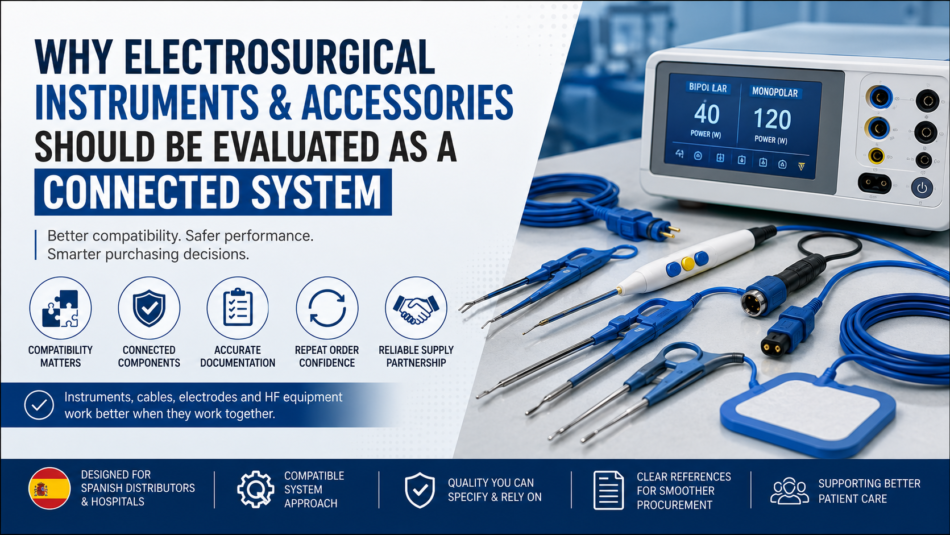
Electrosurgical purchasing becomes more reliable when instruments and accessories are evaluated as components of a connected system rather than as independent catalogue items. A bipolar forceps may require a specific cable, a monopolar electrode may depend on a particular interface, and every equipment-side connector must correspond with the intended HF unit.
For medical distributors and hospital procurement teams in Spain, documenting those relationships early can improve product comparison, sample evaluation, quotation accuracy and repeat-order control.
Electrosurgery Is Built Around Interfaces
An electrosurgical portfolio can contain products that appear commercially separate but depend on one another technically.
These may include:
- bipolar forceps
- non-stick bipolar forceps
- single-use bipolar forceps
- monopolar electrodes
- HF handles
- bipolar cables
- connectors
- laparoscopic HF instruments
- the electrosurgical equipment to which those products connect
Professional procurement should therefore establish not only what each item is, but also how it relates to the other parts of the system.
Start With the Equipment Reference
The HF unit is often a useful starting point for compatibility discussions.
When requesting an alternative instrument or cable, buyers can provide:
- equipment manufacturer
- model
- existing instrument reference
- existing cable reference
- equipment-side connector information
- the product category being replaced
This gives the supplier a defined technical context.
A broad request such as “bipolar forceps compatible with our generator” provides less useful information than a request that identifies the equipment model and existing connection arrangement.
Procurement Insight
electrosurgical compatibility should be recorded as a relationship between defined product references. Instrument, cable and HF equipment information should stay connected from sample evaluation through repeat purchasing.
Bipolar Forceps and Their Cable Requirements
Bipolar forceps are a good example of why connected sourcing matters.
The purchasing specification can include:
- instrument pattern
- overall length
- tip configuration
- standard or non-stick requirement
- single-use or reusable format
- instrument-side cable interface
- cable reference
- equipment-side connection
A forceps with the correct tip geometry but an unsuitable cable arrangement is not a complete match for the intended system.
Single-Use Cables Need the Same Compatibility Discipline
Single-use cables can simplify lifecycle management by providing a defined sterile cable for one intended use, but they still need to be selected against the intended instrument and equipment.
A distributor may carry several cable references because hospital customers use different HF equipment platforms.
For this reason, cable product records should preserve:
- instrument-side connection
- equipment-side connector
- intended instrument family
- manufacturer reference
- equipment information used during compatibility review
Seemann Technologies currently presents several single-use bipolar cable configurations for HF forceps and different equipment connections.
Monopolar Electrodes Create a Different Connection Path
Monopolar active electrodes should not be grouped with bipolar instruments simply because both are part of electrosurgery.
The electrode may need to be evaluated against:
- working-end profile
- shaft diameter
- working length
- insulation
- handpiece or instrument interface
- cable arrangement
- compatible equipment
For laparoscopic products, extended shaft dimensions and access requirements may add further distinctions.
A distributor building a complete electrosurgical portfolio should preserve the electrical modality in every product description.
HF Handles and Active Electrodes Should Be Matched Deliberately
HF handles connect active electrodes with the rest of the electrosurgical system. Buyers should therefore identify the electrode interface and cable arrangement before approving a handpiece.
Where detachable electrodes are used, the shaft fit becomes an additional mechanical interface.
Where the electrode forms part of a single-use handpiece configuration, the complete supplied product should still be checked against the equipment-side connection.
Visually similar products should not be assumed to be equivalent.
Connected Sourcing Can Improve Product-Range Organisation
Medical distributors often benefit from organising products by connection relationships rather than simply by alphabetical catalogue category.
For example:
Bipolar Family
- bipolar forceps
- non-stick bipolar forceps
- single-use bipolar forceps
- bipolar forceps cables
- associated equipment connections
Monopolar Family
- active electrodes
- laparoscopic electrodes
- HF handles
- cables or connectors
- equipment relationships
This structure can make customer enquiries easier to manage because each instrument is presented with the components required to evaluate it properly.
Why Sample Approval Should Include Connected Accessories
A hospital may approve the physical feel and dimensions of an instrument while overlooking the connection configuration.
Sample review is more complete when it includes:
- instrument reference
- instrument dimensions
- tip or working-end specification
- cable
- connector
- equipment information
- packaging
- supporting technical information
If the sample is supplied with a cable that differs from the later commercial order, the change should be clearly documented.
Single-Use and Reusable Products Can Coexist
Hospital electrosurgical portfolios do not have to follow an entirely single-use or entirely reusable model.
A healthcare organisation may use reusable instruments in one area and sterile single-use products in another according to its existing systems and purchasing requirements.
The procurement comparison should therefore focus on the exact product requirement rather than assuming that one lifecycle format is automatically preferable.
Where both versions are offered, distributor descriptions should distinguish them clearly.
Documentation Should Follow the Product Reference
Electrosurgical systems can involve several linked products, which makes documentation discipline particularly important.
Specifications for one forceps, cable or electrode should not be assumed to apply to another reference.
Professional buyers may request:
- product specifications
- instructions for use
- packaging and sterile-status information
- compatibility information
- labelling details
- applicable conformity documentation
These records should remain associated with the exact product being evaluated.
Building an Electrosurgical Product Range for Spanish Distribution
A distributor introducing an HF surgery range can begin with the equipment platforms already used by its hospital customers.
From there, the portfolio can be organised into:
- Core bipolar forceps references
- Non-stick or specialised bipolar options
- Equipment-specific bipolar cables
- Common monopolar electrode families
- HF handle and electrode combinations
- Laparoscopic HF instruments
- Specialised products supplied against confirmed requirements
This gives sales and procurement teams a commercially usable range without treating every catalogue item as routine inventory.
Evaluating an Electrosurgical Instrument Supply Partner
Manufacturers and suppliers should be assessed on more than catalogue breadth.
Professional buyers should determine whether the supplier can provide clear specifications and discuss how related product categories connect.
Seemann Technologies provides single-use electrosurgical instruments for professional healthcare supply, with product categories including bipolar forceps, monopolar electrodes, cables, HF handles and related minimally invasive instruments.
Every proposed product should still be confirmed against the purchaser’s exact technical and documentation requirements.
Information to Include in an Electrosurgical RFQ
- Required product category
- Instrument pattern or working end
- Required dimensions
- Single-use or reusable format
- Standard or non-stick requirement, where relevant
- Instrument-side connection
- Cable requirement
- Equipment-side connector
- HF unit manufacturer and model
- Existing reference, where applicable
- Sample requirement
- Commercial quantity
- Packaging requirements
- Destination
- Documentation required for evaluation
A Connected Specification Makes Electrosurgical Purchasing More Reliable
Electrosurgical instruments, cables, electrodes and HF handles should be evaluated according to their interfaces rather than purchased as unrelated products.
For Spanish distributors and hospital procurement teams, maintaining those relationships in catalogue records and quotation requests makes product comparison clearer and helps ensure that repeat orders correspond with the configurations previously assessed.
The most useful starting point is a defined equipment reference and a clear description of the instrument, cable or electrode that needs to connect to it.


