 WhatsApp Us Now
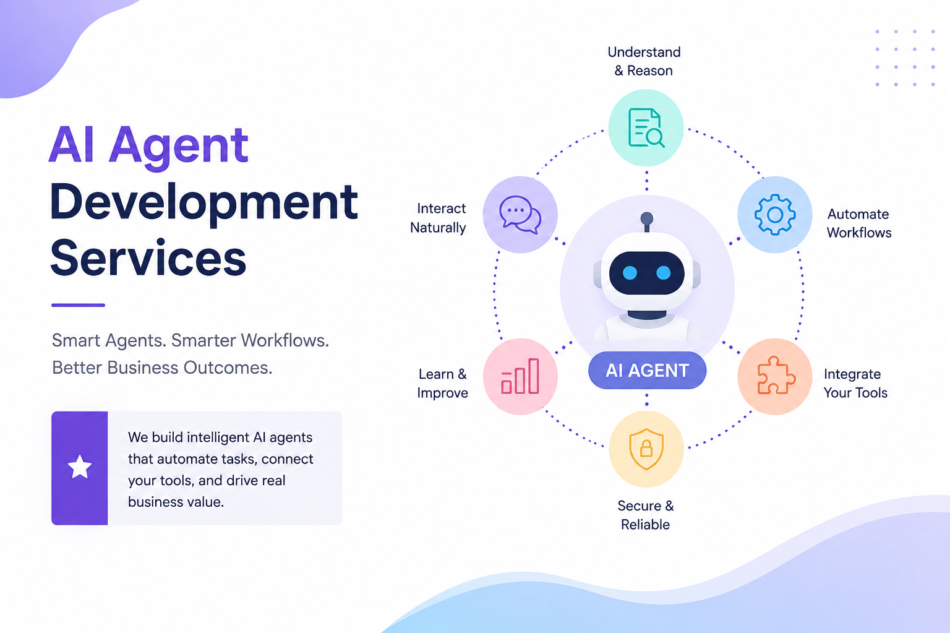
AI agents are moving beyond simple chat experiences. Businesses are beginning to use them for tasks that involve searching information, making decisions, working with software, and moving a process from one step to the next.
That changes the conversation.
A chatbot can answer a question. An AI agent can potentially take the next action.
For a sales team, that could mean qualifying an enquiry and updating the CRM. For customer support, an agent might look up an account, find relevant information, and prepare a response. In operations, it could monitor a workflow and flag an issue before it becomes a larger problem.
This is why AI agent development services are becoming an important part of business automation. But building a useful agent is not simply about connecting a language model to a prompt. The agent needs the right tools, data, permissions, workflow logic, and safeguards.
What Makes an AI Agent Different From a Chatbot?
The easiest way to understand the difference is to look at what happens after the conversation starts.
A traditional chatbot is generally designed to respond. An AI agent can be designed to reason through a task and interact with external systems.
Imagine a customer asking:
“Can you check my order and arrange a replacement?”
A basic chatbot may explain the replacement policy.
An agent could potentially verify the order, check eligibility, create the replacement request, and confirm the next step.
That extra layer of action is what makes agentic systems interesting for businesses.
IBM’s 2026 research describes deployed agents as systems that can interact with real data, software, databases, and business tools while being monitored for reliability and performance.
Where Can Businesses Use AI Agents?
There is no single industry or department that owns this technology.
The right use case depends on where a business has repetitive work, complex information, or workflows that involve several systems.
Some practical examples include:
Sales: An agent can help qualify leads, summarize customer information, prepare follow-ups, or update CRM records.
Customer service: Agents can search knowledge bases, understand customer requests, suggest resolutions, and route cases.
Finance: They can assist with document review, invoice workflows, reconciliation support, and reporting.
HR: An internal agent can answer policy questions, guide employees through processes, and help with routine requests.
Operations: Agents can monitor workflows, retrieve information, identify exceptions, and coordinate tasks.
Software development: Development agents can assist with code-related tasks, documentation, testing, and issue analysis.
The strongest use cases usually have one thing in common: there is a clear process that needs to be improved.
Why Businesses Are Looking Beyond AI Pilots
There has been plenty of experimentation with generative AI. The harder challenge is making an agent reliable enough to become part of everyday operations.
That requires more thought.
What information should it use?
Which systems can it access?
What can it change?
When should a person approve an action?
What happens if the agent misunderstands the request?
These questions may sound less exciting than talking about autonomous AI, but they are essential when the system starts interacting with real business data.
IBM reported in June 2026 that only 11% of surveyed technology leaders felt fully prepared for the expected scale of AI-agent deployment, while 59% identified security and compliance as major barriers.
In other words, the next challenge is not simply building more agents. It is building agents that businesses can trust.
What Does an AI Agent Development Company Actually Build?
An experienced AI agent development company looks at the complete system rather than just the AI model.
Depending on the project, development may involve:
- Agent architecture
- Reasoning workflows
- Memory systems
- Tool integration
- API connections
- Knowledge retrieval
- Multi-agent orchestration
- Workflow automation
- Security controls
- Monitoring and evaluation
Xicom’s AI development offering includes autonomous AI agent development, multi-agent orchestration, memory and reasoning architecture, tool-integrated agent ecosystems, and goal-driven workflow automation.
The exact architecture depends on the job the agent needs to perform.
A simple internal assistant may need one agent with access to a knowledge base. A complicated enterprise process may require several specialized agents working together.
When Does a Multi-Agent System Make Sense?
More agents do not automatically mean a better system.
Sometimes one well-designed agent is enough.
A multi-agent setup becomes more interesting when a workflow contains clearly different responsibilities.
For example, imagine an insurance workflow:
Intake agent → document analysis agent → risk assessment agent → review agent
Each component can focus on a particular task rather than forcing one agent to handle everything.
This approach can make complicated workflows easier to organize, but it also introduces additional coordination and monitoring requirements.
The architecture should therefore follow the workflow—not the other way around.
Connecting Agents to Business Tools
An agent becomes far more useful when it can work with the systems employees already use.
Think about a sales workflow.
The agent may need to:
- Read a new enquiry.
- Search the customer’s history.
- Check product information.
- Score the opportunity.
- Prepare a response.
- Update the CRM.
- Schedule a follow-up.
None of these steps is especially valuable in isolation. Together, they form a useful business process.
This is why AI agent integration matters so much.
Agents may need controlled access to CRMs, ERP systems, databases, APIs, document repositories, search systems, and internal applications.
The integration layer needs to be reliable, secure, and easy to monitor.
Memory and Context Can Make Agents More Useful
Imagine speaking to an assistant that forgets everything after every interaction.
It would be difficult to have a meaningful workflow.
Agent memory can help maintain relevant context across interactions. Depending on the application, this might include previous conversations, user preferences, task history, or information retrieved during a workflow.
But memory should not mean unlimited storage.
Businesses need to decide what information should be retained, for how long, and who can access it.
This is particularly important when an agent works with customer or employee information.
Automation Is Where the Real Business Opportunity Lies
The biggest opportunity may not be the agent itself.
It may be the workflow surrounding the agent.
Suppose an employee currently spends 30 minutes handling a routine request. If an agent can gather the required information, perform the low-risk steps, and leave the employee with only the final approval, the process becomes much faster.
This is the kind of opportunity businesses should look for.
Not:
“Where can we put an AI agent?”
But:
“Which workflow is costing us time, and can an agent safely remove some of that work?”
That small change in thinking can lead to much better projects.
Security and Guardrails Cannot Be Added Later
An agent with access to business systems needs boundaries.
It should not have more permissions than necessary. Sensitive actions may require approval. Every important action should be traceable.
Potential controls can include:
- Role-based access
- Permission limits
- Human approval
- Action logging
- Data protection
- Tool restrictions
- Output validation
- Monitoring
- Failure handling
This is becoming especially important as agents move into production. IBM’s 2026 research found that organizations are increasingly focusing on governance, visibility, and control as agent deployment expands.
The idea is straightforward: an autonomous system still needs accountability.
How Do You Know an AI Agent Is Working?
A good demonstration is not enough.
Once an agent enters production, businesses should measure what changed.
Depending on the use case, useful metrics might include:
- Time saved
- Tasks completed
- Response time
- Human intervention rate
- Error rate
- Customer satisfaction
- Cost per task
- Workflow completion rate
- Revenue impact
For example, a customer service agent should not be judged only by how naturally it talks. The business may care more about whether resolution time improved and whether customers received accurate answers.
The metric should match the reason the agent was built.
Choosing the Right AI Agent Development Company
The market is filling quickly with AI agent providers, so businesses need to look beyond impressive demos.
Ask potential partners how they approach the less visible parts of development.
Can they integrate with existing systems?
How do they handle permissions?
How is agent performance evaluated?
What happens when an agent fails?
Can the architecture scale?
How will the system be monitored after launch?
A strong AI agent development company should be comfortable discussing these questions because production software involves much more than the initial build.
What Is Next for AI Agent Development?
The direction is clear: agents are moving from isolated assistants toward connected business workflows.
IBM’s 2026 research describes an emerging shift toward agentic workflows that span functions such as finance, supply chain, HR, procurement, operations, and customer service.
That does not mean every business will suddenly hand entire processes to autonomous systems.
More likely, adoption will happen one workflow at a time.
A company may start with an internal knowledge agent. Then it may automate a support workflow. Later, several specialized agents may coordinate across departments.
The businesses that move carefully can learn from each implementation before expanding further.
Frequently Asked Questions
What are AI agent development services?
AI agent development services involve designing, building, integrating, testing, and deploying AI agents that can perform tasks, use business tools, retrieve information, and automate workflows.
What is an AI agent development company?
An AI agent development company helps businesses create custom agents around specific workflows, including architecture, integrations, memory, reasoning, automation, security, and deployment.
How are AI agents different from chatbots?
Chatbots primarily respond to users, while AI agents can be designed to plan tasks, use tools, access information, and take actions within defined boundaries.
Can AI agents connect with existing business software?
Yes. Agents can be integrated with APIs, CRMs, ERPs, databases, knowledge bases, and other applications when the appropriate access and security controls are in place.
Are AI agents suitable for every business process?
No. They work best where there is a clear workflow, useful data, repetitive work, or decisions that can be supported by controlled automation.
Final Thoughts
The appeal of AI agents is easy to understand. They can potentially do more than answer questions—they can help move work forward.
But the most successful projects will not be built around autonomy for its own sake.
They will start with a business process, define what the agent should accomplish, give it the right tools, restrict what it can access, and measure whether the result is actually better.
That is the real role of AI agent development services.
From a single workflow assistant to a connected multi-agent environment, the opportunity is to make business processes faster without losing the oversight that keeps them dependable.


