 WhatsApp Us Now
Important: US sanctions and import restrictions concerning Russia are highly dynamic. This article provides general trade information, not legal advice. Before placing an order, a US business should verify the current rules for its specific product, supplier, transaction, and country of origin.
Introduction
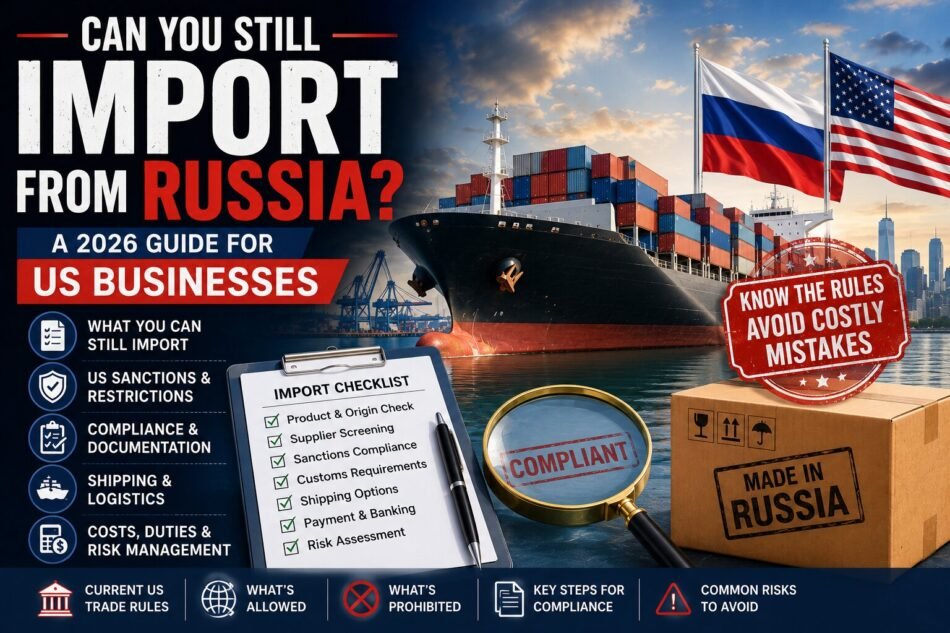
The question sounds simple: Can you still import from Russia into the United States in 2026?
The honest answer is: sometimes, but it depends heavily on what you are importing, who you are buying from, where the product originates, how the transaction is structured, and which sanctions or import restrictions apply.
The US has prohibited numerous categories of Russian-origin goods since 2022. These restrictions include major energy products, certain seafood, alcoholic beverages, non-industrial diamonds, and other categories that have subsequently been subject to additional measures. At the same time, US sanctions do not create a blanket prohibition on every commercial transaction involving every Russian-origin product.
That distinction matters for businesses considering a US import from Russia.
An importer cannot simply look at a product’s price, arrange transportation, and assume the shipment can enter the United States. A lawful transaction requires careful screening of the product, supplier, ownership, payment arrangements, transportation providers, origin, and applicable regulations.
This guide explains what businesses should understand before attempting to import from Russia in 2026.
Why Importing from Russia Is Different in 2026
International trade normally involves familiar steps:
Supplier → Purchase Order → Production → Shipping → Customs → Delivery
Russia-related trade can require another layer:
Supplier → Product → Origin → Sanctions Screening → Payment Screening → Shipping Screening → Customs → Compliance Review
That additional compliance layer is what makes Russian trade different from sourcing from many other markets.
The US Department of the Treasury’s Office of Foreign Assets Control, commonly known as OFAC, administers and enforces US economic sanctions. Meanwhile, US Customs and Border Protection handles customs entry and import enforcement.
A transaction can therefore create problems even when the physical product itself does not appear to be prohibited.
For example, a business may discover that:
- The product is restricted.
- The seller is a sanctioned person.
- A bank involved in the transaction is blocked.
- A shipping company creates sanctions exposure.
- The product has a prohibited Russian origin.
- The transaction requires authorization that the importer does not have.
The lesson is straightforward: screen the entire transaction, not just the product.
Can You Still Import from Russia?
Yes, some transactions involving Russia may still be possible, but there is no simple “Russia is open” or “Russia is closed” answer.
OFAC’s guidance explains that the Russia-related executive orders prohibiting new investment do not, by themselves, prohibit all imports or exports of goods, services, or technology. However, specific products and transactions are separately prohibited or restricted.
This creates an important distinction.
Some Russian-origin products are prohibited
The United States prohibits imports of certain Russian-origin products, including categories such as:
- Crude oil
- Petroleum
- Petroleum fuels
- Liquefied natural gas
- Coal
- Coal products
- Certain fish and seafood
- Alcoholic beverages
- Non-industrial diamonds
OFAC’s current FAQ materials confirm these restrictions and note that additional product categories have been addressed through subsequent determinations.
Other products may not be automatically prohibited
That does not mean that every other Russian-origin product is automatically legal to import.
A transaction still needs to pass the broader sanctions and customs analysis.
This is why businesses should avoid relying on a simple list of “allowed Russian products.”
The First Question: What Exactly Are You Importing?
Before contacting a Russian supplier, identify the product precisely.
A vague description such as “industrial equipment” isn’t enough.
You should understand:
- What the product is
- What it is made from
- What it does
- Where it was manufactured
- Whether it contains controlled components
- Its tariff classification
- Its intended use
- Its value
- Whether it falls within a restricted category
Product classification matters because different goods can receive completely different treatment.
For example, two products that appear similar to a casual buyer may fall under different tariff classifications or regulatory categories.
If classification is uncertain, US Customs and Border Protection provides a binding ruling program through which importers can seek advance decisions concerning matters such as tariff classification and customs treatment.
Russian Origin Matters
One of the most important concepts in a US import from Russia is country of origin.
A product doesn’t necessarily stop being Russian-origin merchandise simply because it passes through another country.
OFAC guidance explains that Russian Federation origin can include goods produced, manufactured, extracted, or processed in Russia, with specific considerations for goods incorporated into or substantially transformed into foreign-made products.
This matters because an importer cannot simply assume that routing merchandise through another country eliminates Russia-related restrictions.
Consider a hypothetical example.
A Russian manufacturer produces a component. The component is shipped to another country, packaged, and then sent to the United States.
The additional transportation step doesn’t automatically erase the product’s origin.
The importer must examine the actual facts and applicable origin rules.
Step 1: Screen the Supplier
Supplier due diligence becomes especially important when dealing with Russia.
Before entering into an agreement, gather information about:
- Legal company name
- Ownership
- Business address
- Directors and controlling persons
- Bank information
- Manufacturing location
- Export history
- Product details
- Affiliates
- Intermediaries
The purpose is to identify potential sanctions exposure before money or merchandise changes hands.
Don’t rely solely on a supplier’s website or an email signature.
A business should conduct appropriate sanctions screening against relevant US government lists and investigate potential matches carefully.
A name appearing similar to a sanctioned entity does not automatically prove that it is the same person or company, but it should trigger additional investigation.
Step 2: Screen the Product
Next, examine the product itself.
Ask:
Is this product subject to a US import prohibition or another Russia-related restriction?
The answer should be documented before purchasing.
For example, the US prohibition on Russian-origin energy products covers crude oil, petroleum, petroleum fuels, LNG, coal, and coal products.
Separate measures address categories including seafood, alcoholic beverages, and non-industrial diamonds.
Additional restrictions can also arise from other sanctions authorities.
This means an importer should not treat a single government list as the complete compliance analysis.
Step 3: Examine the Entire Transaction
The product is only one part of the picture.
You also need to consider:
- Seller
- Buyer
- Banks
- Freight forwarders
- Shipping companies
- Insurers
- Agents
- Brokers
- Beneficial owners
- Other intermediaries
Why?
Because sanctions can apply to particular people, entities, financial institutions, or transactions even when the underlying merchandise isn’t independently prohibited.
OFAC’s guidance specifically notes that transactions involving blocked persons or otherwise prohibited activities can create sanctions exposure.
A compliant product does not automatically make every transaction involving that product compliant.
Step 4: Check Your Payment Route
Payment can become one of the biggest practical challenges in Russia-related trade.
A transaction may involve:
US buyer → Bank → Foreign intermediary → Russian seller
Every participant can create additional compliance considerations.
Before agreeing to payment terms, determine whether the banks and financial institutions involved can legally process the transaction.
Do not assume that a payment method is acceptable merely because a supplier suggests it.
Also avoid arrangements designed to hide the actual parties, product origin, or purpose of a transaction.
Transparency is one of the most important principles in sanctions compliance.
Step 5: Check Shipping and Logistics Providers
Finding a supplier willing to sell you the product does not guarantee that a carrier will transport it.
Shipping from Russia can involve additional complications such as:
- Carrier restrictions
- Insurance limitations
- Port restrictions
- Banking issues
- Sanctions screening
- Transit-country requirements
- Documentation requirements
Before signing a purchase agreement, confirm that the proposed logistics route is actually workable.
A shipment sitting at a warehouse because the carrier will not accept it is an expensive lesson.
Step 6: Don’t Assume a Third Country Solves the Problem
One of the most dangerous misconceptions in sanctions compliance is the idea that routing goods through another country automatically makes the transaction acceptable.
It doesn’t.
Suppose a Russian-origin product moves:
Russia → Country B → USA
The importer still needs to determine the product’s origin and whether the applicable restrictions follow the merchandise.
OFAC has specifically addressed situations involving Russian-origin goods that are incorporated or substantially transformed outside Russia.
The correct approach is to understand the actual manufacturing and transformation history instead of focusing only on the last country before the United States.
Step 7: Understand US Customs Requirements
Even if a transaction passes the sanctions analysis, it still has to meet US customs requirements.
Importers should prepare accurate information concerning:
- Product description
- Quantity
- Value
- Country of origin
- Tariff classification
- Seller
- Buyer
- Shipping information
CBP’s entry process requires documentation that enables the agency to assess duties, collect trade statistics, and determine whether other legal requirements have been satisfied.
Accuracy matters.
A business should never intentionally undervalue merchandise, misdescribe goods, or provide misleading origin information to make an import appear easier.
Step 8: Calculate the Real Import Cost
Even if the transaction is legally permissible, it may not be commercially attractive.
Calculate the complete landed cost.
Include:
- Product price
- International transportation
- Insurance
- Customs duties
- Brokerage
- Port charges
- Storage
- Domestic transportation
- Compliance costs
- Inspection
- Potential delays
Russia-related transactions can involve additional compliance and logistics expenses.
Therefore, a supplier’s low price does not necessarily translate into a low landed cost.
Step 9: Understand the Role of a Customs Broker
A customs broker can help with customs procedures, classification, documentation, and entry-related tasks.
However, don’t confuse customs assistance with sanctions authorization.
A broker may help prepare an import entry, but that doesn’t mean the broker has determined that your entire transaction complies with OFAC requirements.
The importer needs to understand its own responsibilities.
CBP explains that importers can use customs brokers, but the importer remains responsible for meeting applicable requirements.
For Russia-related transactions, businesses may need both customs expertise and appropriate sanctions/compliance advice.
Common Mistakes Businesses Should Avoid
Mistake 1: Assuming All Russian Goods Are Banned
This is an oversimplification.
Some categories are clearly prohibited, while other transactions require a more detailed analysis. OFAC itself distinguishes between prohibited products and other commercial activity involving Russia.
Mistake 2: Assuming Everything Not on a Prohibited List Is Automatically Safe
The opposite assumption is equally dangerous.
A product may not be independently prohibited but could still involve a blocked person or prohibited transaction.
Always examine the complete transaction.
Mistake 3: Using a Third Country to Hide Origin
Changing the shipping route doesn’t necessarily change the product’s origin.
Never manipulate documentation to disguise Russian origin.
Mistake 4: Ignoring Ownership
Sanctions screening should not stop at the company name.
Ownership and control can matter.
A business should investigate who actually owns or controls the supplier and relevant counterparties.
Mistake 5: Assuming the Bank Will Handle Everything
Banks perform their own compliance checks, but a bank processing a payment doesn’t automatically mean that every aspect of your trade transaction is compliant.
The importer remains responsible for its own obligations.
Mistake 6: Relying on Old Information
Russia-related sanctions have changed repeatedly since 2022.
OFAC continues to update its Russia-related guidance and licenses. For example, OFAC issued an amended Russia-related General License in January 2026 and updated related FAQs.
A webpage published several years ago may therefore provide an incomplete picture.
A Practical Compliance Checklist
Before attempting to import from Russia, ask the following:
Product
- What exactly am I buying?
- Where was it manufactured?
- What is its tariff classification?
- Is it subject to a specific import prohibition?
- Does another US agency regulate it?
Supplier
- Who legally owns the supplier?
- Who controls it?
- Is the company subject to sanctions?
- Are its owners or directors subject to sanctions?
Transaction
- Which banks are involved?
- Who will transport the merchandise?
- Who will insure it?
- Are any intermediaries involved?
- Does any part of the transaction require authorization?
Documentation
- Is the commercial invoice accurate?
- Is the country of origin correctly stated?
- Is the product description complete?
- Is the customs value accurate?
- Are supporting documents available?
Logistics
- Will the carrier accept the shipment?
- Is insurance available?
- Are transit countries involved?
- Could the shipment be delayed?
Compliance
- Have current OFAC requirements been checked?
- Have applicable CBP requirements been reviewed?
- Have product-specific restrictions been checked?
- Has the transaction been reviewed by qualified professionals where appropriate?
If several of these questions cannot be answered confidently, the shipment probably isn’t ready.
When Should a Business Consider an Alternative Supplier?
Sometimes the best business decision is not to proceed.
If a product is difficult to source legally, expensive to transport, difficult to finance, or exposed to significant compliance uncertainty, another sourcing country may make more commercial sense.
Businesses should compare:
- Product price
- Quality
- Availability
- Shipping cost
- Tariffs
- Lead time
- Regulatory requirements
- Sanctions risk
- Payment availability
International sourcing is ultimately a risk-versus-reward decision.
A cheaper supplier isn’t necessarily the better supplier if getting the merchandise into the United States creates substantial uncertainty.
What the Future Could Mean for US Importers
Russia-related trade policy can change with new executive actions, sanctions designations, legislation, diplomatic developments, and agency determinations.
That means businesses should avoid building a supply chain around assumptions that today’s rules will remain unchanged indefinitely.
Instead, create a compliance process that can be updated.
For recurring imports, consider maintaining:
- Supplier screening records
- Product classifications
- Origin documentation
- Sanctions screening records
- Shipping records
- Payment records
- Compliance reviews
This creates an audit trail and makes it easier to reassess the transaction when regulations change.
Final Thoughts
So, can you still import from Russia in 2026?
The answer is not simply yes or no.
The United States prohibits imports of numerous Russian-origin products, including major energy categories and other specified products. At the same time, US sanctions do not amount to a blanket prohibition on every possible commercial transaction involving Russia.
That means businesses considering a US import from Russia need to take a transaction-specific approach.
Start with the product.
Then examine its origin.
Verify the supplier and ownership.
Screen the parties.
Review the payment route.
Check the logistics providers.
Understand customs requirements.
Calculate the complete landed cost.
And, most importantly, verify the rules that apply at the time you plan to transact, rather than relying on an old article, supplier statement, or outdated tariff assumption.
For businesses, the most valuable skill in Russia-related importing isn’t finding a way around restrictions. It’s knowing exactly where the legal and commercial boundaries are before money and merchandise move.
That careful approach can prevent shipment seizures, payment problems, costly delays, and serious compliance consequences.
Frequently Asked Questions
Can US businesses still import Russian products in 2026?
Some Russia-related commercial transactions may still be possible, but numerous Russian-origin products are subject to US import prohibitions or other restrictions. Businesses must assess the specific product and transaction rather than assuming that all Russian imports are either permitted or prohibited.
What Russian products are prohibited from entering the US?
US measures prohibit imports of certain Russian-origin energy products, including crude oil, petroleum, petroleum fuels, LNG, coal, and coal products. Other measures prohibit or restrict categories including certain seafood, alcoholic beverages, and non-industrial diamonds.
Can I import a Russian product through another country?
Routing a product through another country does not automatically eliminate Russia-related restrictions. Origin and transformation rules must be examined based on the actual facts.
Do I need an OFAC license to import from Russia?
It depends on the particular transaction. Some activities are prohibited unless authorized, while other commercial transactions may not require a specific OFAC license. The applicable sanctions authorities and current guidance should be reviewed for the exact transaction.
Can a customs broker determine whether my Russian import is legal?
A customs broker can assist with customs procedures, but customs clearance and sanctions compliance are separate issues. The importer remains responsible for meeting applicable requirements.
Are Russia’s import rules likely to change?
Russia-related US sanctions and trade restrictions have changed repeatedly and continue to be updated. OFAC was still issuing Russia-related guidance and licenses in 2026, so businesses should verify current requirements before each transaction.
Article Categories:
Consultant


